1
X-Array™ Loudspeaker Systems
immediately determine on site whether or not an
array is safe without having to make weight-distribution calculations. The structural strength ratings
of the individual rigging points and the overall
X-Array™ enclosures are also presented below
so that a complex structural analysis can be made
for any array configuration. The reader should
consult an experienced structural engineer to
perform the complex structural analysis.
The reader is directed to section 5. References
of this manual for a list of rigging references (for
background in general rigging practice) and mechanical engineering references (for background
in structural engineering analysis).
3.3 Simplified Structural-Rating Guidelines
The Guidelines: Electro-Voice engineers have
defined a set of simplified structural-rating guidelines that will enable a rigger to immediately
evaluate the safety of an X-Array™ system on
site without having to make complex force-distribution calculations. A combination of destructive
testing and computer modeling were used to analyze the complex forces throughout arrays.
Conservative working-load ratings were utilized to
simplify the guidelines. Therefore, array configurations other than those illustrated in these simplified guidelines may be permissible – for those
applications, consult section 3.4 Complex Structural-Rating Analysis for a detailed structural
analysis.
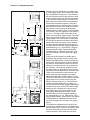
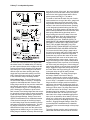
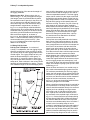
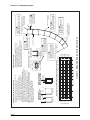
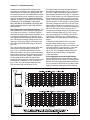
The simplified structural-rating guidelines are
shown in Figure 19. (Note that there is a label on
the back of each flying X-Array™ loudspeaker
enclosure that includes the graphics shown in
Figure 19.) These guidelines provide a simplified
rating for typical arrays based on the:
1. Vertical angle of each enclosure
2. Total weight of that enclosure plus all of the
enclosures and rigging hung below it.
3. Relative side-to-side and front-to-back angles
of the front Xrss or Xrsl rigging straps, or
any custom front rigging straps.
4. Relative side-to-side angles of the Xrhg grid
hinges or Xrhp pickup hinges.
Figure 19 includes a graph of the working-load
weight-versus-angle limit rating for the X-Array™
enclosures. This working-load weight limit is applicable to every enclosure in an array, and includes
the weight of that enclosure plus the total weight
of all enclosures and rigging hardware suspended
below it. The absolute enclosure angle is the vertical angle of that enclosure, where 0° represents
an upright enclosure facing straight ahead
(0°-elevation angle). These working-load-versusangle limits take into account the complex forces
generated in the front rigging straps, the rear rigging hinges, the enclosure and the (optional) pullup line, as a result of the complex weight
distribution throughout the array.
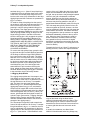
Also included in the simplified structural-rating
guidelines in Figure 19 are side-to-side and frontto-back angle limits for the front rigging straps on
the top enclosure. These limits apply to the Xrss
and Xrsl rigging straps, as well as any custom
wire-rope rigging straps used at the front of the
top enclosure.
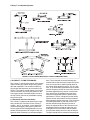
In addition, the guidelines in Figure 19 include a
side-to-side angle limit for the Xrhg grid hinges
and the Xrhp pickup hinges. Front-to-back limits
are not necessary for the Xrhg and Xrhp hinges.
The Xrhl linking hinges do not require any specific
angle limits, because the front-to-back angles are
taken into account by the enclosure weight-versus-angle ratings, and side-to-side angles are impossible to achieve with the linking hinges.
CAUTIONS for the Simplified Structural-Rating
Guidelines: WHEN APPLYING THE SIMPLIFIED STRUCTURAL-RATING GUIDELINES
TO ANY X-ARRAY™ LOUDSPEAKER SYSTEM
SUSPENDED OVERHEAD, THE USER MUST
OBEY THE FOLLOWING RULES:
1.
Never exceed the working-load-versusangle limit for any enclosure in the array.
2. For the top enclosure, never exceed the sideto-side angle limit or the front-to-back angle
limit for the Xrss rigging strap, the Xrsl rigging
strap or any custom rigging strap.
3. For the top enclosure, never exceed the
side-to-side angle limits for the Xrhg grid
hinges or the Xrhp pickup hinges.
4. Always make sure that the hinge locking
pins on every Xrhl linking hinge, Xrhg grid
hinge and Xrhp pickup hinge are fully engaged in the rigging track on the back of
every enclosure (and grid, when applicable)
before lifting overhead.
5. Always make sure that the double-stud fittings on every Xrss rigging strap, Xrsl rigging strap or any custom rigging strap are
securely locked in the rigging track on the
front of every enclosure (and grid, when
applicable) before lifting overhead.
6. Never angle more than the top two enclosures up in any array column. All other enclosures must be pointed straight ahead or
at a downward angle.
page 17