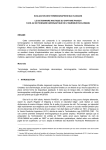
1
The ’Design’
World
The ’Practical’
World
Built-In-Test
Design
Failure Modes
and Effects Analysis
Prognostic and
Health Monitoring
Failure Reporting, Analysis
and Cottective Action System
Functional Independence
Measurement User Manual
Design Engineers anticipating what
will fail, and preparing for it
Operators and maintainers experiencing
what actually fails, and recognizing it
On-site feedback to design
Figure 1: Troubleshooting: Anticipated vs Actual Faults.
The use of reflectometry has commonly been used to determine the integrity of cables and wiring with effective localization of intermittent faults such as open or short circuits.
These methods send a high frequency signal down the line,
which reflects back at impedance discontinuities. The location
of the fault is determined by the phase shift between the incident and reflected signals. Sharma et al. (2007) [65] demonstrates a novel architecture for implementing a Sequence Time
Domain Reflectometry (STDR) method, which uses a pseudonoise code to locate open and short circuits on active wires using an integrated CMOS sensor. The approach has an accuracy
of fault localization of 1ft with low power consumption for the
sensor. Lo and Furse (2005) [66] provide research into similar faults but using a differing kind of reflectrometry known as
Noise-Domain Reflectrometry (NDR) which make use of existing data signals in the wiring. With this method results show the
potential to localism intermittent faults within 3 inches in 180ft
of electrical wiring. However, caution must be taken when using these methods as little is known on the impedance profile of
intermittent faults (with exception to open and short circuits).
Also promising are reflectometry methods, that are proving to
be useful when applied to locating intermittency in an F-18
flight control harness [67]; they do require exceptional accuracy in baseline comparisons. In civil and military aerospace,
recording and maintaining TDR data archives, for even a limited number of circuit’s, may prove to be enormous and costly
[68]. Another technique, called spread-spectrum time-domain
reflectometry (SSTDR) is commercially being used to identify
faults in electrical wires by observing reflected spread spectrum
signals Parkey et al [69].
in electronics and hence are a direct contributor to the NFF phenomena. Damaged solder points are notoriously difficult to detect without extensive visual inspections. They do however produce large variations in thermal resistance which can be used as
a potential suitable method for monitoring solder joint fatigue
inside of the packaging of power modules. Bhatia et al. (2010)
[71] have used this principle as a basis to develop and test a
new solder-joint fault sensor known as the SJ Monitor which
provides the ability to monitor selected I/O pins of powered-off
FPGA’s. The use of RF impedance is also used as a failure precursor and offers interesting prognostic capabilities for solder
joint failures due to the nature of gradual non-linear increases
in impedance as damage increase, whereas the DC resistance
becomes constant. The use of RF impedance is researched at
length by Kwon (2010) [72], who demonstrates prognostic capabilities which are able to predict the remaining useful life of
the solder joint with an error less than 3%. The research also
demonstrates the ability to distinguish between two competing
interconnects failure modes solder joint cracking and pad cratering; the need for such failure distinctions in this case however
is unclear.
The use of embedded molecular test equipment within ICs
enabling them to continuously test themselves during normal
operation, providing visual indications of failure has been proposed by GMA Industries as one of the more advanced and futuristic monitoring technologies [29]. The sensors are used to
measure electrical parameters and various signals such as current and voltage, as well as sensing changes in the chemical
structure of integrated circuits that are indicative of developing
failure modes. The basic structure of the sensors are carbon
nanotubes and the integration of these sensors with conventional IC’s along with molecular wires for the interconnecting
sensor networks is the important focus of this research. However no details of demonstrable in-service products or prototypes are given and to date no research paper offering proofs on
the applicability of the concept has been found.
Recently, a sensitive analyzer was introduced by Universal
Synaptic to simultaneously monitor test lines for voltage variation, and seems to have become an attractive tool for detec-
CMOS Integrated Circuits (IC) are routinely tested using
supply current monitoring which is based upon the knowledge
that a defective circuit will produce a significantly different
amount of current than fault-free circuits. Smith and Campbell
(2000) [70] have developed an in-situ quiescent current monitor that detects, in real-time, elevations in the leakage current
drawn by the IC whilst in a stable state. Other similar current
monitors have been reviewed by Pecht (2006) [43]. Damage to
electronic solder joints are a major contributor to intermittency
7