1
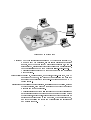
• Your home can for a small cost be connected to an alarm central which guards your home for fires and
theft. The fire department will automatically be contacted if your house is on fire. The local security
company will directly be contacted when there is a burglary in your house etc. By using the existing
power lines, no new infrastructure is needed for installing the fire detection/alarm devices etc.
• Hard To Steal Devices (HTSD). You can program a particular device to work on the power lines in
your own house but on no other power lines. If someone steals your device it will be useless because it
doesn’t work on foreign unauthorized power lines. Further, the device can be traced to an exact location
through the electrical power lines. Let us call these devices hard to steal devices.
2.2 Home systems and object-orientation
Applications for the home system network can take advantage of many techniques used in object-orientation. Concepts like encapsulation, inheritance and dynamic binding should be to great help when building
and reusing components for the home system network.
Physical devices like sensors and heating devices etc. can easily be modelled as objects. Because of the
great number of objects that will exist at the same time, every object should be as simple as possible with a
clear and specific task. The objects should be well defined, encapsulated and communicate in a private
manner with each other. The objects can easily be changed and groups of objects can be reused in different
kinds of applications. These systems will unfortunately be very complex because of its distributed structure.
The building modules used in a home system must have an abstract design, so that we don’t lock our self to
a certain type of device or manufacturer. Devices and components with new and better functionality will
come up all the time. The home system network must be robust to the frequent number of changes that is
typical for a house configuration. This is done with transparent and open-ended solutions. Design patterns
and frameworks seems to be promising tools when designing such systems. In this report we restrict our
self to use design patterns.
A design pattern is a general description of how to build a certain part in a system. The description is
abstract because it concerns abstract design, not a particular design. This leads to reusable components that
can be used over and over again. Many of the design patterns are related to each other and uses inheritance
hierarchies to build an abstract structure that can easily be reused.
Design patterns provides a common vocabulary for designers to communicate, document and explore
abstract design that works in many domains. It also reduces system complexity when complicated design
structures are encapsulated into simpler ones. Ones you have understood the structure and learned how to
use one particular design pattern its easy to learn new ones.
2