1
RESOLUTION MSC.267(85)
Page 14
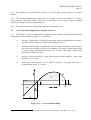
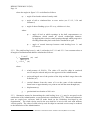
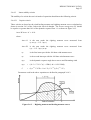
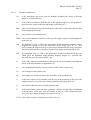
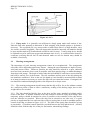
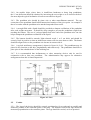
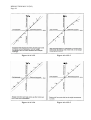
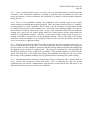
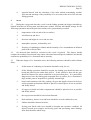
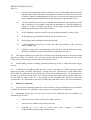
where the angles in figure 2.3.1 are defined as follows:
ϕ0 = angle of heel under action of steady wind
ϕ1 = angle of roll to windward due to wave action (see 2.3.1.2, 2.3.4 and
footnote 6)
ϕ2 = angle of down-flooding (ϕf) or 50° or ϕc, whichever is less,
where:
ϕf = angle of heel at which openings in the hull, superstructures or
deckhouses which cannot be closed weathertight immerse.
In applying this criterion, small openings through which progressive
flooding cannot take place need not be considered as open
ϕc = angle of second intercept between wind heeling lever lw2 and
GZ curves.
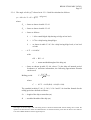
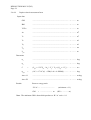
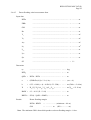
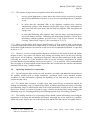
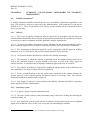
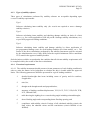
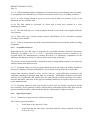
2.3.2 The wind heeling levers lw1 and lw2 referred to in 2.3.1.1 and 2.3.1.3 are constant values at
all angles of inclination and shall be calculated as follows:
P ∗ A∗ Z
(m) and
1000 ∗ g ∗ ∆
= 1.5 ∗ l w1 (m)
l w1 =
l w2
where:
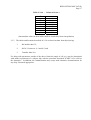
P = wind pressure of 504 Pa. The value of P used for ships in restricted
service may be reduced subject to the approval of the Administration
A = projected lateral area of the portion of the ship and deck cargo above the
waterline (m2)
Z = vertical distance from the centre of A to the centre of the underwater
lateral area or approximately to a point at one half the mean draught (m)
∆ = displacement (t)
g
= gravitational acceleration of 9.81 m/s2.
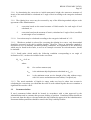
2.3.3 Alternative means for determining the wind heeling lever (lw1) may be accepted, to the
satisfaction of the Administration, as an equivalent to calculation in 2.3.2. When such alternative
tests are carried out, reference shall be made based on the Guidelines developed by the
Organization7. The wind velocity used in the tests shall be 26 m/s in full scale with uniform
velocity profile. The value of wind velocity used for ships in restricted services may be reduced
to the satisfaction of the Administration.
7
Refer to the Interim Guidelines for alternative assessment of the weather criterion (MSC.1/Circ.1200).