1
it ignores the edges and builds, in O(sort(n)) i/o’s, a linear quadtree on the
endpoints of the edges. The quadtree has O(n/k) cells in total, each containing
O(k) vertices. Second, it computes the intersections between the edges and the
quadtree subdivision in O(sort(n + l)) i/o’s. We describe the two steps below.
Constructing the subdivision. Let P = {p0 , p1 , p2 , ...} be the vertices of E. A
straightforward idea to build a quadtree with O(k) vertices per cell would be
to start with one of the standard algorithms for building a quadtree with at
most one vertex per cell, and then traverse the subdivision and merge cells
into cells of size O(k). However, we would like to avoid generating first a larger
subdivision and then merging its cells to get a smaller subdivision. Another
approach might be to build the quadtree top-down: stop if the cell contains
O(k) vertices, otherwise split the cell and distribute the points among the four
children, and continue on the children recursively; however, this may take Θ(n2 )
time as the quadtree may have height Θ(n).
Our idea to generate a quadtree subdivision with O(n/k) cells and O(k)
vertices in each cell directly, is a simple and elegant generalization of an algorithm
in [4]. Assume that P has been sorted in z-order, and denote Pk the set of every
k th point in P: Pk = {p0 , pk , p2k , ...} ⊂ P. The idea is to build the quadtree
subdivision induced by Pk : for every pair of consecutive points in Pk , we find
their smallest enclosing canonical square, and output the z-indices corresponding
to the 4 z-intervals of the quadrants of this square. We claim that:
Lemma 1. The resulting list of z-indices represents a compressed quadtree subdivision with O(n/k) cells and O(k) vertices per cell.
Proof. Every pair of consecutive points of Pk causes a split, and generates 4
cells, therefore O(n/k) cells; each cell contains at most one point of Pk inside
(or otherwise it would have been split), therefore O(k) points of P.
Assuming that the operations involving z-indices take O(1) time, this step
runs in O(n) time and O(scan(n)) i/o’s. With the help of the stack described
in the appendix of [4], we can actually output the z-indices in increasing order
without additional i/o. Thus we get a compressed quadtree subdivision represented by a list of z-intervals, in z-order of their first endpoint: Q = {[z1 =
0, z2 ], [z2 , z3 ], ...} = {I1 , I2 , ...}. We note that in practice we represent the second
endpoint of the intervals implictly.
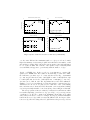
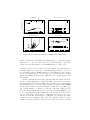
An algorithm for edge distribution when k = 1. Let Q = {I1 , I2 , ...} be a subdivision of the endpoints of E obtained by the algorithm described above, and
assume Q is given in z-order. We will now first consider the case k = 1, i.e.
every cell contains at most one vertex, and the total number of cells is O(n). We
describe how to find the intersections between Q and E in O(sort(n + l)) i/o’s.
Later we will show how to generalize this process to a subdivision with O(k)
vertices in a cell, where k > 1.
We assume edges are oriented from left to right, vertical segments are oriented
upwards, and let E+ and E− denote the edges of positive and negative slope,
respectively. The crux of the algorithm is to process the edges of positive and
negative slope separately. We describe below the two steps.