1
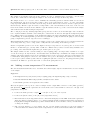
The emission rate en depends on temperature T , the trap energy level ET and the capture cross section of the
trap σc , viz:
en = en (T, ET , σc ) = γn σc T 2 e
−(
Ec −ET
kB T
)
(5)
γn is a set of constants given by:
√
3
γn = 2 3Mc (2π) 2 kb2 m∗ h−3
(6)
Where Mc is the number of minima in the conduction band of the semiconductor and m∗ is the effective electron
mass in the conduction band [1]. Since the trap energy level and the capture cross section characterise different
defects the emission rate en may be different for each defect.
3.3.1
The capacitance transient
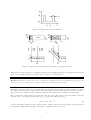
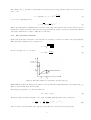
Figure 4 shows how the capacitance of the Schottky diode changes over time as a result of the traps emptying.
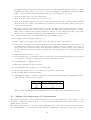
This capacitance transient can be expressed as:
C = C0
r
nT (t)
n
(7)
nT (t)
)
2n
(8)
1−
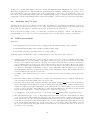
For the case where nT << n we have:
C ≈ C0 (1 −
Figure 4: The time variation of capacitance as traps empty [6].
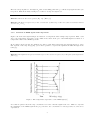
With DLTS we monitor the change in capacitance over some time interval (measurement or rate window) (t 1 , t2 ).
Where t1 is the initial delay after the pulse.
The change in capacitance over the rate window is:
δC = C(t1 ) − C(t2 )
(9)
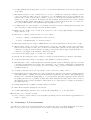
We divide this by the final capacitance C0 to form our DLTS signal (S) which can be written as:
S=
−en (T )t2
δC
ω 2 nT −en (T )t1
= [1 − 02 ]
[e
−e
]
C0
ωb 2n
where ω0 and ωb are the widths of the depletion region under zero and reverse bias respectively.
6
(10)