1
Instruction Manual for Energy Storage Inverter
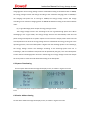
This mode adopts the mains priority principle. When the grid is electrified, the energy
storage inverter is bypassed to the grid, and the grid directly supplies power to the load while
taking power from the grid and charging the battery for three stages through the energy storage
inverter. After the battery is on a full charge, the energy storage inverter automatically stops
charging to enter into the standby mode.
After the grid is powered off, the energy storage inverter is automatically switched to the
off-grid working status (ISLAND) (before the energy storage inverter works off-grid, the off-grid
parameters (see Section 5.3) are required to be set). When the load is light, the off-grid mode is
directly started, the in-grid to off-grid steady-state output switching time is less than 20 ms; if the
off-grid load is heavy in the switching process or the photovoltaic inverter is connected at the AC
side and the power of the photovoltaic inverter is high, the energy storage inverter will
countdown to slowly start the off-grid working mode.
When in the off-grid mode and after the mains is recovered, the energy storage inverter
firstly tracks the grid phase and outputs the sine wave phase in the off-grid mode to be consistent
with the mains, and then the off-grid mode is switched to the in-grid mode. If the battery is not
on a full charge, it shall be charged; if the battery is on a full charge, the energy storage inverter
will be directly switched to the standby mode and bypassed to the mains to supply power to the
load.
(3) Off-grid and in-grid parameter setting
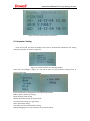
See Section 5.4 for the in-grid parameter setting and run according to the in-grid charging
power limit set in Section 5.4. In the energy storage inverter, the default constant charging
current is 0.2 C. If the actual charging power is larger than the charging power set in Section 5.4,
the charging power of the energy storage inverter will be consistent with the charging power set
in Section 5.4; if the actual charging power is lower than the charging limit power set in Section
5.4, the energy storage inverter will charge by 3 stages according to the default charging power.
For example, if the charging limit power set in Section 5.4 is 1000W, and the maximum
charging power of the energy storage inverter calculated according to the default value is 2000W,
the energy storage inverter will charge according to the maximum charging power of 1000W; if
the charging limit power set in Section 5.4 is 2500W, the energy storage inverter will charge
according to the maximum charging power of 2000W calculated according to the internal default