1
4. TO ADJUST RELEASE DEVICE
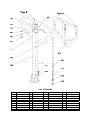
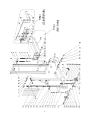
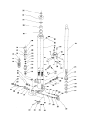
On the draw-bar of this hand stacker, you can find the control handle (D608) which can be regulated in
three positions: LOWER = to lower the forks; NEUTRAL = to move the load, and
LIFT = to raise
the fork. These three positions have been pre-posited at the factory. If however they have been
changed, you can adjust according to following step:
4.1 If the forks elevate while pumping in the NEUTRAL position, turn the adjusting nut (D615) on the
adjusting bolt (D614) clockwise or turn the adjusting screw (234) clockwise until pumping action does
not raise the forks and the NEUTRAL position functions properly.
4.2 If the forks descend while pumping in the NEUTRAL position, turn the nut (D615) or the screw
(234) counter-clockwise until the forks do not lower.
4.3 If the forks do not descent when the control handle (D608) is in the LOWER position, turn the nut
(D615) or the screw (234) clockwise until raising the control handle (D608) lowers the forks. Then check
the NEUTRAL position according to item 4.1 and 4.2 to be sure the nut (D615) and the screw (234) is
in the proper position.
4.4 If the forks do not elevate while pumping in the LIFT position, turn the nut (D615) or the screw (234)
counter-clockwise until the forks elevate while pumping in the LIFT position. Then check the LOWER
and NEUTRAL position according to item 4.1, 4.2 and 4.3.
5. TROUBLES SHOOTING
No
Trouble
Clause
1 The forks cannot be - The hydraulic oil is not enough.
up the max. height.
- Without hydraulic oil.
- The oil has impurities.
2 The forks can not - The nut (D615) is too high or the
be lifted up.
screw (234) is too close, keep the
pumping valve open.
- Air come into the hydraulic oil.
- The piston rod(270) or pump body
(261) or the mast (5) is deformed
resulting from loading slanting to one
side or over-loading.
3 The forks can not - The fork was kept in the high
be descended.
position for long time with piston rod
bared to arise in rusting and jamming
of the rod.
- The adjusting nut (D615) or the
screw (234) is not in the correct
position.
- The rollers (42) are not lubricated.
- Sealing parts worn or damaged.
4 Leaks
- Some part cracked or worn into
small.
- The impurities in the oil cause the
release valve to be unable to close
tight.
5 The fork descends - Some parts of hydraulic system is
without the release cracked or bored.
valve worked.
- Air come into the oil.
- Sealing parts worn or damaged.
- The adjusting nut (D615) or the
screw(234) is not in the correct position.
Fixing Methods
- Pour in the oil.
- Fill in the oil.
- Change the oil.
- Adjust the nut (D615) or the
screw (234) .(see item 4.4)
- Banish the air.(see item 3.4)
- Replace it.
- Keeping the fork in the lowest
position if not using, and pay more
attention to lubricate the rod.
Adjust the nut (D615) or the
screw (234). (see item 4.3)
- Lubricate its.
- Replace with the new one.
- Replace with the new one.
- Replace with new oil.
- Inspect and replace the waste
parts.
- Banish the air. (See item 3.4)
- Replace with the new one.
- Adjusting the nut (D615) or the
screw (234). (See item 4.2)
NOTE: DO NOT ATTEMP TO REPAIR THIS STACKER UNLESS YOU ARE TRAINED AND
AUTHORIZED TO DO SO.
2