1
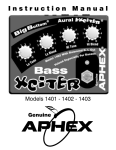
Models 1401 through 1403
The Big Bottom - What Is It?
Low frequencies are the most difficult to reproduce
well. That is because of many problems involving
acoustic mass, standing waves, and acoustic interference. It takes huge amounts of power to project a
strong bass note. Those of you who are bass players know that. Simply giving bass frequencies more
power can heighten the volume level, but at some
point it is impractical to go any further. Big Bottom
was developed to get an extended and stronger
bottom end with existing amps and speakers.
Whereas the Aural Exciter clarifies and projects the
sonic details mainly carried in the upper frequencies,
Big Bottom improves the low end reproduction.
In certain ways, Big Bottom behaves like a bass
compressor, because it extends and sustains the
notes. But, unlike a compressor, it does nothing
to stop the leading edge of transients. It does not
reduce or diffuse the snap, pluck, or punch. And,
because it uses a dynamic, constantly changing
kind of boost, it progressively augments the deeper
tones as they decay, making the notes more solid
and allowing your amp and speakers to develop
Page 18
Instruction Manual
their maximum output more safely.
Now, it may come to mind that this is obviously a
good thing for bass instruments, but what about
others? Why do I need the Big Bottom for acoustic
guitar, for example? The answer is this. We have
discovered, by making the Big Bottom’s range of
frequencies adjustable, that the specific process is
musically adaptive to upper bass areas as well. It’s
all about tone. The “box” of the guitar can be warmly
accented without making it thuddy. The richness of
chords can be improved. Amplified horns receive an
exhilarating reach to the lower notes. Of course, not
all instruments can benefit. We doubt whether Big
Bottom does much for a Cornet, for example. But,
you never know until you try! We have been pleasantly surprised many times.
Now the tech stuff again. Big Bottom starts by splitting the unaltered input signal to a main path and a
side chain. The side chain comprises an adjustable
lowpass filter (Lo Tune), a frequency dependent
phase shifter, and a peak limiter. The output from
the side chain is added to the unaltered signal in an
adjustable amount set by the Lo Blend. The characPage 19