1
White Paper | A/V Installation Cooling
Note:
Multiply the inefficiency (100% - efficiency in %) of an amplifier by the total
rated power to determine the amplifier’s heat output.
Forced Air Rack Design
A forced air rack design uses fans or blowers to remove heat by creating pressure
differences that ensure a steady flow of air through the rack enclosure. This design is
typically used for dense rack installations where considerable heat is generated
inside the rack or where space constraints cannot support passive convection.
Forced air can maintain cooler temperatures for electronic components because of
the increased amount of air flowing through the rack.
The installation designer has greater aesthetic control when using forced convection
because the vertical placement of specific components has little effect on the overall
cooling performance unless a component is blocking the main airflow path of an
intake vent or the rack’s exhaust fans.
When designing a forced air rack, the most important design features are 1) the
placement of vent plates, and 2) the type and size of exhaust fans. Vent plates are
perforated metal plates attached to the front of the rack. Vent plates allow air to flow
into the rack from the environment. They come in various “open area” designs, the
more open area, the easier for the air to travel in. Vent plates with the most open area
are typically added at the bottom of the rack. Those with lesser open area are usually
placed in the middle to prevent the bulk of the airflow from entering the middle of the
rack and skipping the lower electronics.
When placing vent plates, use the following guidelines.
•
The total open area of all vent plates should be equal, at minimum, to the
combined intake area of all exhaust fans.
•
Vent plates should not be placed in the upper region of the rack, otherwise the
bulk of the airflow will skip the electronic components in lower shelves.
•
Blanking plates can be used to provide clearance for electronics vented at the top.
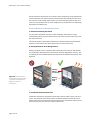
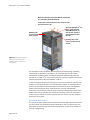
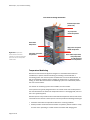
Well-designed Forced Air Installation
Figure 17 shows correct placement of various electronic components in a forced air
rack design.
Page 13 of 24