1
Christian-Albrechts-University Kiel
Department of Computer Science
Programming Languages and Compiler
Construction
Diploma Thesis
An Eclipse-Based Integrated
Development Environment for Curry
Marian Palkus ([email protected])
December 4, 2012
Advised by:
Prof. Dr. Michael Hanus
Abstract
We present the Curry IDE, an integrated development environment (IDE) for the declarative multi-paradigm language Curry. The Curry IDE provides various features known
from modern IDEs including syntax highlighting, code completion, code navigation, and
error reporting. Any Curry runtime system can be used to execute Curry programs in an
integrated console view. The Curry IDE is restricted to support the haskell case-mode
and does not provide type checking. Curry analyses are loaded dynamically from an external tool and can be executed out of the Curry IDE. Additionally, we present a generic
interface that allows developing visualizations for analyses which can be integrated into
the Curry IDE at runtime as well. The Curry IDE is based on Eclipse and implemented
using the Xtext framework.
iii
Contents
List of Figures
ix
List of Tables
xi
Listings
xiii
1 Introduction
1
2 Curry
2.1 Main Features of Curry . . . . . . . . . .
2.1.1 Overview . . . . . . . . . . . . .
2.1.2 Predefined Types and Operations
2.1.3 Functions . . . . . . . . . . . . .
2.1.4 Pattern Matching . . . . . . . . .
2.1.5 Conditions . . . . . . . . . . . . .
2.1.6 As-Patterns . . . . . . . . . . . .
2.1.7 Local Declarations . . . . . . . .
2.1.8 Constraints and Equality . . . . .
2.1.9 Higher-order Features . . . . . . .
2.1.10 Layout . . . . . . . . . . . . . . .
.
.
.
.
.
.
.
.
.
.
.
3
3
3
4
4
5
5
6
6
7
7
8
.
.
.
.
.
.
.
.
11
11
15
15
15
18
19
19
20
4 Foundations
4.1 Theoretical Foundations . . . . . . . . . . . . . . . . . . . . . . . . . . .
4.1.1 Language Recognition Workflow . . . . . . . . . . . . . . . . . . .
21
21
21
3 Requirements and Specification
3.1 Existing Tools . . . . . . . . . . . .
3.2 The Curry IDE . . . . . . . . . . .
3.2.1 General Requirements . . .
3.2.2 Curry-Specific Requirements
3.3 Integration of Curry Analysis Tools
3.3.1 Curry Analyses . . . . . . .
3.3.2 Protocol . . . . . . . . . . .
3.3.3 Integration . . . . . . . . .
.
.
.
.
.
.
.
.
.
.
.
.
.
.
.
.
.
.
.
.
.
.
.
.
.
.
.
.
.
.
.
.
.
.
.
.
.
.
.
.
.
.
.
.
.
.
.
.
.
.
.
.
.
.
.
.
.
.
.
.
.
.
.
.
.
.
.
.
.
.
.
.
.
.
.
.
.
.
.
.
.
.
.
.
.
.
.
.
.
.
.
.
.
.
.
.
.
.
.
.
.
.
.
.
.
.
.
.
.
.
.
.
.
.
.
.
.
.
.
.
.
.
.
.
.
.
.
.
.
.
.
.
.
.
.
.
.
.
.
.
.
.
.
.
.
.
.
.
.
.
.
.
.
.
.
.
.
.
.
.
.
.
.
.
.
.
.
.
.
.
.
.
.
.
.
.
.
.
.
.
.
.
.
.
.
.
.
.
.
.
.
.
.
.
.
.
.
.
.
.
.
.
.
.
.
.
.
.
.
.
.
.
.
.
.
.
.
.
.
.
.
.
.
.
.
.
.
.
.
.
.
.
.
.
.
.
.
.
.
.
.
.
.
.
.
.
.
.
.
.
.
.
.
.
.
.
.
.
.
.
.
.
.
.
.
.
.
.
.
.
.
.
.
.
.
.
.
.
.
.
.
.
.
.
.
.
.
.
.
.
.
.
.
.
.
.
.
.
.
.
.
.
.
.
.
.
.
.
.
.
.
.
.
.
.
.
.
.
.
.
.
.
.
.
.
.
.
.
.
.
.
.
.
.
.
.
.
.
.
.
.
.
.
.
.
.
.
v
Contents
.
.
.
.
.
.
.
.
.
.
.
.
.
.
.
.
.
.
.
.
.
.
.
.
.
.
.
.
.
.
.
.
.
.
.
.
.
.
.
.
.
.
.
.
.
.
.
.
.
.
.
.
.
.
.
.
.
.
.
.
.
.
.
.
.
.
.
.
.
.
.
.
.
.
.
.
.
.
.
.
.
.
.
.
.
.
.
.
.
.
.
.
.
.
.
.
.
.
.
.
.
.
.
.
.
.
.
.
.
.
.
.
.
.
.
.
.
.
.
.
.
.
.
.
.
.
.
.
.
.
.
.
.
.
.
.
.
.
.
.
.
.
.
.
.
.
.
.
.
.
.
.
.
.
.
.
.
.
.
.
.
.
.
.
.
.
.
.
.
.
.
.
.
.
.
.
.
.
.
.
.
.
.
.
.
.
.
.
.
.
.
.
.
.
.
.
.
.
.
.
.
.
.
.
.
.
.
.
.
.
.
.
.
.
.
.
.
.
.
.
.
.
.
.
.
.
.
.
.
.
.
.
.
.
.
.
.
.
.
.
.
.
.
.
.
.
.
.
.
.
.
.
.
.
.
.
.
.
.
.
.
.
.
.
.
.
.
.
.
.
.
.
.
.
.
.
.
.
.
.
.
.
.
.
.
.
.
.
.
21
22
23
24
28
28
28
28
29
29
29
30
32
32
33
34
38
.
.
.
.
.
.
.
.
.
.
.
.
.
.
.
.
.
.
.
.
.
.
.
.
.
.
.
.
.
.
.
.
.
.
.
.
.
.
.
.
.
.
.
.
.
.
.
.
.
.
.
.
.
.
.
.
.
.
.
.
.
.
.
.
.
.
.
.
.
.
.
.
.
.
.
.
.
.
.
.
.
.
.
.
.
.
.
.
.
.
.
.
.
.
.
.
.
.
.
.
.
.
.
.
.
.
.
.
.
.
.
.
.
.
.
.
.
.
.
.
.
.
.
.
.
.
.
.
.
.
.
.
.
.
.
.
.
.
.
.
.
.
.
.
.
.
.
.
.
.
.
.
.
.
.
.
.
.
.
.
.
.
.
.
.
.
.
.
.
.
.
.
.
.
.
.
.
.
.
.
.
.
.
.
.
.
.
.
.
.
.
.
.
.
.
.
.
.
.
.
.
.
.
.
.
.
.
.
.
.
.
.
.
.
.
.
.
.
.
.
.
.
.
.
.
.
.
.
.
.
.
.
.
.
.
.
.
.
.
.
.
.
.
.
.
.
.
.
.
.
.
.
.
.
.
.
.
.
.
.
.
.
.
.
.
.
.
.
.
.
.
.
.
.
.
.
.
.
.
.
.
.
.
.
.
.
.
.
.
39
40
40
41
42
48
58
62
64
67
69
70
72
72
72
73
74
76
6 Integration of Curry Analysis Tools
6.1 Concept . . . . . . . . . . . . . . . . . . . . . . . . . . . . . . . . . . . .
6.2 Implementation . . . . . . . . . . . . . . . . . . . . . . . . . . . . . . . .
6.2.1 The Curry Analysis SDK . . . . . . . . . . . . . . . . . . . . . . .
79
79
80
80
4.2
4.3
4.4
4.1.2 Lexical Analysis . . . . . . . . . . .
4.1.3 Syntactic Analysis . . . . . . . . .
4.1.4 EBNF . . . . . . . . . . . . . . . .
4.1.5 Recursive-Descent Parsing . . . . .
4.1.6 Parser Generators . . . . . . . . . .
4.1.7 Syntactic and Semantic Predicates
ANTLR - A Parser Generator . . . . . . .
4.2.1 ANTLR-Works . . . . . . . . . . .
Eclipse Rich Client Platform . . . . . . . .
4.3.1 Eclipse . . . . . . . . . . . . . . . .
4.3.2 Eclipse RCP . . . . . . . . . . . . .
Xtext . . . . . . . . . . . . . . . . . . . . .
4.4.1 Generation Workflow . . . . . . . .
4.4.2 Customization . . . . . . . . . . . .
4.4.3 The Grammar Language . . . . . .
4.4.4 Data Model . . . . . . . . . . . . .
4.4.5 The generated IDE . . . . . . . . .
5 The Curry IDE
5.1 Why use Xtext? . . . . . . . . . . . . .
5.2 The Grammar . . . . . . . . . . . . . .
5.2.1 Lexicon . . . . . . . . . . . . .
5.2.2 Basic Xtext Grammar . . . . .
5.2.3 Resolving Grammar Issues . . .
5.3 The Layout . . . . . . . . . . . . . . .
5.4 Linking . . . . . . . . . . . . . . . . .
5.4.1 Scoping . . . . . . . . . . . . .
5.4.2 Implementation . . . . . . . . .
5.4.3 Import- and Export Mechanism
5.4.4 External Paths and Libraries .
5.5 Finishing . . . . . . . . . . . . . . . . .
5.5.1 Outline . . . . . . . . . . . . .
5.5.2 Labeling and Documentation .
5.5.3 Additional validation . . . . . .
5.5.4 Curry Perspective . . . . . . . .
5.6 Testing . . . . . . . . . . . . . . . . . .
vi
.
.
.
.
.
.
.
.
.
.
.
.
.
.
.
.
.
.
.
.
.
.
.
.
.
.
.
.
.
.
.
.
.
.
Contents
.
.
.
.
.
81
84
84
84
86
7 Conclusions
7.1 Summary . . . . . . . . . . . . . . . . . . . . . . . . . . . . . . . . . . .
7.2 Discussion . . . . . . . . . . . . . . . . . . . . . . . . . . . . . . . . . . .
7.3 Future Work . . . . . . . . . . . . . . . . . . . . . . . . . . . . . . . . . .
87
87
87
88
Appendices
88
A Complete Xtext Grammar
91
6.3
6.2.2 Curry IDE Integration . . . . .
A Sample Curry Analysis Visualization
6.3.1 Prerequisite . . . . . . . . . . .
6.3.2 Development . . . . . . . . . .
6.3.3 Deployment . . . . . . . . . . .
B Installation Guide
B.1 Prerequisite .
B.2 Installation .
B.2.1 Step 1
B.2.2 Step 2
B.2.3 Step 3
B.3 Update . . . .
.
.
.
.
.
.
.
.
.
.
.
.
.
.
.
.
.
.
.
.
.
.
.
.
.
.
.
.
.
.
.
.
.
.
.
.
.
.
.
.
.
.
.
.
.
.
.
.
.
.
.
.
.
.
.
.
.
.
.
.
.
.
.
.
.
.
.
.
.
.
.
.
.
.
.
.
.
.
.
.
.
.
.
.
.
.
.
.
.
.
.
.
.
.
.
.
.
.
.
.
.
.
.
.
.
.
.
.
.
.
.
.
.
.
.
.
.
.
.
.
.
.
.
.
.
.
.
.
.
.
.
.
.
.
.
.
.
.
.
.
.
.
.
.
.
.
.
.
.
.
.
.
.
.
.
.
.
.
.
.
.
.
.
.
.
.
.
.
.
.
.
.
.
.
.
.
.
.
.
.
.
.
.
.
.
.
.
.
.
.
.
.
.
.
C Project structure
C.1 Overview . . . . . . . . . . . . . . . . . . . . . . . . . .
C.1.1 de.kiel.uni.informatik.ps.curry.CurryIDE . . . . .
C.1.2 de.kiel.uni.informatik.ps.curry.CurryIDE.ui . . . .
C.1.3 de.kiel.uni.informatik.ps.curry.CurryIDE.analysis
C.1.4 de.kiel.uni.informatik.ps.curry.CurryIDE.sdk . . .
C.1.5 CurryUpdateSite . . . . . . . . . . . . . . . . . .
Declaration
.
.
.
.
.
.
.
.
.
.
.
.
.
.
.
.
.
.
.
.
.
.
.
.
.
.
.
.
.
.
.
.
.
.
.
.
.
.
.
.
.
.
.
.
.
.
.
.
.
.
.
.
.
.
.
.
.
.
.
.
.
.
.
.
.
.
.
.
.
.
.
.
.
.
.
.
.
.
.
.
.
.
.
.
.
.
.
.
.
.
.
.
.
.
.
.
.
.
.
.
.
.
.
.
.
.
.
.
.
.
.
.
.
.
.
.
.
.
.
.
.
.
.
.
.
.
.
.
.
.
.
.
.
.
.
.
.
.
.
.
.
.
99
99
100
100
100
102
104
.
.
.
.
.
.
105
105
105
106
107
107
107
111
vii
List of Figures
3.1
Curry development process . . . . . . . . . . . . . . . . . . . . . . . . . .
14
4.1
4.2
4.3
Language recognition workflow . . . . . . . . . . . . . . . . . . . . . . .
Xtext generation process . . . . . . . . . . . . . . . . . . . . . . . . . . .
SimpleCurry data model . . . . . . . . . . . . . . . . . . . . . . . . . . .
22
31
37
5.1
5.2
5.3
5.4
5.5
5.6
5.7
5.8
5.9
Grammar rule diagram: identifier issue
Syntax trees of ambiguous grammar . .
Layout example . . . . . . . . . . . . .
TokenSource interface . . . . . . . . . .
Layout algorithm outline . . . . . . . .
Module scope example . . . . . . . . .
Local definition scope example . . . . .
Do-expression scope example . . . . . .
List comprehension scope example . . .
.
.
.
.
.
.
.
.
.
.
.
.
.
.
.
.
.
.
.
.
.
.
.
.
.
.
.
.
.
.
.
.
.
.
.
.
.
.
.
.
.
.
.
.
.
.
.
.
.
.
.
.
.
.
.
.
.
.
.
.
.
.
.
.
.
.
.
.
.
.
.
.
.
.
.
.
.
.
.
.
.
.
.
.
.
.
.
.
.
.
.
.
.
.
.
.
.
.
.
.
.
.
.
.
.
.
.
.
.
.
.
.
.
.
.
.
.
.
.
.
.
.
.
.
.
.
.
.
.
.
.
.
.
.
.
.
.
.
.
.
.
.
.
.
.
.
.
.
.
.
.
.
.
.
.
.
.
.
.
.
.
.
49
54
59
60
63
64
66
66
67
6.1
6.2
6.3
6.4
Curry analysis visualizations interface . . .
Overview: Curry Analysis Tool integration
Context menu for Curry analyses . . . . .
Example of a Curry visualization extension
.
.
.
.
.
.
.
.
.
.
.
.
.
.
.
.
.
.
.
.
.
.
.
.
.
.
.
.
.
.
.
.
.
.
.
.
.
.
.
.
.
.
.
.
.
.
.
.
.
.
.
.
.
.
.
.
.
.
.
.
.
.
.
.
.
.
.
.
81
82
84
85
B.1
B.2
B.3
B.4
B.5
Installation
Installation
Installation
Installation
Installation
.
.
.
.
.
.
.
.
.
.
.
.
.
.
.
.
.
.
.
.
.
.
.
.
.
.
.
.
.
.
.
.
.
.
.
.
.
.
.
.
.
.
.
.
.
.
.
.
.
.
.
.
.
.
.
.
.
.
.
.
.
.
.
.
.
.
.
.
.
.
.
.
.
.
.
.
.
.
.
.
.
.
.
.
.
100
101
102
103
103
guide:
guide:
guide:
guide:
guide:
Step 1 . . . . . . .
Step 2 . . . . . . .
Step 3 . . . . . . .
Security warning .
New Curry project
.
.
.
.
.
.
.
.
.
.
.
.
.
.
.
.
.
.
.
.
.
.
.
.
ix
List of Tables
5.1
Scoping: search strategies . . . . . . . . . . . . . . . . . . . . . . . . . .
68
xi
Listings
4.1
Sample SimpleCurry-program. . . . . . . . . . . . . . . . . . . . . . . . .
33
5.1
5.2
5.3
5.4
5.5
The remaining rule definitions of the Xtext-grammar. . . . . . . . . . . .
Modified rules Expr and FunctExpr . . . . . . . . . . . . . . . . . . . . .
The different meanings of a dot in Curry. . . . . . . . . . . . . . . . . . .
Compact definition of the rules SimpleTypeExpr, SimplePat, and BasicExpr.
Modified CurryParser. . . . . . . . . . . . . . . . . . . . . . . . . . . . .
45
48
49
52
59
xiii
1 Introduction
In the last decades, the computer has become an essential part of modern societies. More
and more tasks are delegated to computer systems for reason of speed, efficiency, security,
costs, and other advantages over different solutions. To satisfy all these expectations,
the development process of such systems has to be efficient and affordable. Generally,
they consist of hardware which is controlled by software. Hence, the software plays a
key role for the success of computer systems.
At the beginning of every software project, a programming languages has to be chosen that should be used for the development. Programming languages can be used to
specify instructions which are executed by a machine, particularly a computer. They
usually abstract from machine instructions to ease the work of developers. This level
of abstraction differs from one language to another. High level programming languages
promise a lot of advantages over programming languages of lower levels, including the
following: Shortened development time, higher readability and maintainability of code,
and less error-proneness. Hence, a basic step for every software project is to choose the
right programming language(s) to use. Generally, this choice is significantly influenced
and restricted by particular project conditions, especially the target platform(s). Another factor is the existing tooling for a programming language. There are often various
tools for widely used programming languages which simplify the use of the corresponding language and raise productivity of software developers, often they are combined into
an integrated development environment (IDE). Additionally, the need for tool support
rises with the number of developers working together on large software projects. Modern
IDEs simplify the work of developers in various ways including fast navigation through
code, code completion, and instant error notification.
This thesis deals with tool support for Curry. Curry is a declarative programming
language aiming to combine functional and logic programming paradigms. It is developed by an international initiative intended to provide common platform for research,
teaching, and application of integrated functional logic languages. Curry is a high level
language and, hence, may be a good choice for software projects. Chapter 3 lists the existing tools for Curry and identifies their shortcomings compared to modern IDEs. The
result shows that the tooling for Curry can and, having the importance of tool support
in mind, should be improved. The objective of this thesis is to provide a modern IDE
for Curry oriented towards the Eclipse Java IDE1 . It will be called Curry IDE in the
1
The Eclipse Java IDE is described in Chapter 3
1
1 Introduction
following. An additional objective is the integration of existing Curry analysis tools.
The development of a modern IDE is quite complex so that this thesis is meant to
build a usable IDE that can be enhanced in the future. It is necessary to restrict
the recognition strength of the IDE slightly and to exclude type checking to keep the
programming effort within reasonable limits.
This thesis is structured as follows: In Chapter 2, the programming language Curry
is introduced. Chapter 3 provides an overview of existing tooling for Curry, their shortcomings compared to the Eclipse Java IDE, and defines the specification for the Curry
IDE. In Section 3.3 the integration of Curry analysis tools is specified. In Chapter 4
basic knowledge for this thesis is introduced, including theoretical foundations in Section 4.1 and the technologies applied in Sections 4.2, 4.3, and 4.4. Chapter 5 describes
the concept and implementation of the Curry IDE as well as encountered problems and
corresponding solutions. In Chapter 6, the realization of the Curry analysis tool integration is documented. Finally, Chapter 7 evaluates the resulting Curry IDE and lists
its limitations regarding the specifications.
2
2 Curry
Curry is a general-purpose declarative programming language that integrates functional
with logic programming. Therefore, Curry seamlessly combines the key features of functional, logical, and concurrent programming.
• Functional Programming: nested expressions, lazy evaluation, higher-order functions
• Logical Programming: logical variables, partial data structures, built-in search
• Concurrent Programming: concurrent evaluation of constraints with synchronization on logical variables
Moreover, Curry provides additional features in comparison to the pure languages (compared to functional programming: search, computing with partial information; compared
to logic programming: more efficient evaluation due to the deterministic evaluation of
functions).
The development of Curry is an international initiative intended to provide a common
platform for research, teaching and application of integrated functional logic languages.
The language specification including its syntax and operational semantics can be found
in the Curry Report [Han12].
There are different implementations of Curry available, some of these will be mentioned
in Chapter 3. In this thesis, we will use PAKCS (Portland Aachen Kiel Curry System)
[HAB+ 12] as the default implementation.
There is a tutorial [Ant07] that gives a good introduction to programming in Curry,
further, the Curry Report [Han12] describes every feature of the language in detail. We
will summarize Curry’s key features and give a short introduction by using examples
from these sources in the following.
2.1 Main Features of Curry
2.1.1 Overview
The major elements of a Curry program are expressions, functions and data structures:
3
2 Curry
• An expression is either a symbol or literal value or the application of an expression
to another expression. Symbols and literal values constitute the most elementary
expressions, for example, numbers and the Boolean symbols “True” and “False”.
• A function defines a computation similar to an expression, with the difference that
it is named and, hence, can be executed over and over again in the same program
with possibly different parameters. Moreover, a function provides a procedural
abstraction. Rather than coding a computation by means of a possibly complicated
expression, you can factor out portions of this computation and abstract them by
their names.
• A data structure is a way to organize data. The way in which information is
organized may ease some computations, such as retrieving portions of information,
and is intimately related, through pattern matching, to the way in which functions
are coded.
2.1.2 Predefined Types and Operations
A type is a set of values. Ubiquitous types, such as integers or characters, are predefined
in Curry. We call these types built-in. The availability of built-in types as well as their
characteristics may depend on a specific implementation of Curry. As mentioned above,
we use PAKCS to execute Curry programs which provides the module “Prelude” containing all predefinitions. In PAKCS, the buit-in types Integer, Floating Point Numbers,
Boolean, Character, String, List, Tuples, Success, and Unit are available. The details of
these types can be found in the PAKCS User Manual [HAB+ 12].
Additionally, there are frequently-used functions and infix operators predefined in
Curry including Boolean equality, Constrained equality, Boolean conjunction, Boolean
disjunction, Parallel conjunction, and Constrained expression. Curry predefines many
more functions and operations, a complete list can be found both in the Curry Report
[Han12] and the “Prelude”.
2.1.3 Functions
In Curry, functions abstract functions in the mathematical sense by being a device that
takes arguments and returns a result. The result is obtained by evaluating an expression
which generally involves the function’s arguments. For instance, the following function
computes the square of a number:
1
square x = x * x
The symbol “square” is the name or identifier of the function and the symbol “x” is
the function’s argument. The above declarations referred to as an equation defining
4
2.1 Main Features of Curry
a function. Functions can also be anonymous, i.e., without a name. An anonymous
function definition has the following structure:
1
\args -> expression
2.1.4 Pattern Matching
The definition of a function can be broken into several equations. A single equation
would suffice many cases. However, several equations allow a definition style, called
pattern matching, which is easier to code and understand. This feature allows a function
to dispatch the expression to be returned depending on the values of its arguments.
For instance, the following definition:
1
not x = if x == True then False else True
can be rewritten using pattern matching as follows:
1
2
not True
not False
= False
= True
which seems to be a lot more readable.
2.1.5 Conditions
Each equation defining a function can include one or more conditions. For Boolean
conditions, an equation has the following general structure:
1
2
3
functionId arg1 , ..., argm | cond1 = expr1
| ... = ...
| condn = exprn
A condition is tested after binding the arguments of a call to the corresponding arguments
in the left-hand side of the equation. The function is applied to the arguments only if the
condition holds. Each condition expri is an expression of type Boolean. The conditions
are tested in their textual order so that the first right-hand side with a condition evaluable
to True is taken. Furthermore, the last condition can be “otherwise” which is equivalent
to True, i.e., it is always taken, if none of the preceding conditions is True. The following
example shows a definition of the maximum of two numbers:
1
2
max x y | x < y
= y
| otherwise = x
5
2 Curry
2.1.6 As-Patterns
The patterns in a defining equation, i.e., the arguments of the left-hand sides, are required
to be data terms without multiple occurrences of variables. A pattern denotes some part
of a structure of the actual argument. The as-pattern allows to reuse this structure in
the right-hand side of the defining equation by identifying this structure by a variable.
An as-pattern has the form v@pat where the variable v identifies the structure matched
by the pattern pat. For instance,
1
2
dropFalse (False:ys) = ys
dropFalse xs@(True:_) = xs
is equivalent to
1
2
3
4
dropFalse xs = dropFalse´ xs
where
dropFalse´ (False:ys) = ys
dropFalse´ (True:_)
= xs
Local declarations introduced by the keyword where are discussed in the following.
2.1.7 Local Declarations
Since not all auxiliary functions should be globally visible, it is possible to restrict the
scope of declared entities. Note that the scope of parameters in function definitions
is already restricted since the variables occurring in parameters of the left-hand side
are only visible in the corresponding conditions and right-hand sides. The visibility of
other entities can be restricted using let in expressions or where in defining equations.
Both keywords introduce a set of local names. The list of local declarations can contain
function definitions as well as definitions of constants by pattern matching. There is a
small difference regarding visibility and scoping of local definitions in let- and whereclauses, however, this is discussed later in this thesis in detail. For now, we consider two
code snippets to get a first impression of local definitions. For instance, the expression:
1
2
3
let a = 3 * b
b = 6
in 4 * a
reduces to the value 72. The function equation:
1
2
sumSquares a b = (square a) + (square b)
where square x = x * x
can be used to evaluate the expression “sumSquare 3 5” to 34.
6
2.1 Main Features of Curry
Free Variables
Since Curry is intended to cover functional as well as logic programming paradigms, expressions (or constraints, see Section 2.1.8) might contain free (unbound, uninstantiated)
variables. The idea is to compute values for these variables such that the expression is
reducible to a data term or that the constraint is solvable. For instance, consider the
following definitions:
1
2
3
mother John
mother Alice
mother Andrew
= Christine
= Christine
= Alice
We can use free variables and constraints for special computations. For instance, a
child of Alice can be computed by solving the equation “mother x =:= Alice”. Similarly,
we can compute a grandchild of Christine by solving the equation “mother (mother x)
=:= Christine” which yields the value “Andrew” for x.
2.1.8 Constraints and Equality
An equation can also have a constraint as a condition, which is an expression of the type
Success. In this case, the constraint is checked for satisfiability in order to apply the
equation. Constraints have the form e1 =:= e2 where e1 and e2 are expressions. e1 =:= e2
is satisfied if both sides are reducible to a same ground data term (cf. [Han12]). This
notion of equality is called strict equality. As a consequence, if one side is undefined
(non-terminating), then the strict equality does not hold. For instance, the equational
constraint [x] =:= [0] is satisfiable if the variable x is bound to 0.
Constraints can be combined into a conjunction written as c1 &c2 . The conjunction is
interpreted concurrently: if the combined constraint c1 &c2 should be solved, c1 and c2
are solved concurrently. The single constraints c1 and c2 can communicate using common
variables.
2.1.9 Higher-order Features
Curry is a higher-order language supporting common functional programming techniques
by partial function applications and lambda abstractions. A function application is
denoted by juxtaposition the function and its argument. For instance, the well-known
map function is defined in Curry by:
1
2
3
map :: (a->b)-> [a] -> [b]
map f []
= []
map f (x:xs) = f x : map f xs
7
2 Curry
2.1.10 Layout
Curry allows to use layout information to define the structure of blocks, similarly to
Haskell. Therefore, we define the indentation of a symbol as the column number indicating the start of this symbol. The indentation of a line is the indentation of its first
symbol [Han12].
The layout rule applies to lists of syntactic entities after the keywords let, where, do,
or of. The structure (beginning and ending of the list, separation of single entities)
of these lists is specified by indentation: the indentation of a list of syntactic entities
after let, where, do, or of is the indentation of the next symbol following the let, where,
do, of. Any item of this list starts with the same indentation as the list. Lines with
only whitespaces or an indentation greater than the indentation of the list continue the
item in its previous line. Lines with an indentation less than the indentation of the list
terminates the entire list. Moreover, a list started by let is terminated by the keyword
in.
For the purpose of illustration, in the following example [Han12] we use curly braces
(’{ }’) to specify the beginning and ending of a block and a colon (’;’) to separate single
entities:
1 f x = h x where
{g y = y+1 ; h z = (g z) * 2 }
This is written with the layout rules as
1 f x = h x where
2
g y = y+1
3
h z = (g z) * 2
or also as
1 f x = h x where
2
g y = y+1
3
h z = (g z)
4
* 2
To avoid an indentation of top-level declarations, the keyword module and the end-of-file
token are assumed to start in column 0.
Infix Operators
Curry allows the definition and usage of infix operators. For instance, “1 + 2 ∗ 3 + 4 ==
x&&b” is a valid expression using the infix operators +, *, ==, and &&. However, there
are various ways to interpret this expression depending on the associativity of the single
operators. One way to define this expression unambiguously is by using brackets. For
8
2.1 Main Features of Curry
instance, the expressions “(((1 + 2) ∗ (3 + 4)) == x)&&b” and “((1 + ((2 ∗ 3) + 4)) ==
(x&&b))” are unambiguously.
Indeed, we want the * to have a greater associativity than the + for instance to
minimize the use of brackets. Therefore, Curry allows to assign an associativity and
precedence to each operator by a fixity declaration. There are three kinds of associativities, non-, left-, and right-associativity (infix, infixl, infixr ) and ten levels of precedence,
0 to 9, where level 0 binds least tightly and level 9 binds most tightly. All fixity declarations must appear at the beginning of a module. Any operator without an explicit
fixity declaration is assumed to have the declaration infixl 9.
The associativities and precedences for the operators +, *, ==, and && are defined in
the prelude, according to those fixity declarations, the expression “1+2∗3+4 == x&&b”
is equivalent to “((((1 + (2 ∗ 3)) + 4) == x)&&b)”.
List Comprehension
List comprehensions constitute another special case. They provide a compact notation
for lists and have the general form (cf. [Han12]:
1
[ e | q1 , ..., qk ]
where k ≥ 1 and each qi is a qualifier that is either
• a generator of the form p <- l, where p is a local pattern (i.e., an expression
without defined function symbols and without multiple occurrences of the same
variable) of type t and l is an expression of type [t], or
• a guard, i.e., an expression of type Bool.
The variables introduced in a local pattern can be used in subsequent qualifiers and the
element description e. Such a list comprehension denotes the list of elements which are
the result of evaluating e in the environment produced by the nested and depth-first
evaluation of the generators satisfying all guards. For instance the list comprehension
1
[ (x,y) | x <- [1,2,3], y <- [4,5] ]
denotes the list [(1, 4), (1, 5), (2, 4), (2, 5), (3, 4), (3, 5)].
9
3 Requirements and Specification
The intention of this paper is to develop a tool to simplify the use of Curry. To accomplish
this goal, the current development process and tools of Curry developers are examined
in Section 3.1. By comparing the current state with a modern and widely used IDE, like
the Eclipse Jave IDE, a set of additional features, which are necessary to enhance the
user experience of Curry developers, is identified. These features are used to write an
informal specification of the Curry IDE in Section 3.2. The last part, Section 3.3, of the
specification describes how existing Curry analyses are integrated into the Curry IDE.
3.1 Existing Tools
This section gives a short overview of the existing tooling for Curry. There are various
types of tools available which focus on different tasks within the development process.
The set of tasks includes writing, reading, debugging, refactoring, testing, compiling,
executing, analyzing, and generating code. The following list shows some tools available1
at the time of writing:
• PAKCS : The Portland Aachen Kiel Curry System is an implementation of Curry
jointly developed by the Portland State University, the Aachen University of Technology, and the University of Kiel. PAKCS is an interactive system to develop
Curry programs. It contains a lot of additional tools and libraries. PAKCS compiles Curry programs to Prolog programs. 2
• MCC : The Münster Curry Compiler is a native code compiler for Curry which
conforms to the Curry report except for committed choice which is not supported. 3
• KiCS and KiCS2: The Kiel Curry System is a compiler that translates Curry to
Haskell. The KiCS24 is a new implementation of KiCS.
1
As listed on http://www.curry-language.org, last visited December 3, 2012
http://www.informatik.uni-kiel.de/~pakcs/, last visited December 3, 2012
3
http://danae.uni-muenster.de/~lux/curry/, last visited December 3, 2012
4
http://www-ps.informatik.uni-kiel.de/kics2/, last visited December 3, 2012
2
11
3 Requirements and Specification
• FLVM : The FLVM5 is a virtual machine for functional logic computations. Curry
programs are compiled to FLVM instructions that are executed by the FLVM
interpreter that is implemented in Java. [AHLT05]
• Sloth: The Sloth system6 is a compiler which translates Curry programs to Prolog
programs. It is under development at the Technical University of Madrid. The
Sloth system has an interactive interface to load programs and evaluate expressions.
• COOSy: The Curry Object Observation System is an implementation of a lightweight approach for debugging functional logic programs in Curry by observations.
It consists of a library plus a viewing tool. Programmers can annotate their program with observation functions for data structures and functions which may both
contain or be applied to logical variables. The parts of observed objects that are
evaluated during the execution are recorded in a trace file and can be viewed by
means of a pretty printer integrated in a graphical user interface. [BCHH04]
• CurryBrowser : CurryBrowser is a generic analysis environment for Curry. It supports browsing through the program code of an application written in Curry, i.e.,
the main module and all directly or indirectly imported modules. Each module can
be shown in different formats (e.g., source code, interface, intermediate code) and,
inside each module, various properties of functions defined in this module can be
analyzed. In order to support the integration of various program analyses, CurryBrowser has a generic interface to connect local and global analyses implemented
in Curry. CurryBrowser is completely implemented in Curry using libraries for
GUI programming and meta-programming. [Han06]
• CurryDoc: CurryDoc is a documentation tool for declarative programs. It can
be used for automatic generation of documentation manuals in HTML format
from programs written in Curry. The documentation is generated by combining
comments in the source program with information extracted from the program. It
extends other tools with a similar goal (e.g., javadoc, lpdoc) by the inclusion of
information in the generated documents which has been computed by analyzing
the structure and approximating the run-time behavior of the program. [Han02]
• CurryTest: CurryTest7 is a simple tool in the PAKCS distribution to write and
run repeatable unit tests. CurryTest simplifies the task of writing test cases for a
module and executing them.
5
http://web.cecs.pdx.edu/~antoy/homepage/download.html,
last visited December 3, 2012
6
http://babel.ls.fi.upm.es/research/Sloth/, last visited December 3, 2012
7
http://www-ps.informatik.uni-kiel.de/currywiki/tools/currytest,
last visited December 3, 2012
12
3.1 Existing Tools
• EasyCheck : EasyCheck is a library for automated, specification-based testing of
Curry programs. It it distributed with the Curry implementation KiCS. The ideas
behind EasyCheck are described in [CF08].
• iCODE : iCODE (Interactive Curry Observation DEbugger) is a tool to support
programmers stepping on the lazy evaluation order of expressions at the source
code level. Every executed expression is covered in a layout of the source code and
its runtime value can be represented to the user.
• Emacs plug-in: Emacs8 is an extensible, customizable text editor. There is an
Emacs plug-in for Curry, which provides syntax coloring.
The following list contains older implementations that are no longer actively maintained.
• Curry2Java: Curry2Java is another back end for PAKCS which translates Curry
programs to Java programs. Is uses Java threads to implement the concurrent
non-deterministic features of Curry.
• CIDER: CIDER9 is a graphical programming and development environment for
Curry. CIDER is intended as a platform to integrate various tools for analyzing and
debugging Curry programs. CIDER is completely implemented in Curry. Although
the graphical debugger contains an interpreter for executing Curry programs, it
is mainly intended for visualizing the execution of smaller programs but not for
executing large programs. [HK01]
This overview shows that there is good tool support for Curry. However, most tools
are standalone applications which leads to a poor user experience. This is also reflected
by considering the development process for Curry programs.
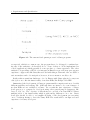
Figure 3.1 illustrates the current workflow of Curry developers, which has been determined by consultation with experts. This process includes the use of various tools with
different UIs and separate windows. The code is written and modified in Emacs. It is
compiled using any of the existing runtime systems, such as PAKCS, KiCS, or MCC.
This can be done within the UI of Emacs using a built-in console. If there are errors
during compilation, these errors are printed to the console providing the line and position of the first error that occurred. The developer has to navigate manually to that
code position to fix it. Usually, these steps are done multiple times. When the code
compilation succeeds without errors, its runtime behavior has to be tested. Therefore,
it is executed, again, using any available runtime system. If the program does not work
8
9
http://www.gnu.org/software/emacs/, last visited December 3, 2012
http://www.informatik.uni-kiel.de/~pakcs/cider/, last visited December 3, 2012
13
3 Requirements and Specification
Figure 3.1: The current development process for Curry programs
as expected, which is a common case, the program has to be debugged or analyzed using any of the analysis tools described above. Some of these tools are implemented as
console applications, which generally does not produce good user experience. The other
analysis tools providing a GUI do not integrate in Emacs nor provide homogeneous user
experience. Approaches like CurryBrowser deal with this problem and offer one GUI for
various analyses and code navigation, however, it is not meant to modify code.
Besides this non-uniform landscape of tools, Emacs with Curry plug-in (or any text
editor) does not offer the functionality of modern IDEs, like Eclipse Java IDE.
Summarized, the development of Curry programs usually comprises various tools with
different usability and varying UIs. Although there are many tools, some features of
modern IDEs are not available for Curry. As a result the user experience of Curry
developers is poor compared to developers using other general purpose languages, like
Java, C, C#, etc. The objective of this thesis is to provide a modern IDE for Curry
unifying most of the functionality which is split among different tools so far. Curry
developers should be able to accomplish all tasks of the development process using
one tool without having to leave the Curry IDE. The result will be an improved user
experience for Curry developers.
14
3.2 The Curry IDE
3.2 The Curry IDE
This section introduces the informal specification of the Curry IDE. At first, general
functionality of a modern GUI is described in 3.2.1. The language-specific features of
modern IDEs are listed in Section 3.2.2. The integration of existing Curry analyses is
described in Section 3.3.
3.2.1 General Requirements
The basis for a modern IDE is a modern graphical user interface. But what turns a
GUI into a modern GUI? This question cannot be answered in general, because the
definition of a modern design for instance might be very subjective. However, we focus
on the functionality, which is more objective. Hence, we define a feature set we expect
from a modern application. As the Curry IDE has to contain an editor, the general
requirements for a text editor are also discussed.
The following feature set defines the general, i.e., language independent, requirements
for a modern GUI:
• Layout: The layout should be structured and flexible to support different window
sizes.
• File support: The IDE should be able to open, save, rename, move and print files.
Additionally, common auxiliary functions like opening recent files and displaying
file properties should be provided.
• Text editor : The editor should provide actions like select, copy, paste, and cut
text, search within text, undo, and redo last modifications.
• Customizable appearance: The user should be able to freely change the look of
the application. That is, for instance, change the size, color, and type of font.
Moreover, the Curry IDE might be able to display a lot of information to the
user, it is desirable that the user can choose which information to show. Such
modifications should be easy and intuitive.
3.2.2 Curry-Specific Requirements
This section specifies the main features that turn the application into a powerful IDE.
Therefore, it describes the desirable functionality and discusses the extent to which it is
provided by existing tools.
15
3 Requirements and Specification
Project Explorer
The Curry IDE should provide a custom project explorer that is oriented towards the
Java project explorer. It should support language specific properties of Curry projects
including the definitions of libraries and external paths. To do so, a virtual layer should
be added to every Curry project to display these properties. Additionally, this layer
should contain an element for the source files, i.e., the Curry modules that are part of
the project.
Code Presentation
In general, the developer will spend most of the time writing or reading code. The
main part of an IDE is basically a standard text editor as described above. However,
there are several language-specific features that make the work of developers simpler
and more efficient. To improve the readability, the code can be colored in a special
way, this is called syntax highlighting. Therefore, different parts of the code, for instance
keywords, comments, variables, and strings, have different colors. Syntax highlighting
is already available for Curry using the Emacs Curry plug-in. Another handy feature
is code folding, it enables the developer to hide or show code blocks which might be
temporarily (ir)relevant. This features is not provided by the Emacs Curry plug-in nor
any other existing tool.
Error Visualization
One of the most important features of the Curry IDE is the visualization of errors and
warnings. Modern IDEs display errors and warnings directly in the editor by marking
the corresponding code. Additionally, the IDE shows the error and warning message,
respectively. Up to now, there is no tool available that gives the developer immediate
feedback when writing code. Currently, the runtime system outputs errors and corresponding parts, which have to be found manually by the developer. This feature will
make a huge difference and accelerate the development process a lot.
Additional Functionality
Modern IDEs offer matured language support including code completion and so called
quick fixes. The code completion is often very intelligent, since it is not only a textual
completion of words which already have been written in the current document, but
suggestions for completions that make sense in the current context. Such suggestions
usually result in valid code and might contain language elements from other files or
imported libraries. The quality of this feature is hard to define, however, the Curry IDE
should provide code completion that suggests:
16
3.2 The Curry IDE
• Data types in signatures
• Valid expressions in right hand side of functions, i.e., accessible variables, functions,
or constructors
• Existing functions or data types in export declarations.
• Existing functions or data types in import declarations.
Quick fixes are proposals by the IDE to fix existing errors. Again, this feature is hard
to specify, but typically correct suggestions for typing errors should be made. The Curry
IDE should also be able to detect and correct errors such as module names that do not
correspond to file names. None of these features are provided by any existing tools.
Additional Information
The IDE should neatly provide additional information to the developer. For programs
that consist of more than one file, it is important to have an overview of the project’s
file structure. This is provided by the project explorer. Aside from that, the IDE should
offer an overview of the current module. It should contain all defined data types, signatures, functions, imports, and exports. This IDE part is called outline. This kind of
information is provided by the CurryBrowser, which does not allow modifications of the
code. At the same time, Emacs has a project explorer, but does not support a module outline. Modern IDEs also provide additional language-specific information to the
developer. This might be the type of a variable or the needed parameters for a function. Moreover, the Eclipse Java IDE has javadoc 10 integration. Javadoc is a tool for
generating API11 documentation in HTML format from doc comments in source code.
For every element that has a javadoc annotation, Eclipse shows the javadoc wherever
this element is used. The corresponding tool for Curry is called CurryDoc. The Curry
IDE should provide additional information to the developer including the signature of
functions and CurryDoc annotations. This feature becomes very important for huge
projects where developers constantly use code written by other developers. It displays
the needed information to the developer so that in most cases it is not necessary to
browse to the corresponding definition. This feature is not provided up to now and can
be very time-saving.
10
http://www.oracle.com/technetwork/java/javase/documentation/
index-jsp-135444.html,
last visited December 3, 2012
11
application programming interface
17
3 Requirements and Specification
Execution
The code should be executable without leaving the IDE. However, the Curry IDE is not
meant to implement another compiler or interpreter for Curry. The existing runtime
systems should be integrated instead. Therefore, an interactive console for any of the
existing runtime systems should be available within the IDE. It should be possible to
directly start a runtime system and load the active module without manual interaction
with the runtime system.
Code Navigation
It is really uncommon to read code sequentially, instead, it is usual to navigate from one
definition to another which might be in another module or even project. That is the
reason why reading code using an standard text editor (or even Emacs with the Curry
plug-in) can be time-consuming right up to really frustrating. A solution for this lack of
usability, is the integration of hyperlinks within the editor that reference the definition
of any element. The Curry IDE should provide this feature, since it is not provided up
to now. CurryBrowser supports the navigation using the module outline: by selecting
an element in the outline the corresponding code is displayed and marked. This feature
should be also included in the Curry IDE. Another handy type of code navigation is the
advanced search including finding references to a selected element or search for elements
of a specific type. The advanced search is desirable to be available in the Curry IDE.
By implementing all these features, the resulting IDE will provide the main features
of modern IDEs like Eclipse, Netbeans, or VisualStudio. The consultation with experts
certifies that such an IDE will enhance their workflow and simplifies the development
process with Curry.
3.3 Integration of Curry Analysis Tools
To accomplish the goal of supporting the whole development process of Curry programs,
the analysis of the code has to be considered as well. There are a lot of existing analyses
for Curry that should be integrated into the Curry IDE instead of implementing them
from scratch again. Attempts are being made to develop the Curry Analysis Tool which
unifies Curry analyses and makes them accessible via socket communication. At the time
of writing, this tool does not exist yet. However, a protocol has already been specified
that will be supported by the Curry Analysis Tool. Basically, the tool is a server that
allows socket connections on a specific port. After the connection has been established,
text based commands can be sent to the tool which are terminated by a linebreak. The
tool processes the request and sends an appropriate response to the client.
18
3.3 Integration of Curry Analysis Tools
3.3.1 Curry Analyses
To delegate the execution of analyses to the Curry Analysis Tool, basic configuration
is necessary. This includes the path of the module to analyze as well as all paths
containing the Curry modules it refers to directly or indirectly. The Curry analyses are
identified by unique names and can be applied to modules, functions, data types, and
data constructors. Moreover, they might support different output types which specify
how the result text should be interpreted.
3.3.2 Protocol
The protocol specifies valid requests as well as the format of corresponding responses.
The tool sends two different types of responses according to whether the request is valid
or not. If an error occurred, the server sends “error <msg>” where <msg> will be the
error message that is terminated by a linebreak. In case of success, the response starts
with the line “ok <n>” where <n> is the number of lines that the subsequent result
text will consist of. Afterwards, the result text is sent line by line.
One key benefit of the Curry Analysis Tool is the generic approach which also implies
that the provided analyses are not known until runtime. Hence, clients have to fetch
the list of available analyses first, to make valid subsequent request. The corresponding
command is “GetAnalysis”, the server replies to this request with the list of analyses
in the format “<analysis> <output>”. The complete response to the “GetAnalysis”
request could look as follows:
1
2
3
4
5
6
ok 5
Deterministic
Deterministic
Deterministic
HigherOrder
DependsOn
CurryTerm
Text
XML
CurryTerm
CurryTerm
Before starting an analysis, the tool has to be configured by setting the necessary paths
for the analysis. This is supported by the command “SetCurryPath <dir1>:<dir2>:. . . ”
where <dir1>, <dir2>. . . are the single paths separated by a colon.
There are four commands to start an analysis, they differ by the type of the target
element:
1
2
3
4
AnalyzeModule
AnalyzeFunction
AnalyzeDataConstructor
AnalyzeTypeConstructor
<analysis>
<analysis>
<analysis>
<analysis>
<output>
<output>
<output>
<output>
<module>
<module> <function>
<module> <constr>
<module> <type>
19
3 Requirements and Specification
where <analysis> is the kind of analysis and <output> is the output type, the values
should correspond to an available analysis that is part of the response of the GetAnalysiscommand. The remaining arguments are defined as follows: module specifies the module
name, function specifies the function name, constr specifies the constructor name, and
type specifies the data type name.
There is also a command to stop the server: “StopSever”.
3.3.3 Integration
The Curry IDE should provide an easy way to use any of the supported analyses and
present the result in an appropriate way. The protocol implies that the Curry IDE does
not know the particular analyses available at runtime. Therefore, it has to integrate and
call them generically. It is desirable that the available analyses can be started directly
from the context menus of either the editor or the module outline. Moreover, the Curry
IDE has to offer a flexible mechanism to visualize the results. It should be possible to
dynamically load visualization for specific output types into the Curry IDE. This implies
that multiple visualizations for one output type might exist, hence, the user has to be
able to choose the desired visualization, if possible.
20
4 Foundations
This section introduces the basic knowledge for this thesis. At first, the theoretical
foundations are summarized in Section 4.1, various following sections depend on this
knowledge and reference relevant parts when necessary.
4.1 Theoretical Foundations
In this section the theoretical foundations for this thesis are introduced.
4.1.1 Language Recognition Workflow
The ability to “recognize” a language is the basis for most features of any IDE. So, what
does “language recognition” mean? At first the IDE has to be able to decide whether an
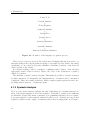
input source code is part of a particular language or not. Figure 4.1 depicts the essential
steps of this process. Furthermore, the resulting data structure, the annotated abstract
syntax tree (AST), serves as a basis for more complex analyses of the input program.
4.1.2 Lexical Analysis
The following definitions are taken from [ASU86]. The lexical analysis aims to divide
a character string (the source code) into a sequence of tokens, which constitute atomic
lexical entities. Tokens which are syntactically of the same kind are grouped into symbol
classes. A scanner is a program for the lexical analysis and is formally defined as follows:
scanner: Σ* → T* where Σ is the alphabet and T is the set of symbol classes.
The scanner is able to ignore tokens of particular symbolic classes, so that they are
not part of the output sequence of tokens. For instance, this is the case for comments
and blanks in many programming languages. There is another special group of tokens,
the keywords. A keyword is an unnamed token, i.e., it does not belong to a specific
symbol class. It is possible that a particular character string can be a keyword and a
member of one or more symbol classes, however, every token is either the member of
exactly one symbol class or it is a keyword. There are widely used principles to resolve
such issues. Often, keywords have higher priority than symbol classes. For instance, the
token “class” is a keyword in Java, consequently, it is not possible to use this token for
the name of a variable, function, or class.
21
4 Foundations
Source Code
|
Lexical Analysis
↓
Token Sequence
|
Syntactic Analysis
↓
Parsing Tree
|
Parsing Action
↓
Abstract Syntaxtree
|
Semantic Analysis
↓
Annotated Abstract Syntaxtree
Figure 4.1: Workflow of the language recognition process
The principle of longest match is also widely used. It implies that the next token of a
character string is the longest prefix belonging to any symbolic class. Hence, the string
“className” is one token in Java (the identifier “className”) instead of the keyword
“class” and the token “Name”.
If a character string could be a member of multiple symbol classes, often, the first
appropriate symbol class is selected. Hence, the order of the declarations of symbol
classes does matter.
The structure of symbol classes is regular. This makes it possible to describe scanners
by finite automata. Consequently, the implementation of scanners can be automated
completely. There are scanner generators, which compile regular expressions and corresponding symbol classes to a scanner program.
4.1.3 Syntactic Analysis
We now focus on the syntactic analysis, the aim of this phase is to identify syntactic entities of the target language from a token sequence. Generally, a scanner is not sufficient
for this kind of task, since many constructs of programming languages are not regular.
A program which does the syntactic analysis is called parser. A parser processes token
sequences (which are the output of scanners) and creates an appropriate model repre-
22
4.1 Theoretical Foundations
senting their grammatical structure. Typically, this model is called syntax tree because
of its tree-like structure [ASU86].
The syntax of most programming languages can be described by context free grammars and implemented by stack machines. Formally, a context free grammar defined as
follows:
Definition 4.1.1. A context free grammar G = (N, T, P, S) consists of:
• A set N of non-terminal symbols
• A set T of terminal symbols where N ∩ T = ∅ (which are basically the symbol
classes of tokens)
• A start symbol S ∈ N
• A set P containing productions (or rules) of the following form:
A → α1 α2 . . . αn
where n ≥ 0, A ∈ N, αi ∈ N ∪ T . We call α1 α2 . . . αn the body of the production.
To create a syntax tree for a specific token sequence, the parser tries to derive it from
a grammar. Starting from the start symbol, the parser subsequently replaces a nonterminal with the body of one of its productions. Depending on the strategy which nonterminal to replace first, we talk about right-most and left-most derivation. Left-most
derivation builds a syntax tree from the root to the leaves, hence it is called top-down
parsing. Whereas right-most derivation builds a syntax tree in the opposite direction,
from the leaves to the root, and is called bottom-up parsing.
In both cases, the root of the syntax tree consists of the start symbol, the leaves consist
of terminal symbols only, inner nodes, and their children correspond to the production
which has been applied. It is possible, that there are more than one syntax tree for one
and the same input. A grammar that allows to build multiple syntax trees for one input
is called ambiguous. Note that this characteristic is generally undesired for programming
languages.
4.1.4 EBNF
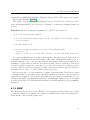
The Extended Backus-Naur Form (EBNF) is a metasyntax notation that can be used
to express context free grammar. It consists of terminal symbol and non-terminal production rules. The following symbols are:
23
4 Foundations
Symbol
=
,
;
|
Meaning
Definition
Concatenation
Termination
Alternative
Symbol
[. . . ]
(. . . )
{. . . }
“..” and ’. . . ’
Meaning
Optional
Grouping
Repetition
Terminal string
4.1.5 Recursive-Descent Parsing
Any context free grammar can be analysed using the popular CYK-algorithm (Cocke,
Younger, Kasami), however, its worst case running time is O(n3 ) [You67]. In general,
this is not sufficient for use in field, where linear methods are wanted. For the sake of
performance, specialized methods and corresponding context free grammars are considered.
In the following, we introduce the concept of recursive-descent parsing, a top-down
parsing strategy. A recursive-descent parser reads a sequence of tokens from left to right
and tries to consume it token by token. It consists of a set of functions where each
function usually implements one of the production rules of the grammar. Functions
related to terminal symbols consume the corresponding token from the input sequence.
A recursive-descent parser accepts a token sequence of an input program, if the token
sequence is completely consumed. Otherwise, the input program is not correct in sense
of syntax defined by the grammar.
Many grammars contain multiple productions which have the same non-terminal on
the left-hand side. In this case the function representing such a non-terminal has to be
able to decide which function to apply. It is desirable that this decision can be made
looking at the next token of the input sequence. This is not always possible, hence,
there are more powerful parsing techniques, like LR-parsing which will not be discussed
in this thesis.
There is a special class of grammars that can be parsed using the recursive-descent
method. Grammars belonging to this class are called LL(k) grammars.
LL(k) Grammar
An LL(k) grammar is a context free grammar having additional characteristics. LL(k)
stands for left-to-right parsing with left-most derivation and k -symbol-lookahead.
During the parsing process, there are often situations in which multiple production
rules can be applied. This is due to the fact, that an arbitrary number of production
rules can have it on the left-hand side. For LL(k) grammars it is possible to decide which
production to apply by looking at the subsequent k token of the input sequence.
Consequently, ambiguous grammars and all grammars that contain left recursion
(which is described in the following section) are no LL(k) grammars. However, most
structures of programming languages can be expressed by an LL(1) grammar [ASU86].
24
4.1 Theoretical Foundations
The good thing is that recursive-descent parsers run in linear time [ASU86].
Formally, LL(k) grammars are defined as follows:
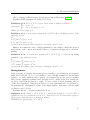
Definition 4.1.2.
Let w ∈ T ∗ be a word. Then startk is defined as follows:
(
w if |w| < k
startk (w) =
u if w = uv where |u| = k
Where |w| is the length of w.
Definition 4.1.3. A context free grammar G = (N, T, P, S) is a LL(k)grammar, if the
following is true:
If
L∗
L∗
S → uAα → uβ1 α →∗ uv
L∗
L∗
S → uAα → uβ2 α →∗ uw
are two left derivations where startk (v) = startk (w), then β1 = β2 .
Further, we restrict the class of LL(k) grammars for the ability to make the decision
independent of the context and, finally, achieve a constructional approach for decisionmaking.
Definition 4.1.4. A context free grammar G = (N, T, P, S) is called strong LL(k)
grammar, if the following is true:
If
L∗
L∗
S → u1 Aα1 → u1 β1 α1 →∗ uv
L∗
L∗
S → u2 Aα2 → u2 β2 α2 →∗ uw
are two left derivations where startk (v) = startk (w), then β1 = β2 .
Parsing Process
In the following, we describe the parsing process formally to get an impression how parser
make their decisions. To do so, we assume to have a LL(k) grammar G and an input
sequence of tokens, which should be parsed. As explained above, the parser consumes
this sequence applying grammar rules and may need to make decisions regarding the
selection of the right production to apply. To have a basis of decision-making, the set
of all token sequences (of length k ) is derived for every right-hand side of a production.
By matching the subsequent k tokens of the input sequence with these sets, the right
production can be chosen.
Formally, this set of tokens is defined as follows:
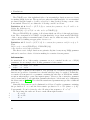
Definition 4.1.5. Let G = (N, T, P, S) be a context-free grammar, α ∈ (N ∪ T )∗ a
right-hand side of a production and k > 0. Then the set of all start token sequences
which can be derived from α is defined as follows:
F IRSTk (α) = {startk (ω)|α →∗ ω ∈ T ∗ }
25
4 Foundations
The F IRSTk -sets of the right-hand sides of non-terminal productions serve as a basis
for making LL(k)-decisions. The special case where the right-hand side of a non-terminal
production has the length < k can be solved by looking at the following context of the
non-terminal. Therefore, we define the “following context” as follows:
Definition 4.1.6. Let G = (N, T, P, S) as context-free grammar, A ∈ N and k > 0.
Define the following set:
F OLLOWk (A) = {ω ∈ T ∗ |S →∗ uAv and ω ∈ F IRSTk (v)}
The set F OLLOWk (A) consists of all tokens which can follow A throughout derivations. The concatenation of F IRSTk of a right-hand side of a production and F OLLOWk
of the corresponding non-terminal symbol can be used to make necessary decision. We
express this by defining an appropriate director set:
Definition 4.1.7. Let G = (N, T, P, S) be a context-free grammar and (A → α) ∈ P .
Then
Dk (A → α) = startk (F IRSTk (α) · F OLLOWk (A))
is the director set for this production.
The director sets of all productions are pairwise disjoint for any strong LL(k) grammar
and can be used as a basis of decision-making for recursive-descent parsers.
Left-recursion
As mentioned above, left-recursive grammars are not contained in the set of LL(k)
grammars. As an example, the following grammar is left-recursive:
1
2
Expr
Expr
→
→
Expr ’+’ Term
Term
The rule Expr contains a left-recursion. The problem for a recursive-descent parser is
that it is not possible to determine how often the rule Expr has to be applied. Technically,
a recursive-descent parser for a grammar containing the rule Expr would fall into infinite
recursion when trying to parse any input sequence. However, any context free grammar
can be transformed to an equivalent grammar that has no left-recursion by eliminating
the left-recursion [ASU86]. Note that the transformed grammar may produce a different
parse tree.
Generally, left-recursion can be eliminated as follows: Consider a grammar containing
the production X → α and the left-recursive production X → Xβ (where α ̸= X).
Consequently, X can be derived to the following token sequences: X → ∗ αβ ∗
We can rewrite the rules as follows to make them right-recursive:
X → αX ′
X ′ → βX ′
X′ →
1
2
3
26
4.1 Theoretical Foundations
Left-factoring
A common problem for LL-parsing is that productions have same prefixes. If the length
of a common prefix of two productions is greater or equal to the lookahead constant
k, the parser is not able to make a decision which of those productions to take (in
corresponding situations). Usually, it is possible to rewrite the production rules to
postpone the decision. This transformation is called left-factoring.
In general left-factoring can be applied as follows: Let A → αβ1 |αβ2 be two productions. We rewrite them as follows:
1
2
A → αA′
A′ → β1 |β2
This transformation allows the parser to make the decision when necessary information
is available.
Backtracking
Backtracking is an approach to extend the decision-making ability of top-down parsers.
The idea of this approach is to test possible alternatives subsequently for their applicability. If an alternative has been tested successfully, the parser make the appropriate
decision. The problem with backtracking is that, in the worst case, it may take time
that is exponential in the input length.
There is also a method to realize backtracking that guarantees linear parsing time, in
return, it has very huge memory consumption [FK02].
LL(*) Parsing
LL(*) is a top-down parsing strategy which focuses on expressiveness rather than on
pure performance. [PF11] introduces the concept as follows:
LL(*) stands for LL(k) parsing with dynamic lookahead k ≥ 1. The key idea is to use
regular-expressions rather than fixed constant or backtracking with a full parser to do
lookahead. This can be done by trying to construct a deterministic finite automaton
(DFA) for each non-terminal in the grammar to distinguish between between alternative
productions. If no suitable DFA for a non-terminal can be found, a backtracking strategy
is used. As a consequence, LL(*) parsers can use arbitrary lookahead and, finally, fail
over to backtracking depending on the complexity of the parsing decision. Although, the
parsers decide on a strategy dynamically according to the input sequence. This means
that just because a decision might have to scan arbitrarily far ahead or backtrack does
not mean that it will at parse-time. In practice, LL(*) parsers only look ahead one or
two tokens ahead on average despite needing to backtrack occasionally.
27
4 Foundations
4.1.6 Parser Generators
The construction of parsing tables is very easy - but quite time-consuming. Hence, it is
a good idea to automate this process. Parser generators use a grammar as input and
yield a parser program as output. Some parser generators allow grammars which are
enriched with syntactic and semantic predicates and embedded actions. At the beginning the parser generator supported LL(1) or LR(1)-languages only due to efficiency.
Further research and more efficient algorithms enabled support for LL(k)- and even
LL(*)-languages (k ≥ 1) in the last few years.
4.1.7 Syntactic and Semantic Predicates
It is possible to improve the recognition strength of an LL-parser using syntactic and
semantic predicates [PQ94]. Basically, predicates are actions that are embedded in the
grammar. Syntactic predicates can be used help the parser to make a particular decision
between productions. They tell the parser to try to parse the predicated production first,
i.e., syntactic predicates introduce local backtracking procedures.
Semantic predicates are more expressive, they allow to execute arbitrary actions to
help the parser to make decisions. They can be used to resolve finite lookahead conflicts
and syntactic ambiguities with semantic information.
4.2 ANTLR - A Parser Generator
ANTLR, Another Tool For Language Recognition, is a parser generator, which can be
used to construct parsers, interpreters and compilers. The underlying parsing strategy
of ANTLR is LL(*) (cf. Section 4.1). The input to ANTLR is a context-free grammar
augmented with syntactic and semantic predicates. Further, ANTLR accepts all but leftrecursive context-free grammars, because it is based on LL(*) parsing [PF11]. ANTLR
is widely used which is underpinned by the analysis of download statistics presented
in [PF11], further, it is mentioned that ANTLR is used by a large number of projects
including Google App Engine, IBM Tivoli Identity Manager, Yahoo! Query Language,
Apple Keynote, Sun/Oracle JavaFX language, and NetBeans IDE.
4.2.1 ANTLR-Works
ANTLR-Works is a graphical development environment for ANTLR grammars. It contains an editor to create and modify ANTLR grammars. As well, it provides an interpreter and a language-diagnostic debugger. Moreover, it detects and visualizes errors in
the grammar, like ambiguities and left-recursive rules.
28
4.3 Eclipse Rich Client Platform
4.3 Eclipse Rich Client Platform
The majority of modern software products that are meant to be used by some human
being are developed with the focus on user experience. That is, the end-user shall be
able to do his/her work quickly. Often, the user interface (UI) is enriched with various
features, like drag and drop, system clipboard, navigation, and customization. That
is why we talk about rich user interfaces. Additionally, such applications have to be
very fast and, therefore, directly run on the client’s machine. As many features are part
of various rich client applications, it is a good idea to implement them once and just
customize them where needed. This way, a lot of development time can be saved. Rich
client platforms (RCP) provide such building blocks to easily create user interfaces.
4.3.1 Eclipse
Eclipse is an open-source based community that builds Java-based tools. The most popular output of this community is the Eclipse Java Integrated Development Environment.
The Eclipse IDE is built on top of a rich client platform, called Eclipse RCP.
4.3.2 Eclipse RCP
[MLA10] gives a good overview of the main characteristics of Eclipse RCP:
Components - Eclipse applications are built by combining individual software components. There is a specification called OSGi which describes a modular approach
for Java applications. It enables a development model where applications are dynamically composed of many different reusable components. The OSGi specification enables
components to hide their implementation from other components while communicating
through services, which are objects that are shared between components. The Eclipse
platform contains Equinox which is one implementation of the OSGi specification and
loads, integrates, and executes Eclipse components, which are called plug-ins.
Native user experience - A native user experience includes a responsive UI that integrates into the desktop. The Eclipse platform supports different user interface toolkits,
such as:
• The Eclipse Standard Widget Toolkit (SWT) provides a graphical user interface
toolkit for java that allows efficient and portable access to the native UI facilities
of the operating system it is implemented on. This technology makes it possible
to create Java-based applications that are indistinguishable from platform’s native
applications.
29
4 Foundations
• JavaFX is designed to provide a lightweight, hardware-accelerated Java UI platform for enterprise business applications. With JavaFX, developers can access
native system capabilities.
Portability - The Eclipse platform can be executed on various desktop operating
systems, such as Windows, Linux, and Max OSX. Eclipse applications can even run on
tablets as well as mobile and embedded devices.
Intelligent install and update mechanism - Eclipse plug-ins are versioned, this
allows running multiple versions of the same plug-in side-by-side. Applications can be
configured to run with the exact version they need. Moreover, the Eclipse platform enables plug-ins to be deployed and updated using various mechanisms: HTTP, Java Web
Start, Update sites, simple file copying or sophisticated enterprise management systems.
Tool support - The Eclipse IDE serves as a first-class Java IDE with integrated
tooling for developing, testing, and packaging rich client applications.
Component libraries - The Eclipse community has produced plug-ins for building
pluggable UIs, managing help content, install and update support, text editing, consoles,
product introductions, graphical editing frameworks, modeling frameworks, reporting,
data manipulation, and much more.
This paper will refer to Eclipse 4.2, which as of this writing is the latest release. Note
that the simultaneous release of Eclipse named Juno (in June 2012) also was based on
Eclipse 4.2.
4.4 Xtext
The Eclipse project Xtext is a framework for developing programming languages or
domain-specific languages (DSLs). Xtext provides a set of domain-specific languages and
APIs to describe the different aspects of a programming language. That information is
used to generate an Eclipse-based development environment providing features known
from the Eclipse Java IDE. Therefore, Xtext generates a parser, a language model used
for abstract syntax trees, a serializer, a code formatter, and a code generator or an
interpreter. These runtime components are combined into a feature-rich Eclipse-based
development environment for the specified language. Depending on the complexity of
the target language, the following default functionality is provided among others:
• Syntax highlighting: the editor supports syntax coloring based on the lexical structure.
• Content Assist: The editor proposes valid code completions at any place in the
document, helping developers with the syntactical details of the language.
30
4.4 Xtext
• Validation and Quick Fixes: Xtext has support for static analysis and validation
of language models. Errors and warnings are displayed in the editor which can be
corrected by custom quick fixes.
For languages where the default functionality is not sufficient, Xtext provides DSLs
and APIs that allow to configure or change the most common things very easily.
As mentioned above, languages can be described by grammars. That is why a grammar
is the main input for Xtext. It can be written in an EBNF like notation, which is enriched
with additional information.
Figure 4.2: Xtext generation process
Figure 4.2 shows how Xtext generates an Eclipse-based IDE from an input grammar.
Xtext creates a custom EMF (Eclipse Modeling Framework ) model for the language.
The Xtext-grammar is translated into an ANTLR-grammar, which is augmented by
semantic actions to build an abstract syntax tree using the generated EMF model. The
language specific default functionality for the resulting IDE is constructed to work with
the EMF model as well. Finally, an Eclipse RCP application is created containing an
editor, which is connected to the generated parser, and integrating all components to
provide the default functionality. This application is (in most cases) a full-functional IDE
for the defined language. As mentioned above, this works for “simple” DSLs, whereas
more complex languages require additional configuration.
It is worth mentioning that Xtext uses ANTLR, but does not support semantic predicates nor allow including code blocks in the grammar. This might be due to the fact
that Xtext makes heavy use of code blocks in the ANTLR grammar to make the parser
build an abstract syntax tree that corresponds to the EMF model.
31
4 Foundations
4.4.1 Generation Workflow
Now we take a look at the generation process of Xtext. The generator uses a special
DSL called MWE2 (the modeling workflow engine1 to configure the generation process.
Basically, the generator executes a set of fragments that are implementations of the interface IGeneratorFragment 2 . Among other methods, the interface specifies the methods
generate and getGuiceBindings, which can be used to generate a component based on
the grammar and integrate it into the resulting IDE. The integration based on bindings
and dependency-injection is described in the following paragraph.
Every Xtext project contains a MWE2 file with a default configuration of the generator. This configuration can be modified by removing or adding fragments. By default
various fragments are integrated into the generation process including the following:
• EcoreGenerator: Generates the EMF model and the corresponding Java API
• XtextAntlrGenerator: Generates the ANTLR parser
• JavaValidator: Creates an empty implementation of a validator and integrates it
into the resulting IDE.
We do not introduce MWE2 in this thesis, but it is worth mentioning that it comes with
an engine to execute workflows. For the workflow of Xtext-projects, this means running
the generation process of the IDE for the specified grammar.
The XtextAntlrGenerator is obviously a very important fragment. It generates the
ANTLR grammar and runs ANTLR to generate the lexer and parser. The errors produced by ANTLR during the generation will be directly outputted on the console. The
reasons for such errors are usually not immediately obvious, especially within complex
grammars. As mentioned in Section 4.2.1, ANTLR Works simplifies the debugging of
grammars. Xtext provides a special fragment that generates a debug version of the
ANTLR grammar. This fragment can simply be added to the generation workflow. The
resulting debug ANTLR grammar does not contain any code blocks, is more readable
than the normal grammar, and, hence, good for debugging purposes.
4.4.2 Customization
One reason for Xtext’s flexibility is that it uses dependency-injection for all components that are integrated into the resulting IDE. Dependency-injection is a software
design pattern that allows a choice of component to be made at run-time rather than
compile time. Xtext employs the lightweight dependency-injection framework Guice 3
1
http://www.eclipse.org/Xtext/documentation.html#MWE2,
last visited December 3, 2012
2
package: org.eclipse.xtext.generator
3
http://code.google.com/p/google-guice/, last visited December 3, 2012
32
4.4 Xtext
(pronounced ’juice’) that is developed by Google. Guice provides the interface Module
that contributes configuration information, typically interface bindings, which will be
used to create an injector. An injector builds the graphs of objects that make up an
application. It tracks the dependencies for each type and uses bindings to inject them.
Every Xtext project contains an implementation of Guice’s Module interface with
the default configurations. It enables users to inject custom implementations for every
feature of the resulting IDE.
4.4.3 The Grammar Language
To get a better understanding how Xtext works, we consider a simple language that has
a Curry-like syntax, named SimpleCurry. It allows the definition of a module header
and its body containing any number of data declarations and function signatures. A
valid input program could look as follows:
1 module MyModule where {
2
data MyDataType = MyDataConstructor;
3
myFunction :: MyDataType -> AnotherDataType;
4 }
Listing 4.1: Sample SimpleCurry-program.
The first step is the definition of a grammar for SimpleCurry. Being the heart of any
Xtext-language specification, the grammar definition is the starting point and the corner
stone of every Xtext project. It is defined using a special grammar language, which
itself is a DSL designed for the description of textual languages. It is based on EBNF
augmented with some extensions to direct the parser and to influence how the AST is
constructed. The basic Xtext-grammar definition for SimpleCurry looks as follows:
1
2
3
4
5
6
7
8
9
10
11
12
13
Module hidden(ANY_OTHER):
’module’ ModuleID ’where’ Body;
Body:
’{’
(BlockDeclaration ’;’)*
’}’;
BlockDeclaration: DataDeclaration
| Signature;
DataDeclaration: ’data’ TypeConstrID ’=’ ConstrDecl;
ConstrDecl:
DataConstrID;
Signature:
FunctionID ’::’ TypeExpr;
TypeExpr:
TypeConstrID (’->’ TypeExpr)?;
// Identifiers consist of any sequence of letters.
ModuleID:
ID;
33
4 Foundations
14
15
16
17
18
TypeConstrID:
ID;
DataConstrID:
ID;
FunctionID:
ID;
terminal ID:
terminal ANY_OTHER:
(’a’..’z’ | ’A’..’Z’)+;
.;
In large parts, the grammar definition is compliant to the EBNF notation. It only
differs by the keywords ’hidden’ and ’terminal’. The ’terminal’ keyword is used to define
token classes for the lexer. In line 18 of Listing 4.1 the class of ’identifiers’ is defined
as all words consisting of one or more letters. In line 19 the ’.’ instructs the lexer to
recognize everything else (non-IDs) as a token of the class named ANY OTHER, so
that, for instance, whitespaces and newlines are members of this token class. Tokens of
the class ANY OTHER are only used by the lexer to separate the identifiers, the parser
is not interested in them. To handle this common case, Xtext provides the concept of
hidden tokens. The ’hidden’ keyword in line 1 of Listing 4.1 defines that all tokens of the
class ANY OTHER are hidden from the parser rules. Consequently, the parser works
effectively on a token sequence from which all hidden tokens have been removed.
4.4.4 Data Model
In this section, we look at the data model that is created for input programs. Xtext
provides a simple way to define and build the data model for custom abstract syntax
trees. All necessary information is embedded in the grammar definition. The following
expressions are supported: assignments, actions, and cross-references.
Assignments
Assignments are used to assign the consumed information to a property of the currently
produced object. The type of the current object is specified by the return type of the
parser rule. If it is not explicitly stated, it is implied that the type’s name equals the
rule’s name. The type of the assigned property is inferred from the right hand side of
the assignment:
1 Module:
’module’ name=ModuleID ’where’ Body;
The syntactic declaration of a module header starts with the keyword ’module’ followed
by an assignment:
1 name=ModuleID
The left-hand side refers to the property ’name’ of the current object (which is a Module).
The right-hand side can be a rule call, a keyword, a cross-reference, or an alternative
comprised by the former. The type of the property needs to be compatible with the type
34
4.4 Xtext
of the expression on the right. As ModuleID is a sequence of letters (i.e., a String), the
property ’name’ needs to be of type String as well. Besides the =-assignment operator,
there are the +=-sign and the ?=-sign that can be used as assignment operators. The
+=-sign indicates that the property on the left is a list and the value on the right will
be added to that list. The ?=-sign expects a property of type boolean and sets it to
true if the right-hand side was consumed independently from the concrete value of the
right hand side.
Actions
The type of the object to be returned by a parser rule is determined from the specified
return type of the rule which may have been inferred from the rule’s name if no explicit
return type is specified. However, Actions allow explicit creation of the return object.
Xtext supports two kinds of actions: Simple actions and assigned actions. A simple
action can be used to explicitly instantiate a particular object. For instance, we could
redefine the rule BlockDeclaration as follows:
1 BlockDeclaration returns Declaration:
2
{DataDeclaration} DataDeclaration
3
| {Signature} Signature;
This will instruct the parser to create a DataDeclaration-object or a Signature-object
depending on the rule alternative that is taken. Both data types have a common super
type called Declarations.
Cross-References
In most programming languages, identifiers are used to refer to particular defined entities. The same goes for Curry as well as SimpleCurry. Consider the code from Listing 4.1,
for instance, the identifier ’MyDataType’ in line 3 is a reference to the DataType ’MyDataType’ defined in line 2. In traditional compiler construction such cross-links are
not established during parsing but in a later linking phase. The same goes for Xtext,
however, the specification of the cross-link information is embedded in the grammar. A
cross-link is defined by square brackets embracing the type of the object to reference
and optionally the class of terminals that is expected as the identifier. To insert the
cross-link within Signatures to DataTypes in SimpleCurry the rule TypeExpr has to be
modified:
1 TypeExpr:
type=[DataDeclaration|TypeConstrID] ..
Additionally, the rule DataDeclaration has to be updated so that the ’name’-property
of DataDeclarations is set appropriately.
35
4 Foundations
1 DataDeclaration:
’data’ name=TypeConstrID ’=’ ConstrDecl;
Now, Xtext automatically establishes the cross-references and produces an error, if for
a particular TypeConstrID within a Signature no target element can be found. For the
sample program from Listing 4.1, this is the case for the identifier ’AnotherDataType’.
So, the definition of cross-links implies semantic validation for references. The complete
Xtext-grammar for SimpleCurry including data model information and the cross-link
looks as follows:
1
2
3
4
5
6
7
8
9
10
11
12
13
14
15
16
17
18
19
20
Module hidden(ANY_OTHER):
’module’ name=ModuleID ’where’ body=Body;
Body:
{Block} ’{’
(declarations+=BlockDeclaration ’;’)*
’}’;
BlockDeclaration: DataDeclaration
| Signature;
DataDeclaration: ’data’ name=TypeConstrID
’=’ constructor=ConstrDecl;
ConstrDecl:
name=DataConstrID;
Signature:
name=FunctionID ’::’ type=TypeExpr;
TypeExpr:
type=[DataDeclaration|TypeConstrID]
(’->’ nextType=TypeExpr)?;
// Identifiers consist of any sequence of letters.
ModuleID:
ID;
TypeConstrID:
ID;
DataConstrID:
ID;
FunctionID:
ID;
terminal ID:
(’a’..’z’ | ’A’..’Z’)+;
terminal ANY_OTHER:
.;
The generated data model for SimpleCurry is presented in Figure 4.3. Figure 4.3a
shows the generated data types for SimpleCurry and their relations. As described,
Xtext takes care of implicit inheritance, hence, Signature and DataDeclaration have the
same super type BlockDeclaration.
Figure 4.3b depicts the AST that is constructed for the input program from Listing 4.1. The green line represents the cross-reference from the TypeExpr within the
Signature of ’myFunction’ to the DataDeclaration ’MyDataType’. On the contrary, the
red line is meant to demonstrate the broken cross-reference for the DataDeclaration ’AnotherDataType’ that does not exist. Indeed, this “AST” is no tree anymore, because the
cross-references create cycles in the undirected graph of objects. However, in the following we will still refer to this kind of data representation as an AST to indicate that we
36
4.4 Xtext
(a) The data model of SimpleCurry generated (b) The “AST” for the sample program from
by Xtext.
Listing 4.1.
Figure 4.3: The data model for SimpleCurry.
37
4 Foundations
mean the output of the parser.
4.4.5 The generated IDE
In this subsection, we give an overview of the parts Xtext generates for the IDE. Basically,
an Xtext project consists of four separate projects. Assuming the project’s name is
“myIDE”, the following individual projects are created:
• myIDE : An Eclipse plug-in that contains grammar definition and all runtime components (lexer, parser, linker, validation, etc. ).
• myIDE.sdk : An Eclipse feature project, a feature is kind of a logical unit that
contains a list of plug-ins. Features are used by the Eclipse update manager.
• myIDE.test: An individual project for Unit tests.
• myIDE.ui : Contains the editor and all the other workbench related functionality.
Besides the src folder, the projects myIDE and myIDE.ui, contain a sub folder called
src-gen. The language specific generated code is saved in this folder. This includes an
ANTLR grammar, the resulting Java parser, and the data model.
38
5 The Curry IDE
The goal of this thesis is to develop an IDE for Curry which satisfies the specification
defined in Chapter 3. For the Curry IDE, it is sufficient to understand Curry to reach our
goal, it does not have to compile nor execute Curry modules. For those tasks, existing
runtime systems can be integrated. If we look at the workflow of compilers described in
Section 4.1.1, we realize that understanding Curry means building a compiler-frontend.
Whereas the compiler-backend makes the language executable, we leave this functionality
to existing runtime systems.
This section describes the development process of the Curry IDE. At first, the reasons
for the usage of the Xtext-framework are listed in Section 5.1. Afterwards, the conceptual
considerations and the implementation is documented step by step. The main part of the
implementation will be the definition of the Xtext-grammar, which is used to generate
the basis for the Curry IDE (see Section 4.4). Therefore, we analyze its suitability for
the Xtext-framework, solve the detected problems, and present a basic Xtext-grammar
in Section 5.2.
The generated IDE can parse Curry modules correctly, i.e., it has the ability to detect
and display syntactical errors as well as create a model representation of the input
program. The model representation is used to validate the input program semantically,
for instance, a typical validation is to check cross-references. Cross-references are links
between elements of the language, for example, a function call is linked to its declaration
using the function name as an identifier. This is quite complex with Curry due to the fact
that the identifiers for different types of elements, like data types and data constructors,
may have the same identifier. Moreover, Curry has local scopes as well as a complex imand export mechanism. Section 5.4 describes how the linking is realized. After we have
made these two important steps, it is possible to modify the generated IDE to satisfy
all requirements defined in Chapter 3. Xtext generates a basic implementation for the
majority of the target features which are well integrated into the IDE. Therefore, these
implementations only have to be modified to match the expected behavior. This finishing
of the generated features is documented in Section 5.5. At the end of this chapter, we
have created a fully-functional IDE for Curry according to the specification of Chapter 3
which is shown on the basis of testing an existing Curry project in Section 5.6.
39
5 The Curry IDE
5.1 Why use Xtext?
One main approach of software engineering is to reuse pieces of software when possible.
For this reason, it is common practice to use frameworks and generators when it comes
to functionality which has to be implemented again and again. This makes the whole development process faster, more maintainable, and less error-prone, i.e., more efficient. A
prime example is a parser generator, which provides a fully-functional parser by defining
the grammar of the target language instead of programming it from scratch.
The same goes for the standard functionality of graphical user interfaces as well as
the common features of IDEs. As described in Section 4.4, Xtext combines a parser
generator and the Eclipse RCP technology to provide a working IDE for a specific language. Furthermore, Xtext is an official Eclipse project which has been awarded as
the most innovative Eclipse project 20101 . Ever since, it has become more and more
popular and matured under active development. The framework promises very high productivity, since it generates an IDE with all the features working out-of-the-box by only
declaring an Xtext-grammar. However, Xtext is intended to be used for domain specific
languages, which are generally not as complex as a general purpose language like Curry.
It is not sufficient to translate the Curry grammar from the Curry report [Han12] to an
Xtext-grammar and expect the framework magic to generate the IDE we aim at. As
we will see in Section 5.2.2, semantic predicates would simplify the parser construction
for Curry, but Xtext supports only syntactic predicates. However, Xtext is very flexible
and allows a lot of modifications to satisfy our requirements. Overall, the usage of the
Xtext-framework promises to have a lot of benefits including very high productivity.
5.2 The Grammar
The grammar definition is the heart of the whole development process. It serves as the
basis for Xtext to generate the stub of the IDE. It is used to generate a parser and a
corresponding data model for Curry. At runtime, the parser reads the input program
and creates a model representation for it, which is basically a kind of annotated syntax
tree2 . All features we aim at can be realized by working with this model representation
of the input program. At first, the Xtext grammar for Curry is defined. As Curry is a
powerful general purpose language containing a lot of syntactic sugar 3 , this task is quite
complex.
1
http://www.eclipse.org/org/press-release/20100322_awardswinners.php,
last visited August 29, 2012
2
We will see that Xtext generates a syntax graph instead of a syntax tree, because it contains cycles
due to cross-references.
3
syntax that is designed to make things easier to read or to express
40
5.2 The Grammar
At the end of this section, we present an Xtext-grammar which can be used to generate an IDE that parses Curry modules correctly, this is, it detects syntactical errors.
However, semantic errors are not detected. This kind of validation is the topic of Section 5.4.
5.2.1 Lexicon
A lexicon is a set of words that serves as the basis for any syntax. The syntax defines
valid combinations of words from the lexicon by grammar rules. Before we start to
develop the grammar for Curry, we have to define the lexicon:
Curry’s lexicon is defined as follows [Han12]:
• Every word beginning with a letter followed by any number of letters, digits, underscores, and single quotes, these words are called identifiers (ID)
• Any string of characters from the string “˜!@#$%ˆ&*+-=<>?./|\:“, we call these
words infix operators 4
• Any word from (ID) enclosed in ’...’ like ’mod’ is also called infix operator
• The strings “(“, “)”, “[“, “]”, “@”, “{“, “}”, “;”, “{-” and “-}”, newlines, and whitespaces
(blanks and tabs)
• Strings, characters, numbers, and floats like ”abc”, ’a’, 36, and 3.14159.
Moreover, the case of words matters, so that abc and Abc are two unequal identifiers.
Curry supports four case modes which define different constraints on the case of particular identifiers. The modes are prolog mode, gödel mode, haskell mode, and free mode.
We implement the haskell mode, later it may be possible to weaken the constraints
towards free mode. This seems to be a good approach, because the constraints prohibit
ambiguities and, hence, facilitate the parsing.
As the name suggests, the haskell mode corresponds to the definitions for the lanuguage
Haskell. The Haskell Report 2010 [Mar] defines the identifiers as follows:
There are six kinds of names in Haskell: those for variables and constructors denote
values; those for type variables, type constructors, and type classes refer to entities related to the type system; and module names refer to modules. There are two constraints
on naming:
Names for variables and type variables are identifiers beginning with lowercase letters
or underscore; the other four kinds of names are identifiers beginning with uppercase
letters.
4
There are some exceptions which are mentioned later.
41
5 The Curry IDE
5.2.2 Basic Xtext Grammar
We start to develop the Curry IDE by defining a basic grammar that serves as a valid
input for Xtext and sticks close to the grammar presented in [Han12, pp.67-71]. Afterwards, it is enhanced gradually with further validation and features. In the following,
we will refer to the grammar defined in [Han12, pp.67-71] by the name CRG (Curry
Report Grammar). The notation of Xtext grammars is really similar to EBNF, hence,
the translation of CRG to a corresponding Xtext grammar is not that difficult. The
CRG does not include the following non-terminal symbols defining classes of identifiers:
ModuleID, TypeConstrID, DataConstrID, TypeVarID, InfixOpID, FunctionID, and VariableID.
All of these classes except InfixOpID consist of an initial letter, followed by any number
of letters, digits, underscores, and single quotes. To satisfy the haskell case mode, we
introduce one terminal class for each identifier type:
1 terminal ID_UPPER:
2
’A’..’Z’ (’a’..’z’|’A’..’Z’|’_’|’0’..’9’|’\’’)*;
3 terminal ID_LOWER:
4
(’a’..’z’) (’a’..’z’|’A’..’Z’|’_’|’0’..’9’|’\’’)*;
Consequently, the rules for the identifier classes look as follows:
1
2
3
4
5
6
ModuleID: ((ID_UPPER | ID_LOWER) ’.’)* ID_UPPER
TypeConstrID:
ID_UPPER
DataConstrID:
ID_UPPER
TypeVarID: ID_LOWER
FunctionID: ID_LOWER
VariableID: ID_LOWER
In [Han12], the infix operators are described as any string of characters from the string
“˜!@#$%ˆ&*+-=<>?./|\:” or another identifier enclosed in ‘..‘ like ‘mod‘:
1 terminal INFIX_OP_ID: (’~’|’!’|’@’|’#’|’$’|’%’|’^’|’&’|’*’
2
|’+’|’-’|’=’|’<’|’>’|’?’|’.’|’/’|’|’|’\’ | ’:’)+
3
| | ’‘’ (ID_LOWER | ID_UPPER) ’‘’
The following tokens are defined to recognize whitespaces and newlines:
1 terminal WS: ’ ’ | ’\t’
2 terminal NL: ( ’\r’ | ’\n’ )+
Curry supports single-line as well as multiple-line comments. Single-line comments
start with ’−−’ and end by the end of the line. Multiple-line comments are embraced
by ’{-’ and ’-}’. The corresponding rule definition looks as follows:
42
5.2 The Grammar
1 terminal COMMENTS:
2
| ’{-’->’-}’;
’--’ !(’\r’ | ’\n’)*
Values like ’a’ or ’0’ belong to the terminal class CHAR. Special characters can
be denoted with a leading backslash, e.g., ’\n’. Moreover, characters can be written
as decimal or hexadecimal value, e.g., ’\010’ (decimal) or ’\xA4’ (hexadecimal). For
strings, we define the terminal class STRING which consists of inputs like “Hello”, note
that, strings may contain escaped characters as well.
For numbers, like 5 and 555 the terminal class NATURAL is defined. Floating point
numbers, like 3.14159 or 5.0e-4, belong to the terminal class FLOAT.
We group these terminal classes by the rule Literals:
1
2
3
4
5
6
7
8
9
10
11
12
13
14
15
16
17
18
19
20
21
terminal CHAR:
"’’’"
| "’" !("’"|’\\’) "’"
| "’" ’\\’ (’b’|’t’|’n’|’f’|’r’|’u’|"\\"|’"’|"’") "’"
| "’" ’\\’ (’0’..’9’)(’0’..’9’)(’0’..’9’) "’"
| "’" ’\\’ ’x’ (’a’..’f’|’A’..’F’|’0’..’9’)
(’a’..’f’|’A’..’F’|’0’..’9’)
"’";
terminal STRING:
’"’ (’\\’ (’b’|’t’|’n’|’f’|’r’|’u’|’"’|"’"|’\\’)
| ’\\’ (’0’..’9’) (’0’..’9’) (’0’..’9’)
| ’\\’ ’x’ (’a’..’f’|’A’..’F’|’0’..’9’)
(’a’..’f’|’A’..’F’|’0’..’9’)
| !(’\\’ | ’"’))*
’"’;
terminal NATURAL:
(’0’..’9’)+;
terminal FLOAT:
NATURAL ’.’ NATURAL (’e’ ’-’? NATURAL)?;
Literal:
STRING | CHAR | NATURAL | FLOAT;
The entry rule of the grammar is called Module. We specify the list of terminal symbols
we are not interested in by declaring them as hidden. This means that they can occur
everywhere in the input. If any grammar rule that is applied directly or indirectly by
the entry rule needs to see one of them, it can rewrite the list of hidden terminals.
1 Module hidden(WS, NL, COMMENTS, ANY_OTHER):
2
’module’ ModuleID (Exports)? ’where’ Block
43
5 The Curry IDE
Like the CRG, this basic grammar does not support the full layout capabilities that
Curry provides. The brackets ’{’ and ’}’ are used to structure code blocks and the
semicolon ’;’ is used to mark the end of a line within a code block. The remaining
grammar rules are defined as follows:
44
5.2 The Grammar
1
2
3
4
5
6
7
8
9
10
11
12
13
14
15
16
17
18
19
20
21
22
23
24
25
26
27
28
29
30
31
32
33
34
35
36
37
38
39
40
Exports
Export:
|
|
|
Block:
: ’(’ Export? (’,’ Export)* ’)’;
QFunctionName
QTypeConstrID
QTypeConstrID ’(..)’
’module’ ModuleID;
’{’
( ImportDecl ’;’)*
( FixityDeclaration ’;’)*
(BlockDeclaration ’;’)*
’}’;
ImportDecl:
’import’ (’qualified’)? ModuleID
(’as’ ModuleID)? (ImportRestr)?;
ImportRestr: ’(’ Import ( ’,’ Import)* ’)’
| ’hiding’ ’(’ Import ( ’,’ Import )* ’)’;
Import:
FunctionName
| TypeConstrID
| TypeConstrID ’(..)’;
BlockDeclaration:
TypeSynonymDecl
| DataDeclaration
| FunctionDeclaration;
TypeSynonymDecl: ’type’ SimpleType ’=’ TypeExpr;
SimpleType:
TypeConstrID TypeVarID*;
DataDeclaration: ’data’ SimpleType ’=’ ConstrDecl
(’|’ ConstrDecl)*;
ConstrDecl:
DataConstrID SimpleTypeExpr*;
TypeExpr:
SimpleTypeExpr (’->’ TypeExpr)?;
SimpleTypeExpr: QTypeConstrID SimpleTypeExpr*
| TypeVarID
| ’_’
| ’(’’)’
| ’(’ TypeExpr (’,’ TypeExpr)* ’)’
| ’[’ TypeExpr ’]’
| ’(’ TypeExpr ’)’;
FixityDeclaration:
FixityKeyword Natural INFIX_OP_ID ( ’,’ INFIX_OP_ID)*;
FixityKeyword:
’infixl’ | ’infixr’ | ’infix’;
Natural:
DIGIT | DIGIT Natural;
45
5 The Curry IDE
41
42
43
44
45
46
47
48
49
50
51
52
53
54
55
56
57
58
59
60
61
62
63
64
65
66
67
68
69
70
71
72
73
74
75
76
77
78
79
80
FunctionDeclaration: Signature | Equat;
Signature:
FunctionNames ’::’ TypeExpr;
FunctionNames:
FunctionName (’,’ FunctionName)*;
FunctionName:
’(’ INFIX_OP_ID ’)’ | FunctionID;
Equat:
FunLHS ’=’ Expr ( ’where’ LocalDefs)?
| FunLHS CondExprs (’where’ LocalDefs)?;
FunLHS:
FunctionName SimplePat*
| SimplePat INFIX_OP_ID SimplePat;
Pattern: QDataConstrID SimplePat SimplePat* (’:’ Pattern)?
| SimplePat (’:’ Pattern)?;
SimplePat: VariableID
| ’_’
| QDataConstrID
| LITERAL
| ’(’ ’)’
| ’(’ Pattern ’,’ Pattern (’,’ Pattern)* ’)’
| ’(’ Pattern ’)’
| ’[’ (Pattern (’,’ Pattern)*)? ’]’
| VariableID ’@’ SimplePat;
LocalDefs:
’{’
ValueDeclaration ( ’;’ ValueDeclaration )*
’}’;
ValueDeclaration: FunctionDeclaration
| PatternDeclaration
| VariableID (’,’ VariableID)* ’free’;
PatternDeclaration:
Pattern ’=’ Expr CondExprs?;
CondExprs:
’|’ Expr ’=’ Expr CondExprs?;
Expr: ’\\’ SimplePat SimplePat* ’->’ Expr
| ’let’ LocalDefs ’in’ Expr
| ’if’ Expr ’then’ Expr ’else’ Expr
| ’case’ Expr ’of’ ’{’ (Alt (’;’ Alt)*)? ’}’
| ’fcase’ Expr ’of’ ’{’ (Alt (’;’ Alt)*)? ’}’
| ’do’ ’{’ (Stmt ’;’)* Expr ’}’
| Expr QInfixOpID Expr
| ’-’ Expr
| FunctExpr;
FunctExpr:
BasicExpr (BasicExpr)*;
BasicExpr: QVariableID
| ’_’
46
5.2 The Grammar
81
82
83
84
85
86
87
88
89
90
91
92
93
94
95
96
97
98
99
100
101
102
103
104
105
106
107
108
109
|
|
|
|
|
|
|
|
|
|
|
|
QDataConstrID
QFunctionID
’(’ QInfixOpID ’)’
(LITERAL | Natural)
’(’ ’)’
’(’ Expr ’)’
’(’ Expr (’,’ Expr)* ’)’
’[’ (Expr (’,’ Expr)*)? ’]’
’[’ Expr (’,’ Expr)? ’..’ Expr? ’]’
’[’ Expr ’|’ Qual (’,’ Qual)* ’]’
’(’ Expr QInfixOpID Expr’)’
’(’ QInfixOpID Expr’)’;
Alt:
GdAlts:
Qual:
Stmt:
Pattern ’->’ Expr (’where’ LocalDefs)?
| Pattern GdAlts (’where’ LocalDefs)?;
’|’ Expr ’->’ Expr GdAlts?;
Expr
| ’let’ LocalDefs
| Pattern ’<-’ Expr;
Expr
| ’let’ LocalDefs
| Pattern ’<-’ Expr;
QVariableID:
QFunctionName:
QFunctionID:
QTypeConstrID:
QDataConstrID:
QInfixOpID:
( ModuleID ’.’)? VariableID;
’(’ INFIX_OP_ID ’)’ | QFunctionID;
( ModuleID ’.’)? FunctionID;
( ModuleID ’.’)? TypeConstrID;
( ModuleID ’.’)? DataConstrID;
(ModuleID ’.’)* INFIX_OP_ID;
Listing 5.1: The remaining rule definitions of the Xtext-grammar.
47
5 The Curry IDE
This grammar is a mindless translation from the CRG to an Xtext grammar. As
mentioned in Chapter 4, Xtext and ANTLR, support LL(*)-languages only, that is
why left-recursive grammars are not supported. However, the grammar rules Expr and
FunctExpr are left-recursive and have to be modified as described in Section 4.1. This
operation can also be performed automatically with ANTLR Works (note that this
modification has to be copied to the Xtext grammar manually). The resulting modified
grammar rules look as follows:
1 Expr: (’\\’ SimplePat SimplePat* ’->’ Expr
2
| ’let’ LocalDefs ’in’ Expr
3
| ’if’ Expr ’then’ Expr ’else’ Expr
4
| ’case’ Expr ’of’ ’{’ (Alt (’;’ Alt)*)? ’}’
5
| ’fcase’ Expr ’of’ ’{’ (Alt (’;’ Alt)*)? ’}’
6
| ’do’ ’{’ (Stmt ’;’)* Expr ’}’
7
| ’-’ Expr
8
| FunctExpr)
9
(QInfixOpID Expr)?;
10 FunctExpr:
BasicExpr (BasicExpr)*;
Listing 5.2: Modified rules Expr and FunctExpr
After this modification, the Xtext editor does not display any errors for this grammar.
However, there are some issues that are reported when running the Xtext generation
process. As mentioned in Section 4.4, some grammar errors are outputted to the console.
Those errors are the redirected output of the ANTLR generation process and can be
debugged using ANTLR Works (cf. Section 4.2.1).
5.2.3 Resolving Grammar Issues
Many grammar errors can be solved by using backtracking. However, this will only
suppress various errors and the grammar might still be ambiguous. As a result, the
parse tree is not created as expected. Additionally, backtracking is really expensive
(see 4.1). Instead of using it, we try to resolve the errors by grammar modifications.
Identifiers
Consideration of ANTLR Works for the debug version of the grammar shows an issue
according to the rule ModuleID. We use ANTLR Works to visualize the problem. Figure
5.1 shows the syntax diagram for the related rules.
The green and red arrows represent two different alternatives which can be used to
parse one and the same input, e.g., the token sequence [ID UPPER, ’.’]. It can be either
48
5.2 The Grammar
Figure 5.1: Inputs such as the token sequence [ID UPPER, ’.’] can be matched using
multiple alternatives. Diagram generated by ANTLR Works.
the qualifying prefix of a ModuleID or the qualifying prefix of a QVariableID consisting
of an unqualified ModuleID followed by a dot. Moreover, the dot can also be an infix
operator. Consider the following example:
1
2
3
4
5
6
data Bool = True | False; -- Defined in module ’Prelude’
(.)
:: Bool -> Bool -> Bool
{- ... -}
f = True . False
-- This dot is an infix operator
f = Prelude.True
-- This dot is part of a qualifier
f = Prelude.True . Prelude.False -- Mixed meaning
Listing 5.3: The different meanings of a dot in Curry.
The Curry code snippet in Listing 5.3 illustrates the different meanings of the dot.
Line 4 shows an infix expression, whereas the expression in line 5 is a qualified data
constructor. The expression in line 6 mixes the different meanings consisting of an infix
expression with two qualified arguments. To distinguish these cases, no characters (e.g.,
spaces) are allowed between the dot and the names of modules and entities in qualified
identifiers. On the other hand, if the infix operator of an infix expression starts with
a dot, there must be at least one space or similar character behind the left expression
[Han12]. Therefore, the lexer can make the decision which meaning a dot has. This is
implemented by introducing a new class of terminal symbols called QUALIFIER. The
rules for qualified identifiers are modified appropriately:
1
2
3
4
5
6
7
terminal DOT:
’.’;
terminal QUALIFIER: (ID_UPPER | ID_LOWER) ’.’;
ModuleID:
QVariableID:
QFunctionName:
QFunctionID:
QUALIFIER* ID_UPPER;
QUALIFIER* VariableID;
’(’ INFIX_OP_ID ’)’ | QFunctionID;
QUALIFIER* FunctionID;
49
5 The Curry IDE
8 QTypeConstrID:
9 QDataConstrID:
QUALIFIER* TypeConstrID;
QUALIFIER* DataConstrID;
Note that the rules Import and Export are affected as well, because they contain
the anonymous terminal ’(..)’. It is not enough to simply update this rule to ’(’ DOT
DOT ’)’. The token sequence ’DOT DOT ’ will be recognized as an infix operator. To
resolve this issue, we have to introduce a separate terminal DOT DOT, which is of higher
priority than DOT. Consequently, inputs like ’..’ are recognized as DOT DOT. Now we
can update the rules Import and Export to use the DOT DOT :
1
2
3
4
5
6
7
terminal DOT_DOT: ’..’;
terminal DOT: ’.’;
Import: ...
| TypeConstrID ’(’DOT_DOT’)’;
Export: ...
| QTypeConstrID ’(’ DOT_DOT ’)’;
Though this fixes the dot-problem, there are still some remaining issues with identifiers
of infix operators. Some symbols like ’-’, ’:’, ’::’, ’@’, ’->’, and ’−−’ are either unnamed
terminals (since they are used in rule definitions) or terminals of the class of infix operator
identifiers. The same applies to the token ’as’, which is used as an unnamed terminal
in the rule ImportDecl even though it is no keyword. The lexer will recognize those
symbols as unnamed terminals due to priority setting and, consequently, the according
identifiers will never appear in any token sequence.
This is desirable for the following tokens: ’−−’ (introduces comments), ’\’(used in
lambda expressions), ’::’ (used in signatures), ’->’ (used in lambda expressions and type
expressions), ’=’ (used in equations), ’@’ (used in patterns), ’|’ (used in conditional
expressions), and ’:’ (used as list constructor).
On the other hand, we want to allow the tokens ’as’ and ’-’ to be used as identifiers
as well. To resolve this issue, we have to introduce separate terminals for the dash and
the ’as’ and refer to them whenever necessary. The modifications look as follows:
1 terminal DASH:
2 terminal AS_KEYWORD:
’-’;
’as’;
The rules Expr and ImportDecl have to be updated replacing unnamed tokens (’-’ or
’as’) with the terminal class AS KEYWORD.
Single line comments are another special case, for instance, we want inputs like ’− −
−\n’ or ’− − −−\n’ to be recognized as comments. However, the lexer recognizes the
’− − −’ as an infix operator identifier, because it follows the principle of longest match
(cf. Section 4.1.2).
50
5.2 The Grammar
Consequently, we prohibit specifically infix operators with the prefix ’−−’. To do so,
we introduce a helper class called INFIX OP HELPER and modify the definition of the
terminal class INFIX OP ID as follows:
1 terminal INFIX_OP_HELPER:
2
’~’|’!’|’@’|’#’|’$’|’%’|’^’|’&’|’*’
3
|’+’|’=’|’<’|’>’|’?’|’:’|’/’|’|’|’\\’;
4 terminal INFIX_OP_ID:
5
DASH? (INFIX_HELPER|DOT) (INFIX_HELPER | DASH | DOT )*
6
| ’‘’ (ID_LOWER | ID_UPPER) ’‘’;
Moreover, inheritance is not available for terminal symbols, so that the dash, the dot,
and members of the class INFIX OP HELPER cannot be an infix operator identifier
anymore. We need to introduce another rule to take these special cases into account,
named InfixOpIDWithSpecialCases.
1 InfixOpIDWithSpecialCases:
2
INFIX_OP_ID
3
| INFIX_OP_HELPER
4
| DOT
5
| DASH;
All rules that directly refer to INFIX OP ID have to be updated to refer to InfixOpIDWithSpecialCases instead.
To make the token ’as’ available as an identifier, all rules that refer to LOWER ID
need to allow the AS KEYWORD as well.
Identifiers cause another issue in the rule BasixExpr (Basic Expression). The rule
definition uses identifiers to distinguish between variables, data constructors, and functions. The problem here is that the rules QFuntionName and QVariableID are defined
identically. The only way to distinguish between these alternatives was by using semantic or syntactic predicates. We only consider using syntactic predicates, as Xtext
does not support semantic predicates. However, attributing these alternatives with syntactic predicates would cause one rule to be prioritized, which means one alternative
would always be chosen and the other always omitted. To avoid this, the two rules can
be merged. The correct semantic distinction will be made afterwards during the linking
and validation phase. We implement this by introducing a new rule called QFunctionOrVariableID:
1 QFunctionOrVariableID: QUALIFIER* (ID_LOWER | AS_KEYWORD);
2
3 BasicExpr: QFunctionOrVariableID
4
| ’_’
5
| QDataConstrID
51
5 The Curry IDE
6
7
8
| ’(’ QInfixOpID ’)’
| LITERAL
...
Now the case of the identifier (i.e., the corresponding terminal classes) helps the parser to
choose the correct alternative, since identifiers of data constructors start with an upper
case letter.
Rule Simplifications
Some of the existing errors occur because some rule definitions consist of alternatives
that are partially identical and can be improved to be more compact. This is due to
the fact that the grammar uses particular rule alternatives to describe their meaning.
For instance, consider the rule Equat (Equation), see line 45 in Listing 5.1. The rule
consists of two alternatives which start with the same rule, namely FunLHS (Function
Left Hand Side). The rule can easily be rewritten so that the parser has to make a
choice after the FunLHS rule has been applied. This avoids the need to look ahead and
does not affect the set of recognized inputs. Additionally, the last optional part (local
definitions) is identical in both alternatives and, hence, can be merged. The simplified
rule can be defined as follows:
1 Equat:
FunLHS (’=’ Expr | CondExprs) (’where’ LocalDefs)?;
A similar case is the rule Alt (Alternative) as defined in Listing 5.1, line 93. Similar
to the first definition of FunLHS, it is defined by two rule alternatives that are identical
by a large part. It can be written more compact by merging the alternatives wherever
possible. They only differ by an optional part, hence, the rule definition can be simplified
as follows:
1 Alt:
Pattern GdAlts? ’->’ Expr (’where’ LocalDefs)?;
We now look at the rules SimpleTypeExpr (Simple Type Expression, Listing 5.1, line
30, SimplePat (Simple Pattern, Listing 5.1, line 51), and BasicExpr (Basic Expression,
Listing 5.1, line 79). These rule definitions include many alternatives for particular
parenthesized terms. However, all of those alternatives start with a left parenthesis and
end with a right parenthesis (or bracket). We can reduce the number of rule alternatives
significantly, in return, the definitions become more complex and may be confusing:
1 SimpleTypeExpr: QTypeConstrID SimpleTypeExpr*
2
| TypeVarID
3
| ’_’
4
| ’(’ (TypeExpr (’,’ TypeExpr)*)? ’)’
5
| ’[’ TypeExpr ’]’;
52
5.2 The Grammar
6
7 SimplePat: VariableID
8
| ’_’
9
| QDataConstrID
10
| LITERAL
11
| ’(’(Pattern (’,’ Pattern)*)? ’)’
12
| ’[’ (Pattern (’,’ Pattern)*)? ’]’
13
| VariableID ’@’ SimplePat;
14
15 BasicExpr: QFunctionOrVariableID
16
| ’_’
17
| QDataConstrID
18
| ’(’ QInfixOpID ’)’
19
| LITERAL
20
| ’(’ ((Expr ((’,’ Expr)+ | QInfixOpID Expr?)?)
21
| QInfixOpID Expr)? ’)’
22
| ’[’ (Expr (’|’ Qual (’,’ Qual)*
23
| (=>’,’ Expr)? (’..’ Expr? | (’,’ Expr)*)))?
24
’]’;
Listing 5.4: Compact definition of the rules SimpleTypeExpr, SimplePat, and BasicExpr.
If we take a close look at the last alternative of BasicExpr in Listing 5.4, line 15, we
notice a syntactic predicate (’=>’) in line 23. Consider the following situation: The
parser has recognized a left bracket and an Expr so far and the following token is a
comma. The parser cannot decide which path to take. The syntactic predicate leads
the parser to apply the optional part “(’,’ Expr)?”, whenever possible. Afterwards, the
remaining decision can be made by the next token: ’..’, ’,’, or any other token.
Infix Expressions
The next crucial issue is caused by infix expressions. The rule definition Expr (Expression) contains some rule alternatives that end with recursive calls to itself. Additionally,
every Expr may be an infix expression. This causes the definition to be ambiguous.
Consider the following sample Curry code:
1 specialAdd a b = if a>0 then a else a + b
The current grammar definition allows multiple ways to parse this input. The relevant
parts of the resulting syntax trees are depicted in Figure 5.2. The red lines mark the
particular decision leading to the corresponding syntax tree.
53
5 The Curry IDE
Figure 5.2: The ambiguous grammar definition allows creating multiple syntax trees
for the same input.
The difficulty here is to decide which Expr is the left expression of the infix expression.
It can be either the variable ’a’ within the else-expression (left syntax tree in Figure 5.2)
or a completed if-expression (right syntax tree in Figure 5.2). In Curry, the innermost
expression has the highest associativity. In this case, the infix expression constitutes the
else-expression, so the left syntax tree of Figure 5.2 represents the desired parsing result.
Other results can be reached by the explicit use of brackets. Inserting an appropriate
syntactic predicate is the method of choice to resolve this issue. This way the parser is
lead to associate the infix operator with the innermost expression:
1 Expr: ...
2
(=> QInfixOpID Expr)?;
However, the definition of infix expressions is still ambiguous, because the associativities
assigned to each infix operator as described in Chapter 2 are not taken into account.
These associativities are not available until runtime (of the parser). To take them into
account, semantic predicates are necessary – but, as pointed out before, they are not
available in Xtext. In fact, it is not necessary for the Curry IDE to parse such infix
expressions correctly. It is sufficient to build a flat list of infix expressions and correct
the structure of the syntax tree later, if necessary.
Moreover, the rule Expr leads to an exponential runtime since it uses backtracking
for deep nested infix operation expressions. This yields in a very bad user experience.
54
5.2 The Grammar
Parsing time for one expression, like the concatenation of 15 strings, can take up to more
than one minute on a modern computer. Note that this is not meant to have any general
validity, but it underlines that the exponential runtime is not acceptable for a good user
experience. The reason for this problem is the need for backtracking when a sequence
of infix operation expressions is parsed: every time an expression is followed by an infix
operator, a new backtracking procedure is started. This is, the remaining part of the
whole expression is parsed two times: at first, the parser tries to parse the optional
infix operation part in backtracking-mode, and if the backtracking has been successful,
it applies the optional infix operation part, so that the remaining part of the expression
is parsed again in non-backtracking mode. This is done for every infix operator so that
the second infix operator starts this procedure two times: the first time in backtrackingmode and again in non-backtracking mode of the backtracking procedure of the first
infix operator. Consequently, the remainder of the whole expression is parsed 4 times.
Considering the example of a concatenation of 15 strings, the right-hand side of the
last infix operation is parsed 214 = 16384 times. On the one hand, we need backtracking
to parse the input, on the other hand we have to prohibit that such an exponential
backtracking procedure is started. Therefore, we distinguish between expressions that
may be the left-hand side of an infix operation and expressions which may be not. The
idea is to let the first expression collect all following infix operations and prohibit the
other expressions involved to be left-hand sides of an infix operation. Therefore, we split
up the rule Expr and introduce the rule ExprHelper as follows:
1 Expr:
2
ExprHelper (=> QInfixOpID ExprHelper)*;
3
4 ExprHelper:
5
’\\’ SimplePat+ ’->’ Expr
6
| ’let’ LocalDefs ’in’ Expr
7
| ’if’ Expr ’then’ Expr ’else’ Expr
8
| ’case’ Expr ’of’ ’{’ (Alt (’;’ Alt)*)? ’}’
9
| ’fcase’ Expr ’of’ ’{’ (Alt (’;’ Alt)*)? ’}’
10
| ’do’ ’{’ (=> Stmt ’;’)* Expr ’}’
11
| DASH Expr
12
| FunctExpr;
As before, this will start one backtracking procedure per infix operator, however, those
are not nested anymore and, hence, will not yield in exponential runtime.
Infix Constructors
In opposite to Haskell, on which Curry’s syntax is based on, there are no infix constructors in Curry (cf. [Han12]). However, they will be available in the future. Currently, the
55
5 The Curry IDE
list constructor ’:’ constitutes the only exception, because it is already integrated into
the language. Therefore, we will simply add it to the rules Expr and BasicExpr and do
not care about the different meaning of infix operators and the constructor, since they
are used in the same way:
1 Expr: ...
2
ExprHelper ((=> QInfixOpID | ’:’) ExprHelper)*;
3 BasicExpr: ...
4
| ’(’ (QInfixOpID | ’:’) ’)’
5
...
6
| ’(’ ((Expr ((’,’ Expr)+ | (QInfixOpID| ’:’) Expr?)?)
7
| (QInfixOpID| ’:’) Expr)? ’)’
8
...
Built-in Types
Curry provides some built-in types that are defined in the standard prelude. The Curry
Report [Han12, Ch. 9] describes important operations for those types. Again, we are
only interested in the effects on the syntax. Some of them are already taken into account:
integer values, like “31”, are considered as constructors (constants) of type Int. The same
goes for values, like “3.14159”, which are considered as constructors of type Float. To
integrate these types, we have to allow the definition of data types without constructors
by rewriting the rule DataDeclaration:
1 DataDeclaration:
2
’data’ SimpleType (’=’ ConstrDecl (’|’ ConstrDecl)*)?;
External Functions
Curry also has a small number of built-in functions that are programmed in other programming languages. Therefore, Curry provides a simple interface (described in [Han12])
to connect those functions. Without going into detail here, we can integrate external
functions into the rule Equat by using the keyword ’external’:
1 Equat: ...
2
| FunctionID ’external’
3
| ’(’ INFIX_OP_ID ’)’ ’external’;
Resolve Remaining Issues
The remaining errors are mostly non-LL(*) decision problems caused by recursive rule
invocations. These kind of problems can be resolved by insertion of appropriate syntactic
56
5.2 The Grammar
predicates. Again, we take a close look at the rule Expr. The definition of do-expressions
in Listing 5.4 in line 6 is such a case. The rule Stmt (Statement), defined in Listing 5.1
in line 100, can be deduced to Expr, which is the last part in curly braces within the
do-expression as well. When the parser has processed a token sequence such as [’do’,
’{’] and any number of statements followed by a semicolon, and the next incoming token
initiates an Expr, the parser can not decide if it is a statement or the actual expression.
By insertion of a syntactic predicate, the parser can be instructed to try to parse the
Expr as a Stmt. If this does not work, it can be seen as the trailing expression:
1 Expr: ...
2
| ’do’ ’{’ (=>Stmt ’;’)* Expr ’}’
A very similar issue can be found in the rule definition of SimpleTypeExpr. The first rule
alternative, defined in Listing 5.4 in line 1, contains a self-recursion. Again, we have to
instruct the parser which path to take using a syntactic predicate:
1 SimpleTypeExpr: QTypeConstrID =>SimpleTypeExpr*
2
...
Looking at the rules Qual (Qualifier within list comprehensions, defined in Listing 5.1
in line 97) and Stmt (Statement, defined in Listing 5.1 in line 100), we notice that their
definitions are identical. The rules could be merged. However, since this duplication does
not cause any problems, we will keep both definitions for the sake of clarity. Though, the
definitions have to be modified, because there are problems associated with the decision
which rule alternative to take. The first alternative consists of a rule call of Expr, which
contains the definition of let-expressions. The second alternative defines a let-statement,
that is in a sense an abbreviated version of the let-expression. Thus, when processing a
’let’-token it is not possible to distinguish between a let-expression and a let-statement.
As in the previous cases, we instruct the parser to try to parse the let-statement first
using a syntactic predicate. Additionally, the rules Qual and Stmt have an alternative
that defines an assignment which starts with a Pattern. The problem here is that both, a
Pattern and an Expr, can start with the same terminals (e.g. ID LOWER, ID UPPER,
LITERAL, ’(’, ’[’). In such case, the parser should try to parse the assignment before
trying to parse an Expr. Therefore, we insert the appropriate syntactic predicates in the
rule definitions:
1 Qual:
2
3
4 Stmt:
5
6
|
|
|
|
Expr
=>’let’ LocalDefs
=>Pattern ’<-’ Expr;
Expr
=>’let’ LocalDefs
=>Pattern ’<-’ Expr;
57
5 The Curry IDE
Now we turn to the rule ValueDeclaration, defined in Listing 5.1 in line 63. In Curry,
ValueDeclarations are part of local definitions in let- or where-blocks. They can be used
to declare mutually recursive functions and definitions of constants by pattern matching. To distinguish between locally introduced functions and variables, local patterns
are defined as a (variable) identifier or an application where the top symbol is a data
constructor [Han12]. If the left-hand side of a local declaration is a Pattern (defined
in Listing 5.1 in line 49), then all identifiers in this pattern that are not data constructors are considered as variables. This definition excludes the definition of 0-ary
local functions since such a definition is considered as the definition of a local variable
[Han12]. To satisfy this guideline, we instruct the parser to prefer PatternDeclarations
to FunctionDeclarations by insertion of appropriate syntactic predicates:
1
2 ValueDeclaration: =>PatternDeclaration
3
| =>VariableID (’,’ VariableID)* ’free’
4
| FunctionDeclaration;
The resulting modified grammar is free of errors and the Xtext generation process can
be run successfully.
5.3 The Layout
The grammar introduced in Section 5.2.2 uses brackets to define the structure of blocks,
because brackets serve as unambiguous markers for parsers even if they are nested. In
Curry, the layout of code can be used to minimize the need for brackets. As described
in Chapter 2, in many cases indentations and line breaks can embody the same information provided by brackets. To implement this layout, the parser has to determine and
remember the indentation of symbols, which is defined by the column number indicating
the start of that symbol [Han12]. To implement this layout, semantic predicates would
have been of great value. Nevertheless, we will kind of simulate them. The idea is to
leave the latest version of the grammar as it is. We rather manipulate the token stream
that serves as the output of the lexer and the input of the parser (see 4.1.1). Therefore,
curly braces and semicolons are inserted appropriately into the original token stream.
Figure 5.3 illustrates the single steps of processing a sample input to an appropriate
token sequence.
Figure 5.3a shows a sample Curry program. The lexer will process this character
string and output a token sequence as depicted in Figure 5.3b. We will manipulate this
token sequence before it is processed by the parser. This manipulated token sequence
contains appropriate curly braces and semicolons corresponding to the indentations of
the original input (illustrated in Figure 5.3c).
58
5.3 The Layout
(a) Sample input code
(b) Token sequence created
by lexer
(c) Manipulated token sequence that serves as input for the parser
Figure 5.3: Layout example
Thanks to Xtext’s great adaptability, we can modify the default parser of the generated IDE to use the manipulated token source. To do so, we implement a new Java
class CurryParserUsingManipulatedTokenSource 5 that inherits from the generated CurryParser -class and overwrites the following method:
1 protected TokenSource createLexer(CharStream stream) {}
This method initiates the generated Curry lexer and starts it with the specified input character stream. The lexer implements the interface TokenSource, which is used
for a lazy implementation of the lexer (see Figure 5.4). It simply specifies a method
called NextToken, that takes no arguments and returns a Token. The parser will use
this method to fetch the tokens successively during the parsing process. Consequently,
we introduce an implementation for TokenSource and call it ManipulatedCurryTokenSource 6 . The idea is that this token source uses a delegate token source, which will
be the lexer that is generated by Xtext (cf. Listing 5.5, line 4), to process the input
character stream and manipulate it as described. Hence, the implementation of CurryParserUsingManipulatedTokenSource looks as follows:
1 protected TokenSource createLexer(CharStream stream) {
2
ManipulatedCurryTokenSource tokenSource =
3
new ManipulatedCurryTokenSource();
4
tokenSource.setDelegate(super.createLexer(stream));
5
return tokenSource;
6 }
5
6
package de.kiel.uni.informatik.ps.curry.parser
package de.kiel.uni.informatik.ps.curry.parser
59
5 The Curry IDE
Figure 5.4: The interface TokenSource. TODO: Insert complete UML class diagram
for relevant classes/interfaces
Listing 5.5: Modified CurryParser.
The modified parser has to be integrated into the generated IDE. Therefore, the
following code is inserted into the CurryRuntimeModule (cf. Section 4.4):
1 public Class<? extends IParser> bindIParser() {
2
return CurryParserUsingManipulatedTokenSource.class;
3 }
Now we turn to the particular implementation of the ManipulatedTokenSource. As
described in Section 2, we are interested in the keywords let, where, do, and of, because
they introduce a new list of syntactic entities. Any item of such a list starts with the
same indentation as the list. Lines with only whitespaces or an indentation greater
than the indentation of the list continue the item in its previous line. Lines with an
indentation less than the indentation of the list terminates the entire list. Moreover, a
list started by let is terminated by the keyword in (cf. [Han12]). In the following we
will call a particular list indentation indentation level.
A minor grammar modification is necessary to be able to refer to the curly braces,
tabs, and semicolons as tokens. However, we only name these tokens, the language
defined by the grammar stays the same:
1
2
3
4
5
6
7
8
terminal
’{’;
terminal
’}’;
terminal
’;’;
terminal
’\t’;
INDENT:
DEDENT:
END_OF_LINE:
INLINE_TAB:
Additionally, every occurrence of these tokens is replaced with the corresponding terminal and in the entry rule Module the list of hidden terminals is updated:
1 Module hidden(WS, INLINE_TAB, COMMENTS, NL, ANY_OTHER) ...
60
5.3 The Layout
To implement the layout guidelines, the indentation of a particular line has to be
compared to the indentation level(s) that have not been closed. Therefore, we keep track
of all active indentation levels using a stack. Additionally, the tokens are requested one
by one from the delegate which is the lexer generated by Xtext. However, it will be
necessary to look ahead some tokens and it is very important that the impact on the
performance is as little as possible. That is why we use a FIFO7 -buffer to save tokens
from the delegate temporarily while looking ahead. The diagram in Figure 5.5 outlines
the algorithm that is used to manipulate the token sequence appropriately.
The ManipulatedTokenSource is stateful, the state consists of the FIFO-buffer which
is called buffer, the original lexer which is called delegate, and a stack of numbers which
is used to save indentation levels. The parser will make subsequent calls to the method
nextToken which is the entry point of the algorithm outlined in Figure 5.5.
At first, we check whether the buffer is empty or not, if it is not empty we simply
return the first token from the buffer. This situation occurs after lookahead actions
which are described in the following. If the buffer is empty, we fetch the next token from
the delegate. This token is classified as one of the following three types:
• Special keyword : Tokens that introduce a new indentation level: let, wehere, do,
and of.
• Newline: Line breaks mark the starting point of indentations.
• No special keyword : All other tokens are not relevant in the current situation.
We handle the case where the token is no special keyword by simply returning this
token. The other two cases are more interesting:
Special keyword: If we have fetched a special keyword, we have to determine the
indentation level of the corresponding list of syntactic entities. This is done by looking
ahead, for this, we save the current token to the buffer and start to read and save the
next tokens from the delegate to the buffer until we find a relevant token. A token is a
relevant token if it is none of the following: comment, curry doc, whitespace, inline tab,
or newline. The column of this relevant token defines the new indentation level which
is added to the corresponding stack. Moreover, we insert a ’{’ into the buffer, add the
last token to the buffer, and return the first token at the front of the buffer.
Newline: On the other hand, if the token is a newline we look ahead to find the next
relevant token, determine its indentation, and compare it to the current indentation level
(the number on top of the stack). We distinguish the following three cases:
• Indentation > current indentation level: This means that this line continues the
previous line. Consequently, we do not have to insert any additional token.
7
First In - First Out
61
5 The Curry IDE
• Indentation = current indentation level: If the indentation of this line equals the
one from the previous line, we have to insert a separator (’;’) to the front of the
buffer.
• Indentation < current indentation level: In this case, the current indentation level
has to be closed. In fact, all indentation levels with greater indentations than the
determined one have to be closed. That is, we insert an appropriate amount of ’}’
to the front of the buffer and remove all closed indentation levels from the top of
the stack.
Finally, the last token is saved to the buffer and the first token from the buffer is returned.
However, the algorithm outlined in Figure 5.5 does not produce the correct result.
Although the use of curly braces is replaced by the layout, brackets and parentheses are
still allowed in expressions or to define lists for instance. The algorithm corresponding to
Figure 5.5 does not take into account that new indentation levels can be initiated within
parenthesized expressions. This is a special case, because all of those indentation levels
have to be closed before the surrounding parentheses or brackets are closed. Basically,
this can be handled by replacing the stack which is used to save the active indentation
levels with a stack of stacks of indentation levels. Consequently, for every opening
parenthesis a new stack of indentation levels is instantiated and just in front of the
corresponding closing parenthesis every indentation level of the current stack is closed
and the stack is removed from the stack of stacks. This seems to be more a problem of
implementation than a conceptual one, consequently, we will not describe the modified
algorithm due to its complexity.
Overall, this solution to the layout problem seems to be a good approach. The good
thing is that either the generated lexer as well as the generated parser can be used
without modification. The manipulation is encapsulated and can easily be replaced or
modified. However, the downside is that the error messages that appear due to an
incorrect layout are not very meaningful.
5.4 Linking
In Chapter 4 we introduced the data model and linking mechanism provided by Xtext
which constitutes a large part of semantic validation and serves as the basis for most IDE
features. The insertion of additional information to make the parser build an appropriate
data model is quite monotonous. To establish linking, we have to enhance the grammar
by appropriate definition of cross-links. We want to make the following elements of
Curry referable: data types, data constructors, functions, infix operators, and variables.
Data types, functions, and infix operators can be used in import and export restrictions.
Additionally, data types can be referenced in signatures or other data type declarations.
Data constructors, functions, and variables can be used on the right hand side of function
62
5.4 Linking
Figure 5.5: Outline of the simple version of the algorithm used in ManipulatedTokenSource.
63
5 The Curry IDE
Figure 5.6: Visualization of the module scope (blue) and the local scopes (red) for a
sample program.
equations, that is, in expressions. The modified Xtext grammar containing all of those
cross-links is listed in Appendix A.
However, this modification is not sufficient because, in Curry, some elements are only
referable in a special region of the code, such regions are called scopes. This allows the
definition of local elements that should not be visible globally [Han12, §2.4]. The good
thing is that this is a common concept in programming languages and DSL’s, so that
the developers of Xtext have included an easy to adapt scoping mechanism that allows
to satisfy local scopes.
In the following, the linking mechanism is described in detail. Xtext employs a so
called linking service that is responsible to find the right target element for cross-links.
Therefore, it has to determine the scope of the element that contains the cross-reference.
To do so, it asks the scope provider for the appropriate scope. In turn, the scope
provides a list of all matching elements that are visible. The linking service may choose
the right element from this list, if the list contains more than one element. Xtext
provides default implementations of every component involved in the linking process.
For Curry, these default implementations are not suitable, hence, we replace them with
custom implementations. Again, this is supported by Xtext by the use of appropriate
interfaces and dependency-injection. The corresponding interfaces are ILinkingService 8 ,
IScopeProvider 9 , and IScope 10 .
5.4.1 Scoping
To implement the scopes with good performance, we use scope inheritance and scope
nesting. For particular elements a new nested scope is created that contains all elements
from its parent scope. An element which has not been assigned a particular scope,
inherits the scope of its parent element. This approach allows to hide global definitions
locally, called shadowing. Later, we will implement a warning for such situations.
We consider some examples to demonstrate the scoping mechanism of Curry.
8
package org.eclipse.xtext.linking
package org.eclipse.xtext.scoping
10
package org.eclipse.xtext.scoping
9
64
5.4 Linking
Figure 5.6 illustrates the scopes that are created for a sample Curry program, the
code snippet is taken from the standard prelude. The module scope is colored blue and
contains the function declaration of map. The local scopes that are created for every
equation are colored red. They inherit the elements from the module scope and extend
it by its locally defined elements. This example illustrates two different ways of selecting
the appropriate elements for a particular scope, we talk about search strategies in the
following. For the module scope (blue), all function and data declarations have to be
picked from the module body. Whereas, for the local scope of a function equation, the
variables introduced in patterns on the left-hand side of an equation are added to the
local scope. We call these strategies ModuleStrategy and PatternStrategy, respectively.
Local Definitions
The scoping gets more complex when local definitions come into play. A sample code
with local definitions and corresponding scopes is depicted in Figure 5.7. Again, the
blue rectangle represents the module scope and the red and green rectangles visualize
local scopes. We can see that for the local scope of the function take (red) not only
the variables are added, as described in the previous example, but also locally defined
functions. The search strategy that is necessary to find local definitions is broadly
similar to the ModuleStrategy, however, they differ in detail and, hence, we introduce
a new strategy, namely the LocalDefinitionStrategy. For both strategies it is important
not to pick elements from inner local definitions. In contrast to declarations on module
level, local definitions can contain definitions of constants by pattern matching. The
names introduced by these declarations are visible in the expression and the right-hand
side of the local declarations (cf. [Han12]). Hence, the LocalDefinitionStrategy has to
add them to the appropriate scope. Besides function equations, there are more cases
where local definitions can occur and the LocalDefinitionStrategy is applied, they will be
discussed later. For the function equations within the local definitions, the scope and
search strategies are similar to declarations on module level.
Do Notation
In Curry, the do notation provides another syntax for I/O sequences (cf. [Han12]). Thus,
the statements in do-expressions have to be treated in a special way. In Figure 5.8, the
scoping for do-expressions is illustrated. Every assignment statement introduces a new
scope for the following statement or the final expression of the do-expression. Hence,
it is necessary to introduce a special search strategy for do-expressions (DoExpressionStrategy) as well as modify the creation of scopes for do-expressions.
65
5 The Curry IDE
Figure 5.7: Visualization of the module scope (blue) and nested local scopes (red and
green) for a sample program with local definitions.
Figure 5.8: Visualization of the special scoping for do-expressions.
66
5.4 Linking
Figure 5.9: Visualization of the special scoping for list comprehensions.
List Comprehension
List comprehension are another special case, since they are a compact notation for
lists, as described in Chapter 2. Figure 5.9 illustrates the corresponding scopes for this
sample. The blue scope represents any parent scope of the expression. The scope for the
expression e contains the variables that are introduced by the generators, that is why
a special search strategy is necessary (ListComprehensionStrategy). The first qualifier’s
parent scope is the parent scope of the whole list comprehension expression. Hence, the
qualifiers do not share a scope with the expression e. The qualifiers scopes are nested
similar to the scopes of statements within do-expressions.
5.4.2 Implementation
To model Curry’s scoping, we have to define when to create a new scope and which
elements are contained. In Xtext, the scope provider is responsible for both concerns.
It has to introduce a new scope for the following elements:
• Modules
• Data declarations
• Type synonym declarations
• All elements that contain local definitions
• Let expressions
• Lambda expressions
• Statements and expressions in do-expressions
• Expressions and qualifiers in list comprehensions
All other entities inherit the scope of their parent entity.
67
5 The Curry IDE
The scope provider employs the different strategies described above to collect the right
elements that belong to a particular scope. Xext’s scoping API provides the interface
IDefaultResourceDescriptionStrategy 11 for custom implementations of such strategies.
In Table 5.1, the single scopes are listed and associated with the appropriate search
strategy and search regions. We can see that the basic search strategies Module-, Pattern, and LocalDefinitionStragety are sufficient to find all elements in every scope. However,
depending on the scope the search strategies have to be applied to different parts of
the AST. Therefore, we implement a custom strategy for every scope by selecting the
appropriate region(s) of the AST and applying the basic strategies.
Table 5.1: The strategies used to find the elements within particular scopes.
Scope
Strategy
Search Region
Module
ModuleStrategy
Module body
Data declaration
PatternStrategy
Left-hand side
Type synonym declaration
PatternStrategy
Left-hand side
Equation
PatternStrategy
Left-hand side
LocalDefinitionStrategy Local definitions
Lambda expression
PatternStrategy
Left-hand side
Let expression
LocalDefinitionStrategy Local definitions
Alternative
PatternStrategy
Pattern
LocalDefinitonStrategy Local definitions
Statement, expression
PatternStrategy
Search in previous statement,
(in do-expression)
if any
Expression in list comprehension PatternStrategy
All qualifiers
Qualifier in list comprehension
PatternStrategy
Previous qualifier, if any
Scope Caching
The linking process can be very expensive due to the calculation of the scope for every
element of the input program. To determine the scope for a particular element the scope
provider needs the parent scope to model the scope nesting. The result is that the scopes
for some elements might be calculated many times. To prevent the scope provider from
creating scopes for one particular element again and again, the scopes that have already
been determined are stored in a cache. This approach is crucial to make the IDE usable
at all. Xtext provides a special cache for scopes of a particular file (or resource) that is
11
package org.eclipse.xtext.resource
68
5.4 Linking
invalidated on changes appropriately.
5.4.3 Import- and Export Mechanism
To provide a mechanism for encapsulation and reuse of definitions, Curry modules can
import other modules. For a finer granularity, the imports can be restricted to either
import particular elements only or hide particular elements from the imported module.
Likewise, the elements which should be exported by a module can be restricted, to be
able to model private declarations. In Curry, a module can even export elements which
are imported from another module, in this case, we talk about reexporting.
As described in Chapter 4, Curry allows the usage of qualified names to eliminate
ambiguities of identifiers. Again, this is a common approach adopted by many programming languages. Xtext supports this by using the data type QualifiedName 12 to identify
elements. The default implementation provided by Xtext uses the dot to separate the
segments of a qualified name, like it is the case in Curry. It is possible to use a custom implementation of IQualifiedNameProvider 13 to modify the construction of qualified names
for particular entities. This is really handy, since the default implementation shipped
with Xtext is not able to handle infix operators that do not consist of letters. By default,
a qualified identifier like “Prelude.Maybe” is split by the dot, so that the qualified name
consists of two segments: “Prelude” and “Maybe”. Considering the infix operator ’.’, the
qualified name provider would create an empty qualified name.
Xtext supports import and export functionality by the concept of global scopes. It provides the interface IGlobalScopeProvider 14 and uses special structures used to store exported elements of a resource, which in our case is a Curry module. An IResourceDescription 15 contains information about the resource itself which consists of its URI 16 , a list
of exported elements in the form of IEObjectDescriptions 17 as well as information about
outgoing cross-references and qualified names it references. The cross-references contain
resolved references only, while the list of imported qualified names also contains those
names which couldn’t be resolved. This information is leveraged by Xtext’s indexing
infrastructure in order to compute the transitive hull of dependent resources.
The IEObjectDescription 18 of an exported element contains the URI of the actual
element and its QualifiedName. In addition, one can export arbitrary information using
a user data map. This will be handy when dealing with the export of data types and
whether its data constructors are also exported or not.
12
package
package
14
package
15
package
16
package
17
package
18
package
13
org.eclipse.xtext.naming
org.eclipse.xtext.naming
org.eclipse.xtext.scoping
org.eclipse.xtext.resource
org.eclipse.emf.common.util
org.eclipse.xtext.resource
org.eclipse.xtext.resource
69
5 The Curry IDE
The IResourceDescriptionManager 19 is responsible to compute the list of exported
IEObjectDescriptions. Analogous to local scoping, we use different search strategies to
find the appropriate elements to export for a particular module. Therefore, we introduce
two search strategies, one for modules without export restrictions and another for modules with restricted exports. The search strategy for modules without export restrictions
is broadly similar to the ModuleStrategy, with the difference that we make use of the user
data to add a reference to the corresponding data type for data constructors. We will
need this information when import restrictions come into play. The strategy used for
modules with export restrictions simply ensures that the list of exported elements is in
agreement with the restrictions. The Curry IDE contains appropriate implementations
for the global scope provider, resource description manager, and both export strategies.
The global scope provider creates the export scope for a particular resource, which
should contain a Curry module. We still need to define how to determine the resource for
an import which is specified by the module name only. This is basically done by searching
a file with the name of the imported module and an appropriate file extension (“.curry”
or “.lcurry”). This search is realized by the CurryImportHelper 20 and is discussed in
detail later.
To enable the import and export mechanism in the Curry IDE, the linking service
is enhanced as follows: To find a target element by a qualified name, it looks in the
appropriate local scope for the target element; if no matching element has been found, the
linking service starts to search the imported elements for the target element. This is done
by asking the global scope provider for the export scope of the single imported modules.
The linking service has to handle import aliases by modifying the qualified name of the
search appropriately. When the linking service has found a potential candidate for the
qualified name, it checks if the finding is in agreement with the import restriction defined
by the importing module.
5.4.4 External Paths and Libraries
Up to now, we did not define which paths are used to find the resource containing
the definition for an import by the module name. We start by describing the project
structure used in the Curry IDE. A Curry project is basically a directory which contains
any number of Curry modules and has an arbitrary subdirectory structure. All Curry
modules can be imported by their module name from any other module within the Curry
project regardless of their project relative path.
However, qualified names are allowed for modules to represent the project structure.
Additionally, the Curry IDE associates every Curry project with one (or none) Curry
library. In most cases, this should be the standard library provided by the Curry runtime
19
20
package org.eclipse.xtext.resource
package de.kiel.uni.informatik.ps.curry.utils
70
5.4 Linking
system that is used for compilation and execution. All modules of the associated Curry
library (including those in subfolders) will be available.
In addition, external paths can be added to a Curry project to make all containing
Curry modules available for the project. The first difference between an external path
and a Curry library is that sub folders of external paths are not available by default
and have to be added explicitly. The second difference is that all external paths are
handed over to the employed Curry runtime system via an environment variable - this
procedure is discussed later. Whereas the Curry library associated to a project should
be the standard library of the employed Curry runtime system and, hence, it is available
for compilation and execution anyway. Additionally, the following ordering is used for
the different kind of paths, i.e., the first occurrence of a module in this search path is
imported:
1. Curry project directory
2. The external paths that are specified for the project
3. The directories of the Curry library associated with the project
Implementation
To implement the global scoping of Curry, we use the specific components provided by
Xtext for such scenarios which are described in the Xtext documentation [xte]. Xtext
ships with an index which remembers all IResourceDescription and their IEObjectDescription objects. The index is updated by an incremental project builder. The global
index state is held by an implementation of IResourceDescriptions (note the plural form)
which is even aware of unsaved editor changes, such that all linking happens to the latest
maybe unsaved version of the resources.
The index is basically a flat list of instances of IResourceDescription and does not
know about any visibility constraints. They are defined by means of so called IContainers 21 . The IContainerManager 22 is responsible to determine which container a resource
belongs to. For a given IResourceDescription, the IContainerManager provides the
corresponding IContainer as well as a list of all IContainers which are visible for the
corresponding resource. Xtext provides the implementations StateBasedContainerManager 23 and WorkspaceProjectsState 24 which keep track of the set of available containers
and their relationships. They are based on plain Eclipse projects and let each project
act as a container and the project references (which can be set in the UI) are the visible
21
package
package
23
package
24
package
22
org.eclipse.xtext.resource
org.eclipse.xtext.resource
org.eclipse.xtext.resource.containers
org.eclipse.xtext.ui.containers
71
5 The Curry IDE
containers. We use this implementation as the basis for the CurryContainerManager 25
which adds all external paths as well as the Curry library (if any has been associated
with the corresponding project) according to the ordering described above.
Finally, the CurryImportHelper can use the CurryContainerManager to find the appropriate resource for a particular module import. Note that the CurryContainerManager is part of the UI project, hence, running the Curry parser generated by Xtext in
isolation will not provide the full import mechanism of Curry. This is due to the fact that
the necessary information regarding external paths and Curry libraries are available in
the context of the UI only and the parser is not meant to run without the UI. However,
we do not insert a dependency from the parser project to the UI project (cf. Section 4.4),
because the CurryContainerManager is injected by the UI and the CurryImportHelper
uses the corresponding interface only.
5.5 Finishing
Now that we have a functioning basis of the Curry IDE including syntax checking and
linking, we are able to realize the features defined in Chapter 3. Xtext provides a basic
implementation for most of them which has to be customized only, however, we will
enhance the generated IDE with additional features as well.
5.5.1 Outline
Xtext creates an outline view for Curry modules and already integrates it into the Curry
IDE. All we have to do is customize the information that should be displayed. This is
done by the CurryOutlineTreeProvider 26 that builds the appropriate tree structure for
Curry modules. This includes the insertion of virtual nodes for imports and exports and
custom textual representations for all declarations.
5.5.2 Labeling and Documentation
The label provider is used to determine the textual representation of elements in various
places including content proposals, find-dialogs and tooltips (of elements). For the Curry
IDE, the custom implementation CurryElementLabelProvider 27 is employed to produce
the textual representation for Curry elements. Besides, we want to integrate CurryDocs
to display additional information as described in Chapter 3. We modify the grammar
by adding the following terminal class:
25
package de.kiel.uni.informatik.ps.curry.ui.container
package de.kiel.uni.informatik.ps.curry.ui.outline
27
package de.kiel.uni.informatik.ps.curry.ui.provider
26
72
5.5 Finishing
1 terminal CURRY_DOC_COMMENT:
2
’---’ !(’\r’ | ’\n’)*;
However, the CurryDoc comments are not part of the language, hence, we hide it in the
entry rule:
1 Module hidden(WS, INLINE_TAB, COMMENTS, CURRY_DOC_COMMENT, ...
Note that the ManipulatedCurryTokenSource has to be modified slightly as well to ignore
CurryDoc comments.
Additionally, we implement and integrate the CurryDocumentationProvider 28 which is
used to create information that is displayed as tooltips for Curry elements in the editor.
It simply looks for a preceding CurryDoc comment and uses it as the information to
display. If no appropriate CurryDoc comment could be found, no description is provided
at all.
5.5.3 Additional validation
The Curry IDE provides full syntactic validation, but the semantic validation is currently
restricted to linking, as described above. Curry imposes some additional constraints to
valid Curry programs. A major feature of Curry is that it is a strongly typed language [Han12]. The types of particular language elements have to be determined by
type inference. The implementation of a type inferencer is complex. Besides, we made
some simplifications regarding the grammar so that parts of the AST have to be modified or processed before the type inference can be started. For instance, consider infix
expressions which are parsed as a flat list regardless of the associativity of the single
infix operators. To determine the type of such expressions, the AST has to be modified
according to the associativities.
These are the reasons why this thesis does not consider Curry’s type system and the
Curry IDE does not check if programs are well-typed [Han12]. However, the Curry IDE
can be extended by type validation in the future.
To demonstrate the definition of additional validations, we implement a check for
module names. The name of modules has to be equal to the name of the file in which they
are stored. The module names can also be qualified, in this case, the qualification prefix
of the module name has to correspond to the project relative path of the file containing
the modules definition. Xtext generates and integrates a validator (CurryValidator 29 )
by default. Further, Xtext provides an easy way to define errors and warnings that are
integrated into the editor appropriately.
28
29
package de.kiel.uni.informatik.ps.curry.ui.documentation
package de.kiel.uni.informatik.ps.curry.validation
73
5 The Curry IDE
It is possible to add validations in a declarative way adding appropriate methods for
every custom validation. Such methods have to be annotated with @Check and take one
argument of any Curry data model type. The data model allows to traverse the whole
AST to gather needed information.
For instance, the function for the module name check looks as follows:
1 @Check
2 public void checkModuleName(Module module) ...
Additionally, we add warnings for particular situations that indicate possible programming errors. For instance, we create warnings for unused variables or declarations
of elements that shadow other elements. The corresponding implementation can also be
found in the class CurryValidator.
There are more situations where warnings might be helpful for programmers, these
can be added in the future.
Content Assist
Eclipse’s concept of code completion is called content assist. In Chapter 3 the desired
proposals are described.
Basically, the ability to make good suggestions for code completions consists of two
steps. At first, the context of the proposal has to be determined. It contains information
about the textual position, the AST elements involved, and the grammar.
In the second step, meaningful proposals depending on this context are generated.
This is done by using appropriate scopes to find matching elements.
Accordingly, the implementation is split into two parts, the context is determined in
CurryContentAssistContextFactory 30 and the proposals are created in CurryProposalProvider 31 .
5.5.4 Curry Perspective
The Eclipse platform allows definition of so called perspectives. They can be created
by the users or provided by plug-ins. A perspective defines the visible views, their
arrangement, the set of available actions, and visible shortcuts. To provide a good user
experience, the Curry IDE comes with a custom Curry perspective. The perspective is
configured to show the custom components tailored for Curry.
30
31
package de.kiel.uni.informatik.ps.curry.ui.contentassist
package de.kiel.uni.informatik.ps.curry.ui.contentassist
74
5.5 Finishing
Preferences and Project Properties
To manage various Curry libraries, a preference page is added to the Curry category
(which is created by Xtext). The preference page is called Libraries and allows to
add and remove arbitrary paths as Curry libraries. The characteristics and differences
to external paths have been mentioned above. Moreover, a default Curry library can
be chosen which is used as the associate library for new Curry projects automatically.
The preference page is defined in the class CurryLibrariesPreferencePage 32 . The Curry
libraries added on this page are stored in the configuration settings of the eclipse instance.
This allows to persist the settings permanently. The storage functionality is encapsulated
in the class CurryUiHelper 33 to be accessible from other parts of the UI.
Moreover, the CurryUiHelper stores the associated Curry library and all external parts
of Curry projects as persistent project properties. Persistent properties have string values
which are stored on disk across platform sessions. The value of a persistent property is
a string which should be short (i.e., under 2KB).
Wizards
The Curry IDE is shipped with custom wizards that allow easy creation of new Curry
projects and Curry modules. The Curry project wizard configures the project appropriately, i.e., the default Curry library (if defined) is associated with new Curry projects.
Additionally, the wizard switches to the Curry perspective when it has been finished.
The new-module-wizard adds the appropriate file extension (“.curry”) if not specified by
the user, and may be extended in the future. For instance, the header could be created
automatically for the new module.
Curry Project Explorer
The Curry Project Explorer shows Curry projects only. It adds a virtual layer to each
project to display referenced projects, external paths and the associated Curry library.
Moreover, appropriate actions are added to the context menu to add and remove external
paths or referenced projects and change the associated Curry library.
Integrate Curry Runtime Systems
To integrate existing Curry runtime systems into the Curry IDE, they are executed
as external programs with a special launch configuration. A launch configuration is a
description of how to launch a program. The CurryRuntimeSystemsLaunchConfigura32
33
package de.kiel.uni.informatik.ps.curry.ui.preferences
package de.kiel.uni.informatik.ps.curry.ui.helper
75
5 The Curry IDE
tionTab 34 provides an input field for the command that should be used to start the Curry
runtime system.
The settings from the launch configuration are passed to a so called launch configuration delegate. The custom implementation CurryLaunchConfigurationDelegate 35 starts
a process whose in- and output streams are redirected to a console view within the
Curry IDE. The launch delegate ensures that the environment variable CURRYPATH
is set according to the subfolders and external paths of the Curry project to which the
selected module belongs. Afterwards, the process executes the command specified in the
launch configurations. The associated console view in the Curry IDE allows arbitrary
interaction with the runtime system.
Eclipse Update Site
Eclipse Update Sites are repositories of plug-ins that allow easy installation and updating
of Eclipse plug-ins. We create a separate Eclipse Update Site project where we add the
feature of the Curry IDE that is created by Xtext and can be found in the project
de.kiel.uni.informatik.ps.curry.CurryIDE.sdk. Now we can easily publish new versions
of the Curry IDE via the update site. Moreover, the Curry IDE can be easily installed
using the built-in software manager of Eclipse (“Help” → “Install New Software. . . ”) and
updated using the corresponding Eclipse mechanism (“Help” → “Check for Updates”) as
well.
5.6 Testing
Now that we have implemented the Curry IDE, we want to make sure that it works as
expected. We avoid any formal verification of the parser due to its immense effort, i.e.,
we do not know whether the generated parser will accept all Curry programs and decline
all non-Curry inputs. As well, the syntax tree created during parsing process may not
be built as expected.
To reduce this uncertainty, we consider the standard Curry libraries as test cases and
try to parse them correctly. The sources of these libraries are available at:
• https://git-ps.informatik.uni-kiel.de/curry/curry-libs
(last visited December 2, 2012).
We import the sources of these libraries (commit a4fbbeb) into the Curry IDE. After
the workspace has been built, we see that the Curry IDE has detected 126 errors. At first
sight, this seems to be a lot, but investigating the particular errors, we realize that most
errors are directly or indirectly caused by incompatible case-modes. The libraries are
34
35
package de.kiel.uni.informatik.ps.curry.ui.launch.tabs
package de.kiel.uni.informatik.ps.curry.ui.launch
76
5.6 Testing
conform to the (default) case-mode, which is free, whereas the Curry IDE just supports
the haskell mode.
As a consequence, we can ignore this kind of error and state the parser of the Curry
IDE to pass the test. Furthermore, all UI components work as expected.
77
6 Integration of Curry Analysis Tools
The specification of the Curry IDE contains the requirement to integrate the Curry
Analysis Tool. The usage of the tool via socket communication and the corresponding
protocol have already been discussed in Chapter 3. The interesting part with respect
to the Curry IDE is how the analysis can be started and how their results are visualized. The analyses as well as their output types are loaded dynamically into the IDE.
Consequently, the Curry IDE has to integrate them generically.
6.1 Concept
At first, we abstract from the communication with the Curry Analysis Tool by implementing an appropriate client that understands the corresponding protocol. In addition,
we add a generic context menu to the Curry editor that contains all dynamically loaded
analyses. The analyses are grouped by the kind of analysis so that the context menu
consists of one submenu for every kind of analysis containing all output types that are
available for this kind of analysis. If there is more than one visualization available for
one particular output type, the visualization can be chosen through another submenu. If
no visualization is available for a particular result type, the plain result text will be displayed. This way, the user can start every Curry analysis provided by the Curry Analysis
Tool and select the desired output type and visualization, respectively. However, due to
the way the analyses are executed, it is reasonable to run them in a separate thread to
avoid UI freezes. Therefore, we need a queueing mechanism to delay analysis requests
occurring while another analysis request is pending. As well, we add a custom view to
the Curry IDE, the Curry Analysis View, that displays either the state of the associated
analysis request or its visualization of the analysis results. However, we want the Curry
IDE to be as flexible as possible in terms of the visualization of the analysis results. The
common case seems to be a visualization that processes the result and displays it within
the Curry Analysis View. For instance, there might be a visualization for the output
type graph that loads an image from the file system that has been created by an external
tool and simply displays it in the Curry Analysis View. Likewise, it is easy conceivable
that the information provided by an analysis should be displayed directly in the editor
by means of warnings or errors.
To provide this kind of flexibility for the visualization of particular output types, we
make use of the capabilities of the Eclipse platform. We define an interface for analysis
79
6 Integration of Curry Analysis Tools
visualizations that supports our requirements to flexibility and define an extension point
where its implementations can be hooked into the Curry IDE. If an Eclipse plug-in
defines an extension point, it allows other plug-ins to add functionality based on the
contract defined by the extension point. Consequently, the analysis visualizations are
Eclipse plug-ins that implement the specified interface and add a contribution to the
corresponding extension point. To handle plug-in dependencies properly, the interface
and extension point are encapsulated in a separate Eclipse plug-in that is part of the
Curry IDE.
6.2 Implementation
The implementation consists of two separated parts. At first the encapsulated Eclipse
plug-in containing an interface for analysis visualizations as well as defining an appropriate extension point is introduced, we call this plug-in Curry Analysis SDK. Afterwards,
we extend the Curry IDE to integrate the CurryAnalysisTool and the visualizations.
6.2.1 The Curry Analysis SDK
The Interface for Visualizations
The basis for the integration of Curry analyses is the interface ICurryAnalysisVisualization 1 that is depicted in Figure 6.1. Every visualization should provide a name that
is used as the textual representation in the UI, hence, it does not have to be unique,
though a good name helps the user to identify the visualization. The output type, which
is a String, is used to match the visualization with corresponding analyses. If the Curry
Analysis Tool provides any analysis with the same output type (the String compare is
case-sensitive) as a visualization, it will be available to display the result of the analysis. Though, it is not accessible, if no analysis with the corresponding output type is
available.
The CurryAnalysisView employs a tabbed view to display various analyses, each in a
single tab. This makes the development of visualizations very easy, because developers
do not have to care about the integration into the UI. Moreover, the tab is created when
the analysis has been requested and an appropriate message indicating the status (e.g.,
loading, success, or error) of the analysis is displayed. For more flexibility this “hosting”
mode within the CurryAnalysisView can be disabled by the appropriate implementation of the method isStandalone(). When the analysis has been finished successfully,
the CurryAnalysisView checks whether the corresponding visualization is a standalone
visualization by calling the method isStandalone(). Depending on the result value, the visualization is executed by calling the method processResult(String[],Composite) (hosted
1
package de.kiel.uni.informatik.ps.curry.curryide.analysis.contract
80
6.2 Implementation
Figure 6.1: The interface for Curry analysis visualizations.
visualization) or processResult(String[]) (standalone visualization). For hosted visualizations an additional argument of type Composite 2 is handed over, which is a reference
to the ui-element that serves as the container for visualization.
There is a separate method, processError(String), that is called when any error occurred during the execution of the requested analysis. The argument of type String
contains an error message with additional information.
The Extension Point
Eclipse’s concept of extensions and extension points offers great flexibility. An extension
point is a declaration made by a plug-in to indicate that it is open to being extended
with new functionality in a particular way. It is found in the plugin.xml file for the
plug-in. The extension point for Curry analysis visualizations consists of the following
definitions:
• The extension point ID: de.kiel.uni.informatik.ps.CurryIDE.analysis.visualization
• The human-readable name: CurryAnalysisVisualization
• An XML schema document, which defines the structure of the meta-data that
extensions are required to supply.
The XML schema document contains the constraint that contributions to this extension
point have to be implementations of the interface ICurryAnalysisVisualization.
6.2.2 Curry IDE Integration
Now, we discuss the integration of the Curry analyses into the Curry IDE. Figure 6.2
gives an overview of the Java classes involved, to which project they belong, and how
they interact. An arrow indicates that the Java class at its source knows the class it
points at. The CurryAnalysisTool is depicted as a cloud, this is meant to illustrate
2
package org.eclipse.swt.widgets.Composite
81
6 Integration of Curry Analysis Tools
that we do not have any knowledge about this tool except that it supports the specified
protocol. The single components of the implementation are described in detail in the
following.
Figure 6.2: Overview of the relevant Java classes involved in the integration of the
Curry Analysis Tool.
CurryAnalysisToolClient
The client used to abstract from the communication with the Curry Analysis Tool is
implemented by the CurryAnalysisToolClient 3 . It is responsible for handling the socket
connection and send valid commands in the sense of the protocol specified in Chapter 3.
CurryAnalysisProvider
To simplify the usage of the analyses in code, we introduce an additional abstraction
layer, the CurryAnalysisProvider 4 . It is responsible for loading all available Curry analyses as well as all Curry analysis visualizations and link the output types of the analyses
3
4
package de.kiel.uni.informatik.ps.curry.ui.curryanalysis
package de.kiel.uni.informatik.ps.curry.ui.curryanalysis
82
6.2 Implementation
to the corresponding visualization(s). Therefore, the analyses are loaded from the CurryAnalysisToolClient, they simply consist of a name and its output type.
The visualizations are loaded from the extension point specified above by using the
Extension Registry provided by the Eclipse platform. This part is very simple, however,
the visualizations are Java classes that we have to instantiate generically. Moreover,
handling these contributions has to be done with some caution, because they consist of
foreign code which might contain errors.
The CurryAnalysisProvider does also extend the class Observable 5 and fires change
notifications when a new Curry analysis has been started. We will use this mechanism
to keep the CurryAnalysisView up to date.
For the reasons mentioned above, the analysis requests are started asynchronously,
however, we do not want to care about this fact when starting an analysis from the
code. Hence, the CurryAnalysisProvider queues incoming analysis requests and employs a worker thread that executes them subsequently in the background using the
CurryAnalysisToolClient. The worker is also responsible for setting the curry path of
the analysis tool (cf. protocol in Chapter 3) before an analysis is executed.
CurryAnalysisCommands
In the next step, we implement a dynamic menu to start an analysis as described above
and add it to the context menu of the Curry project explorer. The implementation of the
dynamic menu can be found in the class CurryAnalysisCommands 6 . It creates the menu
structure specified in Chapter 3 which is shown in Figure 6.3. The submenu consists
of actions that call the CurryAnalysisProvider to start the selected Curry analysis with
the selected output type and visualization.
Moreover, it has to determine which Curry element has been selected, this can be a
module, a function, a data type, or a data constructor. Eclipse provides a SelectionService that can be used to easily get the current selection. For the editor this consists of
a text selection, which does not contain any information about the type of the selected
element. Hence, we have to find the corresponding model element in the current AST
of the editor content. The model element provides all information necessary to start the
appropriate analysis. It is passed to the CurryAnalysisProvider that extracts necessary
information including the module and element name as well as the curry path that has
to be set in advance (cf. protocol in Chapter 3).
CurryAnalysisView
Now, we consider the CurryAnalysisView, as mentioned above, it is used to host the
visualizations of the Curry analyses. It consists of a tab view with one tab per visual5
6
package java.util
package de.kiel.uni.informatik.ps.curry.ui.menu
83
6 Integration of Curry Analysis Tools
Figure 6.3: The context menu for some sample Curry analyses.
ization. The CurryAnalysisView is registered to observe the CurryAnalysisProvider so
that it is notified when a new analysis is started.
6.3 A Sample Curry Analysis Visualization
In this Section, we demonstrate how to develop a new Curry analysis visualization. At
first, we describe the prerequisites for development, afterwards, we create and, finally,
deploy a visualization.
6.3.1 Prerequisite
Curry analysis visualizations are Eclipse plug-ins, hence, an appropriate Eclipse installation is necessary. The Curry IDE is based on Eclipse Juno (4.2). There are various
packages available for downloading on the official website7 , for the development of Eclipse
plug-ins the package Eclipse for RCP and RAP Developers is a good choice.
Moreover, the Curry Analysis Visualization SDK has to be accessible, either through
an Update Site or by a Jar-file 8 .
6.3.2 Development
Having a running Eclipse instance, the next step is to create a new Plug-in Project
(from the category Plug-in Development). To access the interface and the extension
point for the Curry analysis visualization, the Curry Analysis Visualization SDK has to
be available. If it is provided by an Update Site, it can simply be installed using Eclipse’s
built-in mechanism (“Help” -> “Install New Software..”) similar to the installation of
the Eclipse IDE. If the Curry Analysis Visualization SDK is available as a Jar, the
Jar -file has to be copied to the “plugins” directory within the Eclipse distribution that
7
8
http://www.eclipse.org/downloads/, last visited December 3, 2012
Java Archive
84
6.3 A Sample Curry Analysis Visualization
should be used to develop the Curry analysis visualization. Afterwards, the SDK can
be added as a dependency to the project as follows: Go to the “plugin.xml”, switch
to the tab “Dependencies”, in the area “Required Plug-ins” click the “Add. . . ” button.
The plug-in “de.kiel.uni.informatik.ps.curry.CurryIDE.analysis” should be available in
the list of plug-ins (tip: type “curry” into the input field to find it), select it and save
the “plugin.xml”.
Define the Extension
Now, switch to the tab “Extensions” in the “plugin.xml” and click the “Add. . . ” button
within the area “All Extensions”. Select the extension:
• de.kiel.uni.informatik.ps.curry.CurryIDE.analysis.visualization
(Again, the filter might help you find the extension by typing “curry”.) Click “Finish”,
the extension should be added to the list of extension in the “plugin.xml”. Right click on
the extension and select “New”->”Curry Analysis Visualization”. Select the item that
has been created and choose any implementation of ICurryAnalysisVisualization for the
class property in the area “Extension Element Details”. If there is no implementation
yet, click on the hyperlink “class*” to open a wizard to create an appropriate class.
Figure 6.4 shows a snippet of the Extension tab from the “plugin.xml” containing an
extension definition as described.
Figure 6.4: The screenshot shows a sample definition for an extension of the extension
point from the Curry Analysis Visualization SDK.
Implement the Visualization
Now, the code of the visualization is the last thing that is missing. We demonstrate this
by a sample implementation for a simple textual visualization of analysis results that is
displayed in the CurryAnalysisView. We call this visualization “Text Visualization” and
associate it with the output type “Text”:
85
6 Integration of Curry Analysis Tools
1
2
3
4
5
6
public String getName() {
return "Text Visualization";
}
public String getOutputType() {
return "Text";
}
The basic visualization is defined in the body of the method processResult (Note
that we let the isStandalone method return ’false’). We can use the argument of type
Composite to create an SWT based ui representation of our visualization and create a
label for every line of the result and add it to the parent Composite:
1 public void processResult(String[] result, Composite parent) {
2
parent.setLayout(new RowLayout(SWT.VERTICAL));
3
for (String str : result) {
4
Label l = new Label(parent, SWT.NONE);
5
l.setText(str);
6
}
7 }
The visualization is completed and we can turn to the deployment to use it in the Curry
IDE.
6.3.3 Deployment
To be able to use the visualization in the Curry IDE, we have to deploy it as an Eclipse
plug-in. Therefore, we use the export wizard provided by Eclipse. For instance, it can
be opened by right click on the visualization project in the Package Explorer and choose
“Export. . . ”. On the first page of the wizard, the export destination has to be specified,
we select “Deployable plug-ins and fragments” from the category “Plug-in Development”.
On the next page the plug-in has to be selected and the destination directory has to be
defined. The export process can be completed by pressing the button “Finish”. After
a short period of time, the specified destination directory should contain a new folder
called “plugins” which contains a Jar-file with the same name of the plug-in project.
This Jar-file is a runnable Java archive containing the Curry Analysis Visualization
plug-in. To load it into the Curry IDE, this Jar-file has to be copied into the “plugins”
directory of the Eclipse instance that hosts the Curry IDE.
The next time this Eclipse instance is started, the visualization is loaded and, from
this time on, available for usage in the Curry IDE.
86
7 Conclusions
In this chapter, we summarize the development process of the Curry IDE (Section 7.1),
discuss the overall result in Section 7.2, and propose future work in Section 7.3.
7.1 Summary
In the first part of this thesis, we used the framework Xtext to implement an IDE for
Curry. To do so, we transformed the grammar presented in the Curry Report [Han12]
into an LL(*)-grammar that serves as a valid input for Xtext. Moreover, we modified
the generated lexer to support Curry’s layout. Subsequently, we realized basic semantic
validation using Xtext’s linking mechanism, which includes the definition of the data
model representing parsed input programs. We modified the UI components of the
generated IDE as well as added new custom components to the UI.
The second part of this thesis deals with the integration of existing Curry analyses into
the Curry IDE. We realized this using a generic approach that allows to load analyses
from an external tool as well as corresponding visualizations using Eclipse’s plug-in
mechanism. Further, we showed how to implement such an analysis visualization and
how to add it to the Curry IDE.
7.2 Discussion
The result of this thesis is a usable IDE for Curry in compliance with the specification
defined in Chapter 3. The restriction of the supported case-modes is a limitation of the
recognition strength but seems to be a reasonable decision to achieve the stated goals.
As well, type checking is an important validation that is currently not available in the
Curry IDE.
Though, the Curry IDE provides a lot of features that improve the development process of Curry programs. The initial parse times of complete projects including referenced
libraries and external paths are acceptable and subsequent parse times of single modules
are fast, i.e., errors are displayed instantly while typing.
The integration of Curry analyses and their visualizations is completely generic so
that arbitrary contributions are possible during runtime of the Curry IDE.
87
7 Conclusions
Another great advantage is that the Curry IDE is based on Eclipse. This allows using
the whole set of Eclipse-based tools within the Curry IDE. For instance, there is a Git1
tool, called EGit, which integrates the version control system into Eclipse.
Overall, the objective of this thesis has been achieved and the Curry IDE improves the
development process of Curry programs. It is possible to implement an IDE for Curry
without any limitations or restrictions by not using Xtext. However, the development
effort would increase significantly, because Xtext does not just generate large parts of
the UI, but serves as an extensive library as well.
An installation guide of the Curry IDE can be found in Appendix B.
7.3 Future Work
In the future, the Curry IDE should be extended by type checking which provides important information for programmers. A short description of how to implement type
checking is given in Section 5.5.3. Further, the implementation of all case-modes supported by Curry is desirable.
Being based on Eclipse, the Curry IDE can be extended in various ways to continuously
improve the user experience of Curry programmers in the future.
1
Git is a free and open source distributed version control system.
88
Appendices
89
A Complete Xtext Grammar
1
2
3
4
5
6
7
8
9
10
11
12
13
14
15
16
17
18
19
20
21
22
23
24
25
26
27
28
29
30
31
32
33
import "http://www.eclipse.org/emf/2002/Ecore" as ecore
generate curry
"http://www.kiel.de/uni/informatik/ps/curry/Curry"
Module hidden(WS, INLINE_TAB, COMMENTS, NL, ANY_OTHER):
{Module} (’module’ moduleId=ModuleID
(exports=Exports)? ’where’)?
block=Block;
Exports : {Exports}’(’ members+=Export?
(’,’ members+=Export)* ’)’;
Export:
{FunctionExport}
(function=[FunctionOrVariable|FunctionID]
|infixExport?=’(’
function=[FunctionOrVariable|InfixOpIDWithSpecialCases]
’)’)
|{DataTypeExport} dataType=[SimpleType|QTypeConstrID]
(’(’ exportAllConstructors?=DOT_DOT ’)’)?
| {ModuleExport}’module’ moduleId=ModuleID;
Block: {Block}
INDENT
(ImportDeclarations+=ImportDecl END_OF_LINE)*
(FixityDeclarations+=FixityDeclaration END_OF_LINE)*
(BlockDeclarations+=BlockDeclaration END_OF_LINE)*
DEDENT;
ImportDecl:
{ImportDecl} ’import’ (isQualified?=’qualified’)?
importedModuleId=ModuleID
(hasAlias?=AS_KEYWORD importName=ModuleID)?
91
A Complete Xtext Grammar
34
35
36
37
38
39
40
41
42
43
44
45
46
47
48
49
50
51
52
53
54
55
56
57
58
59
60
61
62
63
64
65
66
67
68
69
70
71
72
73
(Restrictions+=ImportRestr)?;
ImportRestr:
{ImportRestr} (isHideMode?=’hiding’)?
’(’ imports+=Import (’,’ imports+=Import )*
’)’;
Import:
{FunctionImport}
importedFunction=[FunctionOrVariable|FunctionID]
| {InfixOpImport}
’(’
op=[FunctionOrVariable|InfixOpIDWithSpecialCases]
’)’
| {DataTypeImport}
importedDataType=[SimpleType|TypeConstrID]
(’(’importAllConstructors?=DOT_DOT’)’)?;
BlockDeclaration:
TypeSynonymDecl
| DataDeclaration
| FunctionDeclaration;
TypeSynonymDecl:
’type’ SimpleType ’=’ originalDataType=TypeExpr;
SimpleType:
{SimpleType} name=TypeConstrID typeVariables+=TypeVarID*;
DataDeclaration:
{DataDeclaration} ’data’ type=SimpleType
(’=’ constructors+=ConstrDecl
(’|’ constructors+=ConstrDecl)*)?;
ConstrDecl: {DataConstructor}
name=DataConstrID typeExprs+=SimpleTypeExpr*;
TypeExpr:
{TypeExpr} simpleTypeExpr+=SimpleTypeExpr
(’->’ simpleTypeExpr+=TypeExpr)?;
92
74
75
76
77
78
79
80
81
82
83
84
85
86
87
88
89
90
91
92
93
94
95
96
97
98
99
100
101
102
103
104
105
106
107
108
109
110
111
112
113
SimpleTypeExpr:
{ConstructTypeExpr} typeRef=[SimpleType|QTypeConstrID]
=>nextTypeExpr+=SimpleTypeExpr*
| {VarTypeRef} name=TypeVarID
| {PlaceholderTypeExpr} ’_’
| {TypeParenExpr}’(’ (typeExprs+=TypeExpr
(’,’ typeExprs+=TypeExpr)*)? ’)’
| {TypeListExpr}’[’ typeExprs+=TypeExpr ’]’;
FixityDeclaration:
infixType=FixityKeyword infixPrio=NATURAL
ops+=InfixOpIDWithSpecialCases
( ’,’ ops+=InfixOpIDWithSpecialCases)*;
FixityKeyword:
’infixl’ | ’infixr’ | ’infix’;
FunctionDeclaration:
Signature | Equat;
Signature:
{Signature} functions=FunctionNames ’::’ type=TypeExpr;
FunctionNames:
functions+=FunctionName (’,’ functions+=FunctionName)*;
FunctionName returns FunctionOrVariable:
=>’(’ name=InfixOpIDWithSpecialCases ’)’ | name=FunctionID;
Equat:
{Equation} leftHand=FunLHS
(’=’ rightHand=Expr | condExpr=CondExprs)
(’where’ localDefs=LocalDefs)?
| {ExternalFunctionEquation}
function=[FunctionOrVariable|FunctionID] ’external’
| {ExternalInfixEquation}
’(’
infixOp=[FunctionOrVariable|InfixOpIDWithSpecialCases]
’)’ ’external’;
FunLHS returns FunctionOrVariable:
93
A Complete Xtext Grammar
114
115
116
117
118
119
120
121
122
123
124
125
126
127
128
129
130
131
132
133
134
135
136
137
138
139
140
141
142
143
144
145
146
147
148
149
150
151
152
153
{InfixOpLHS} leftPattern=SimplePat
name=InfixOpIDWithSpecialCases
rightPattern=SimplePat
| {FunctionLHS} name=FunctionID simplePatterns+=SimplePat*;
Pattern:
{PatternDataConstructor}
name=[DataConstructor|QDataConstrID]
simplePatterns+=SimplePat+
(=>’:’ concPattern=Pattern)?
| {PatternSimple}
name=SimplePat
(=>’:’ concPattern=Pattern)?;
SimplePat:
VariablePattern
| {EmptyPattern}’_’
| {DataPattern} constuctor=[DataConstructor|QDataConstrID]
| {LiteralPattern} Literal
| ParenPattern
| {ListPattern}
’[’ (patterns+=Pattern (’,’ patterns+=Pattern)*)? ’]’
| {AsPattern} varId=VariableID ’@’ simplePattenr=SimplePat;
//This has to be a separate rule to be able
// to instantiate VariablePatterns from ValueDeclarations.
VariablePattern returns FunctionOrVariable:
{VariablePattern} name=VariableID;
ParenPattern:
{ParenPatter}
(’(’ (patterns+=Pattern (’,’ patterns+=Pattern)*)? ’)’);
LocalDefs:
{LocalDefinition}
INDENT
valueDeclarations+=ValueDeclaration
( END_OF_LINE valueDeclarations+=ValueDeclaration )*
DEDENT;
94
154
155
156
157
158
159
160
161
162
163
164
165
166
167
168
169
170
171
172
173
174
175
176
177
178
179
180
181
182
183
184
185
186
187
188
189
190
191
192
193
ValueDeclaration:
{PatternDeclaration}
=>name=Pattern ’=’ expr=Expr
(’where’ localDefs=LocalDefs)?
| FunctionDeclaration
| {FreeVariableDeclaration}
freeVariables+=VariablePattern
(’,’ freeVariables+=VariablePattern)* ’free’;
CondExprs:
’|’ cond=Expr ’=’ expr=Expr nextCondExpr=CondExprs?;
Expr:
( {LambdaExpression}
’\\’ simplePatterns+=SimplePat+ ’->’ expr=Expr
| {LetExpression}
’let’ localDefinitions=LocalDefs ’in’ expr=Expr
| {IfExpression}
’if’ cond=Expr ’then’ expr=Expr ’else’ elseExpr=Expr
| {CaseExpression}
’case’ expr=Expr ’of’ INDENT
(alternatives+=Alt (END_OF_LINE alternatives+=Alt)*)?
DEDENT
| {FCaseExpression}
’fcase’ expr=Expr ’of’ INDENT
(alternatives+=Alt (END_OF_LINE alternatives+=Alt)*)?
DEDENT
| {DoExpression}
’do’ INDENT (=>statements+=Stmt END_OF_LINE)*
expr=Expr DEDENT
| {UnaryMinusExpression} DASH expr=Expr
| {FunctionExpression} expr=FunctExpr)
((=>infixOp=QInfixOpID | infixOp=’:’) infixOpExpr=Expr)?;
FunctExpr:
expressions+=BasicExpr+;
BasicExpr:
{VariableOrFunctionExpr}
funcOrVar=[FunctionOrVariable|QFunctionOrVariableID]
| {AnonymousFreeVariable} ’_’
95
A Complete Xtext Grammar
194
195
196
197
198
199
200
201
202
203
204
205
206
207
208
209
210
211
212
213
214
215
216
217
218
219
220
221
222
223
224
225
226
227
228
229
230
231
232
233
| {ConstructorExpr} constr=[DataConstructor|QDataConstrID]
| {EmbracedInfixOpExpr}
’(’ (op=[FunctionOrVariable|QInfixOpID] | ’:’ | ’,’) ’)’
| {LiteralExpression} Literal
| {ParenExpression}
’(’ ((expr=Expr
((’,’ tupleExprs+=Expr)+
| (op=[FunctionOrVariable|QInfixOpID]| ’:’)
rightExpr=Expr?)?)
| (op=[FunctionOrVariable|QInfixOpID]| ’:’)
rightExpr=Expr)? ’)’
| {BracketExpression}
’[’ (exprs+=Expr (’|’ quals+=Qual (’,’ quals+=Qual)*
| (=>’,’ exprs+=Expr)?
(DOT_DOT Expr? | (’,’ exprs+=Expr)*)))? ’]’;
Alt:
{Alternative} pattenr=Pattern gdAlts=GdAlts? ’->’ expr=Expr
(’where’ localDefinitions=LocalDefs)?;
GdAlts:
’|’ leftExpr=Expr ’->’ rightExpr=Expr nextGdAlts=GdAlts?;
Qual:
{ExpressionStatement} expr=Expr
| {LetStatement}=>’let’ localDefinitions=LocalDefs
| {AssignmentStatement}=>pattern=Pattern ’<-’ expr=Expr;
Stmt:
Expr
| =>’let’ LocalDefs
| =>Pattern ’<-’ expr=Expr;
Literal:
STRING | CHAR | NATURAL | FLOAT;
ModuleID:
QUALIFIER* ID_UPPER;
QFunctionOrVariableID: QUALIFIER* (ID_LOWER | AS_KEYWORD);
QVariableID:
96
QUALIFIER* VariableID;
234
235
236
237
238
239
240
241
242
243
244
245
246
247
248
249
250
251
252
253
254
255
256
257
258
259
260
261
262
263
264
265
266
267
268
269
270
271
272
273
QFunctionName:
QFunctionID:
QTypeConstrID:
QDataConstrID:
’(’ InfixOpIDWithSpecialCases ’)’
| QFunctionID;
QUALIFIER* FunctionID;
QUALIFIER* TypeConstrID;
QUALIFIER* DataConstrID;
TypeConstrID:
DataConstrID:
TypeVarID:
FunctionID:
VariableID:
ID_UPPER;
ID_UPPER;
ID_LOWER| AS_KEYWORD;
ID_LOWER| AS_KEYWORD;
ID_LOWER| AS_KEYWORD;
QInfixOpID:
QUALIFIER* InfixOpIDWithSpecialCases;
terminal CHAR:
"’’’"
|"’"!("’"|’\\’)"’"
|"’"’\\’(’b’|’t’|’n’|’f’|’r’|’u’|"\\"|’"’|"’")"’"
|"’"’\\’(’0’..’9’)(’0’..’9’)(’0’..’9’)"’"
|"’"’\\’’x’(’a’..’f’|’A’..’F’|’0’..’9’)
(’a’..’f’|’A’..’F’|’0’..’9’)"’";
terminal STRING:
’"’(’\\’(’b’|’t’|’n’|’f’|’r’|’u’|’"’|"’"|’\\’)
|’\\’(’0’..’9’)(’0’..’9’)(’0’..’9’)
|’\\’’x’(’a’..’f’|’A’..’F’|’0’..’9’)
(’a’..’f’|’A’..’F’|’0’..’9’)
|!(’\\’|’"’))*’"’;
terminal DOT_DOT:
’..’;
terminal DOT:
’.’;
terminal AS_KEYWORD: ’as’;
terminal DASH:
’-’;
terminal QUALIFIER:
(ID_UPPER | ID_LOWER) DOT;
terminal FLOAT_SUFFIX:
DOT NATURAL (’e’ DASH? NATURAL)?;
FLOAT:
NATURAL FLOAT_SUFFIX;
InfixOpIDWithSpecialCases:
97
A Complete Xtext Grammar
274
275
276
277
278
279
280
281
282
283
284
285
286
287
288
289
290
291
292
293
294
295
296
297
298
299
300
301
INFIX_OP_ID
| INFIX_OP_HELPER
| DOT
| DASH;
terminal INFIX_OP_HELPER:
’~’|’!’|’@’|’#’|’$’|’%’|’^’|’&’|’*’|’+’|’=’
|’<’|’>’|’?’|’:’|’/’|’|’|’\\’;
terminal INFIX_OP_ID:
DASH? (INFIX_OP_HELPER|DOT) (INFIX_OP_HELPER|DASH|DOT)*
| ’‘’ (ID_LOWER|ID_UPPER) ’‘’;
terminal ID_UPPER:
’A’..’Z’ (’a’..’z’|’A’..’Z’|’_’|’0’..’9’|’\’’)*;
terminal ID_LOWER:
(’a’..’z’) (’a’..’z’|’A’..’Z’|’_’|’0’..’9’|’\’’)*;
terminal NATURAL: (’0’..’9’)+;
terminal CURRY_DOC_COMMENT:
’---’ !(’\r’ | ’\n’)*;
terminal COMMENTS:
’--’ !(’\r’ | ’\n’)*
| ’{-’->’-}’;
terminal WS:
’ ’;
terminal INDENT:
’{’;
terminal DEDENT:
’}’;
terminal END_OF_LINE:
’;’;
terminal INLINE_TAB:
’\t’;
terminal NL:
(’\r’|’\n’)+;
terminal ANY_OTHER:
. ;
98
B Installation Guide
B.1 Prerequisite
The Curry IDE is an Eclipse plug-in, that is why an appropriate Eclipse installation is
necessary to run it. The Curry IDE is based on Eclipse Juno (4.2). There are various
packages available for downloading on the official website1 , it is recommended to use the
Eclipse IDE for Java Developers.
Moreover, the Curry IDE has to be accessible through an Update Site or JAR-archive
and an internet connection is required to download additional required Eclipse plug-ins
during the installation process.
1
http://www.eclipse.org/downloads/, last visited December 3, 2012
99
B Installation Guide
B.2 Installation
B.2.1 Step 1
Start Eclipse and select “Help” → “Install New Software..” from the menu as illustrated
in Figure B.1.
Figure B.1: Step 1: Select “Help” → “Install New Software..” from the menu.
B.2.2 Step 2
Next, the source of the Curry IDE has to be specified. Figure B.2 shows how this can
be done. There are various ways to make Eclipse plug-ins accessible. We are using a
local Update Site to demonstrate one of these possibilities.
100
B.2 Installation
Figure B.2: Step 2: Add the source of the Curry IDE.
101
B Installation Guide
• Click the button “Add. . . ” (marked as (1) in Figure B.2).
• In the popup “Add Repository” (marked as (2) in Figure B.2) the source has to
be chosen. Click the button “Local. . . ”, if you want to use a local Update Site,
and select its root directory. Use any name to identify this repository and confirm
using the “OK” button.
• The category grouping mechanism does not work for the Curry Update Site, hence,
it is necessary to uncheck the option “Group items by category” (marked as (3) in
Figure B.2).
B.2.3 Step 3
Select the repository that has been added in Step 2 from the drop-down list labelled
“Work with:“ (marked as (1) in Figure B.3). The “Curry SDK Feature” should be visible
(marked as (2) in Figure B.3), check the corresponding check-box and click “Next” (at
the bottom of the dialog). Eclipse starts to calculate dependencies and requirements of
the Curry IDE, there should be no conflicts. Start the installation process by pressing
the button “Finish” (at the bottom of the dialog). During the installation process some
additional plug-ins that are required to run the Curry IDE are downloaded and installed
as well.
Figure B.3: Step 3: Select the repository and the Curry SDK Feature.
During the installation process a security warning is displayed, because the plug-ins of
the Curry IDE are not signed. Confirm the warning using the “OK” button to continue
the installation process.
102
B.2 Installation
Figure B.4: During the installation process a security warning is displayed.
To finish the installation, Eclipse has to be restarted. Eclipse should automatically
ask you for a restart. Afterwards, the Curry IDE should be ready to use.
Figure B.5: Start the wizard to create a new Curry project.
You can verify that the installation has succeeded by creating a new Curry project.
Select “File” → “New” → “Other. . . ” from the menu. In the dialog that is displayed,
a category name “Curry” should be visible containing the wizards to create a Curry
project and module (see Figure B.5). After a Curry project has been created, Eclipse
automatically asks to switch to the Curry perspective.
103
B Installation Guide
B.3 Update
If an Update Site is available for the Curry IDE, it can be updated using Eclipse update
mechanism. Select “Help”→ “Check for Updates” to check if a new version of the Curry
IDE is available. Follow the instructions of the update wizard to start the update
process.
104
C Project structure
C.1 Overview
C.1.1 de.kiel.uni.informatik.ps.curry.CurryIDE
This project contains the components for language recognition. The most important
packages are the following:
de.kiel.uni.informatik.ps.curry
This package contains the Xtext grammar, the generation workflow, and the configuration for dependency-injection.
de.kiel.uni.informatik.ps.curry.description
The CurryDescriptionManger can be found in this package.
de.kiel.uni.informatik.ps.curry.description.strategies
This package contains all search strategies that are used to determine the elements of
particular scopes.
de.kiel.uni.informatik.ps.curry.linking
The custom linking service for Curry which contains the im- and export logic.
de.kiel.uni.informatik.ps.curry.naming
Contains a custom qualified name provider for Curry.
de.kiel.uni.informatik.ps.curry.parser
This package contains the manipulated token source to support Curry’s layout and the
modified Curry parser that uses it instead of the token source that is generated by Xtext.
105
C Project structure
de.kiel.uni.informatik.ps.curry.scopes
Contains the data model for Curry scopes.
de.kiel.uni.informatik.ps.curry.scoping
This package contains the local and global scope providers that can be used to determine
the scope of a particular Curry element.
de.kiel.uni.informatik.ps.curry.utils
The CurryImportHelper can be found in this package.
de.kiel.uni.informatik.ps.curry.validation
The validator containing additional semantic validation.
C.1.2 de.kiel.uni.informatik.ps.curry.CurryIDE.ui
This is the UI project containing all generated and custom UI components of the Curry
IDE, it depends on the project de.kiel.uni.informatik.ps.curry.CurryIDE. The plugin.xml
can be found in the project’s root folder, it contains a lot of configuration for the Curry
IDE.
de.kiel.uni.informatik.ps.curry.CurryIDE.ui
Contains the configuration for dependency-injection.
de.kiel.uni.informatik.ps.curry.CurryIDE.ui.container
The CurryContainerManager manages the set of visible resource for Curry modules.
de.kiel.uni.informatik.ps.curry.CurryIDE.ui.contentassist
Contains the implementation of custom content assist.
de.kiel.uni.informatik.ps.curry.CurryIDE.ui.curryanalysis
This package contains the implementation of the client for the Curry analysis tool as
well as the additional abstraction layer called CurryAnalysisProvider.
106
C.1 Overview
de.kiel.uni.informatik.ps.curry.CurryIDE.ui.helper
The CurryUiHelper can be found in this package, it provides some functionality to handle
properties of Curry projects.
de.kiel.uni.informatik.ps.curry.CurryIDE.ui.views
Contains the custom views for the Curry IDE including the project explorer and the
analysis view.
de.kiel.uni.informatik.ps.curry.CurryIDE.ui.views
The implementation of the wizards to create new Curry projects and modules can be
found in this package.
C.1.3 de.kiel.uni.informatik.ps.curry.CurryIDE.analysis
The Curry Analysis SDK contains the interface for Curry analysis visualizations and
provides the extension point to contribute visualizations to the Curry IDE.
C.1.4 de.kiel.uni.informatik.ps.curry.CurryIDE.sdk
This project is an Eclipse feature project and defines the plug-ins that should be part of
the Curry IDE package.
C.1.5 CurryUpdateSite
The Curry Update Site allows to make the Curry IDE accessible for installation and
updating. The “site.xml” contains information about versions that are available and can
be used to build new versions.
107
Bibliography
[AHLT05] Sergio Antoy, Michael Hanus, Jimeng Liu, and Andrew Tolmach. A virtual
machine for functional logic computations. pages 108–125, 2005.
[Ant07] Sergio Antoy. Curry: A tutorial introduction, December 2007.
[ASU86] Alfred V. Aho, Ravi Sethi, and Jeffrey D. Ullman. Compilers: principles,
techniques, and tools. Addison-Wesley Longman Publishing Co., Inc., Boston,
MA, USA, 1986.
[BCHH04] Bernd Braßel, Olaf Chitil, Michael Hanus, and Frank Huch. Observing functional logic computations. In Sixth International Symposium on Practical
Aspects of Declarative Languages, pages 193–208, 2004.
[CF08] Jan Christiansen and Sebastian Fischer. Easycheck – test data for free. In
FLOPS ’08: Proceedings of the 9th International Symposium on Functional
and Logic Programming. Springer LNCS 4989, 2008.
[FK02] Bryan Ford and M. Frans Kaashoek. Packrat parsing: a practical linear-time
algorithm with backtracking, 2002.
[HAB+ 12] Michael Hanus, Sergio Antoy, Bernd Braßel, Martin Engelke, Klaus Höppner,
Johannes Koj, Philipp Niederau, Ramin Sadre, and Frank Steiner. PAKCS:
The Portland Aachen Kiel Curry System, 2012.
[Han02] Michael Hanus. Currydoc: A documentation tool for declarative programs.
In 11th International Workshop on Functional and (Constraint) Logic Programming, pages 225–228, 2002.
[Han06] M. Hanus. Currybrowser: A generic analysis environment for curry programs.
In Proc. of the 16th Workshop on Logic-based Methods in Programming Environments (WLPE’06), pages 61–74, 2006.
[Han12] Michael Hanus. Curry - an integrated and functional logic and language. In
Curry - An Integrated and Functional Logic and Language, 2012. Version
0.8.3.
109
Bibliography
[HK01] M. Hanus and J. Koj. An integrated development environment for declarative
multi-paradigm programming. In Proc. of the International Workshop on
Logic Programming Environments (WLPE’01), pages 1–14, Paphos (Cyprus),
2001. Also available from the Computing Research Repository (CoRR) at
http://arXiv.org/abs/cs.PL/0111039 (last visited December 3, 2012).
[Mar] Simon Marlow. Haskell 2010 language report.
[MLA10] Jeff McAffer, Jean-Michel Lemieux, and Chris Aniszczyk. Eclipse Rich Client
Platform. Addison-Wesley Professional, 2nd edition, 2010.
[PF11] Terence Parr and Kathleen Fisher. Ll(*): The foundation of the antlr parser
generator. SIGPPLAN Not., 47(6):425–436, June 2011.
[PQ94] Terence J. Parr and Russell W. Quong. Adding semantic and syntactic predicates to ll(k): pred-ll(k). In In Computational Complexity, pages 263–277.
Springer-Verlag, 1994.
[xte] Xtext 2.3 documentation. http://www.eclipse.org/Xtext/documentation/
(last visited December 3, 2012).
[You67] D. Younger. Recognition and parsing of context-free languages in time n3 .
Information and Control, pages 189–208, February 1967.
110
Declaration
I hereby declare that I have completed the present thesis independently, making use only
of the specified literature and aids. Sentences or parts of sentences quoted literally are
marked as quotations; identification of other references with regard to the statement and
scope of the work is quoted. The thesis in this form or in any other form has not been
submitted to an examination body and has not been published.
Kiel, December 4, 2012
Marian Palkus
111