1
CURRENT HARMONICS THEORY
True-RMS current is very important because it directly relates to the amount of heat
dissipated in wiring, transformers, and loads. Most clamp-on meters already in the
field measure average current, not true RMS current, even if this average value is
displayed on a scale calibrated in RMS. These average-sensing meters are accurate
only for sinusoidal signals.
All current signals are distorted in some way. The most common is harmonic distortion caused by non-linear loads such as office machines, medical equipment,
personal computers, or speed controls for motors. Harmonic distortion causes significant currents at frequencies that are odd multiples of the power line frequency.
Harmonic current can cause a substantial load on the neutral wires of wye-connected power distribution systems.
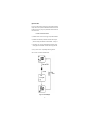
In most countries, 5OHz or 6OHz power distribution systems include 3-phase delta
primary - wye secondary transformers. The secondary generally provides 120VAC
from phase to neutral, and 208VAC from phase to phase. Historically, balancing
the loads on each phase was a big headache for the electrical system designer.
Typically, the vector addition of the phase currents in the transformers' neutral wire
is zero or quite low in a wellbalanced system. Typical devices that present linear
loading include incandescent lighting and small motors. The result is essentially a
sine wave current in each phase and a low neutral current at a frequency of 50Hz
or 60Hz.
Devices such as TV sets, fluorescent fighting, video machines, and microwave
ovens are now commonly drawing power line current for only a fraction of each
cycle so that they cause non-linear loading and subsequentnon-linear current. This
generates odd harmonics of the 50Hz or 60Hz line frequency. Therefore, the current waveform from the transformer could contain not only a 60Hz component, but
also a 180Hz component, a 300Hz component, etc.
The vector addition in a properly balanced power distribution system feeding nonlinear loads may still be quite low. However, the vector addition does not cancel all
the harmonic currents. The odd multiples of the 3rd harmonic (called the
"TRIPLENS") are added together in the neutral. These harmonics can create an
RMS current in the transformers neutral wire that is 130( of the total RMS current
measured in any individual phase. For example, phase currents of 80 amperes may
cause 104 amperes of harmonic current in the neutral, the most common harmonic
being the 3rd. The electrical designer must consider the following issues when
designing a power distribution system that will contain harmonic current.
33
Test Equipment Depot - 800.517.8431 - 99 Washington Street Melrose, MA 02176
FAX 781.665.0780 - TestEquipmentDepot.com