1
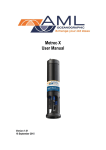
User Manual for AML Oceanographic’s MicroX General Description of the Instrument The AML Oceanographic X•Series instruments and Xchange™ sensors are a major advancement in ocean instrumentation. Swappable and interchangeable sensors dramatically improve the capabilities of ocean instrumentation in the following ways: Change the instrument sensor types while at sea within seconds, and without tools. A CTD can be changed to a sound speed profiler by exchanging sensor heads. To optimize the resolution and accuracy of sensor data, sensors can be swapped to change the measurement range. For example, a 6000 dBar P•Xchange pressure sensor can be swapped with a 500 dBar P•Xchange sensor; the salt water C•Xchange conductivity sensor can be swapped for a fresh water C•Xchange conductivity sensor. Sensors from one instrument can be swapped to another instrument to maintain missioncritical capabilities. Calibrated sensors can be sent from the factory to the instrument. The instrument is not pulled from active duty for calibration. Spare sensors ensure that an instrument can be immediately returned to active duty after sustaining damage. All calibration and traceability data resides within each Xchange™ sensor. Calibration data for all sensors is available from the instrument, and calibration certificates can be printed from AML Oceanographic SeaCast software when the instrument is connected. Logged data is stamped with sensor traceability and instrument configuration data. Only Xchange™ sensors are sent for calibration, leaving the instrument working in the field. Micro•X is the miniature, single-sensor, externally powered, data via cable instrument of the X•Series family. It is designed primarily for sonar transducer array, and hull mounted applications. Communications with the Micro•X are accomplished with RS-232 or RS-485. Sampling rates are programmable by time (25 Hz to every 24 hours). Micro•X is equipped with one Xchange™ sensor port. There are two options available for this port: A primary Xchange™ sensor port (C•Xchange or SV•Xchange) A secondary Xchange™ sensor port (T•Xchange, P•Xchange, Tu•Xchange, UV•Xchange) A Micro•X with a primary Xchange™ sensor port cannot accept Xchange™ sensors designed for a secondary port, and vice versa. 2