1
C1
5
DTR.APCE.APRE.02(ENG)
1. INTRODUCTION
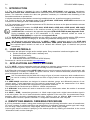
1.1. This User Manual is intended for users of APCE–2000, APCE-2000G smart pressure transmitters,
APRE–2000, APRE–2200, APRE–2000G smart differential pressure transmitters and APR-2000Y smart level
probes. The instruction contains the data and guidelines necessary to understand the functioning of the
transmitters and how to operate them.
It includes essential recommendations concerning installation and use, as well as emergency procedures.
1.2. Technical data for the diaphragm seals for the APCE-2000, APRE-2000, APRE-2200 transmitters are
contained in the catalogue cards “DIAPHRAGM SEALS”.
1.3. The transmitters comply with the requirements of EU directives as shown on the plate and with the relevant
Declaration of Conformity.
1.4. Additional information for APCE–2000, APCE-2000G, APRE–2000, APRE–2000G, APR–2000Y
and APRE–2200 transmitters in Ex versions covered by the EC-type test certificate number KDB
12ATEX 0077X is contained in the appendix designated DTR.APCE.APRE.02(ENG) Appendix Ex.02.
During installation and use of the transmitters in Ex version, reference should be made to
DTR.APCE.APRE.02(ENG) in conjunction with Appendix Ex.02.
1.5. The APCE–2000, APRE-2000 transmitters are also made in a version which complies with the PED pressure
directive, meet the requirements for category IV, and then carry additional markings as in p. 4.3 and 4.4.
1.6. Parameters and information given for APCE..., APRE... transmitters apply to the APCE–2000,
APCE-2000G, APRE-2000, APRE–2200, APRE-2200, APRE–2000G, APR-2000Y transmitters and to
the explosion-proof versions as well as all variants with different types of electrical and process
connections.
i
2.
USER MATERIALS
Transmitters are delivered in single and/or multiple packs. Every transmitter is delivered together with:
a. Product Certificate, which is also a warranty card;
b. Declaration of Conformity;
c. Copy of certificate – on request;
d. User Manual numbered: DTR.APCE.APRE.02(ENG).
Documents b, c and d are accessed at www.aplisens.pl
3.
APPLICATIONS AND MAIN FEATURES
3.1. The APCE... pressure transmitter series are designed to measure gauge pressure, vacuum pressure and
absolute pressure of gases, vapours and liquids including corrosive substances.
3.2. Differential pressure transmitters APRE–2000 series are used to measure liquid levels in closed tanks, with
static pressure up to 25MPa or 32MPa for special versions, and to measure differential pressure liquid and
gases at elements such as filters, orifices, etc.
3.3. The transmitters may be fitted with a range of types of process connectors, which enables them to
be used in a variety of conditions such as thick or highly reactive media, high and low temperatures,
etc.
3.4. APRE–2000G transmitters are designed to measure absolute, gauge, and differential pressure of nonreactive gases. Typical applications are low pressure measurement include the measurement of air blasts,
chimney draughts, or pressure and overpressure in combustion chambers.
The transmitters are constructed up to 35kPa or 100kPa overpressures.
3.5. APR-2000Y level probes are used to measure the level in closed tanks where the medium is accessed
from the tank top.
3.6. APCE..., APRE... transmitters generate a 4...20mA output signal and a digital communication signal in
a two-wire system. The use of smart electronics enables regulation of the zero point, the measurement range,
damping, radical conversion characteristic and other functions using an Aplisens KAP communicator or
a HART/RS232 converter, Aplisens “RAPORT 2” configuration software and a PC computer.
i
4. IDENTIFYING MARKS. ORDERING PROCEDURE
4.1. Every transmitter carries a rating plate containing at least the following information: name of manufacturer,
CE mark, numbers of notified institutions and designations of certificates obtained, product type, basic range,
min. set range, static pressure limit, output signal, series number, power supply voltage.
Version types and the method of specifying of the desired product by ordering are described in the current
“Information Cards” and the Catalogue.