1
This paper presents a plug-in application with a graphical user interface (GUI) for VMD for the analysis of
electrostatic potentials. It is meant to provide a first glance of the distribution of charges and electrostatic
interactions to the researchers that may be recomputed with more detail and precision off-line. False-color
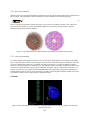
representations of the distribution of charges, projection of the atoms onto 2D planes, and 3D representations of the
effect of electrostatic interactions on selected molecules are made available almost instantly. Visual clues provide
feedback to the researcher about computation progresses and scales.
The GUI implements an algorithm that approximates computationally intensive calculations of the electrostatic
forces by dividing the sample space into N x M x L boxes. Pseudo-atoms that represent averages over each of the
boxes are then used to reduce the amount of computation. Multi-threading and the use of C++2 for the most CPU
intensive parts of the code also help to achieve the response times expected from an interactive application.
2. Background
The VMD program is compatible with main file formats produced by MD simulators. This relieves the VMD plugin programmer of the direct interpretation and manipulation of the data. Access to the positions, types and charges
of the atoms is made through the Python modules provided by VMD. Tkinter3,4, a GUI package for Python, is used
for building the window that let the researcher control points of view, atom types being viewed, and computation of
interactions.
2.1. Python and CPU intensive code
Python is an interpreted programming language. It is designed to be minimalist in the sense of syntactic complexity.
As a consequence the code written in that language is relatively easy to understand and modify even by non-experts.
At the same time, it supports programming paradigms such as object oriented programming and structured
programming. Functionality pertinent to the construction of computational tools for MD simulations such as
graphical user interfaces, threading, interprocess communications and interfacing with compiled languages is
provided by a large collection of modules. On the other hand, being an interpreted language with a characteristic of
placing syntax clarity over efficiency, it presents further limitations to computationally intensive applications. A
study made about performance between different programming languages reports that it took 192 seconds per
iterations to solve the Flavius Josephus problem in Python using a code consisting of 41 lines6.
2.2. VMD modules
VMD provides three modules for accessing and manipulating VMD state with objects that represent important
entities. They are referred in the VMD User's Manual as proxy classes that “are written in pure Python and use the
lower level built-in interfaces to communicate with VMD”. They provide the classes:
Molecule: a proxy for molecules loaded into VMD;
MoleculeRep: to keep track of the representations in a molecule;
AtomSel: whose instances are independent of the molecules and representations in VMD.
Other non-object oriented modules are provided for interacting with VMD including:
color: used to change the color definitions, color maps, or edit the color scale;
display: controls the VMD camera as well as screen updates;
graphics: used to create custom 3-D objects from graphics primitives such as triangle, line, sphere, text,
material, etc.
2.3. electrostatic model
When electrostatic charges are present, the Coulomb potentials between two atoms ai, aj is given by
(1)
where Qi and Qj are the charges of the atoms, ri,j their distance, and ε0 is a constant. For each atom, the potential
233