1
between it and all other atoms is computed and added to obtain the net potential on that atom:
(2)
where ri,j is the unit vector pointing from ai to aj.
2.4. test case: CNT-DNA hybrids
CNTs are cylindrical sheets of carbon with diameters of ~1nm and lengths up to a few centimeters. CNTs have
electronic and structural properties that vary depending on the diameter, chirality and length. They have many
interesting properties such as high mechanical strength and electronic stability. These features make them
candidates for practical applications.
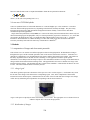
Single strand deoxyribonucleic acid (ss-DNA) is a variant of the widely known biomolecule that consists only one
chain of alternating sugars and phosphates. They are often represented by sequences of the letters C, A, T, and G that
correspond to the different base units. It is understood that ss-DNA attaches to the CNT by the π − π stacking
interaction. MD simulations of ss-DNA adsorbing to a CNT used in this project have been done both at the
University of Pennsylvania and at the University of Puerto Rico at Humacao8,9.
3. Methods
3.1. computation of charges and electrostatic potentials
This software serves to visualize two different properties related to charged particles: the distribution of charges
throughout the space, and the Coulomb potential at each of the atoms as described in section 2.3. Sometimes it is
desirable in a simulation to view the distribution of the charges and the interactions between them. The problem is
that many algorithms used for this task are time consuming. A new approach is needed to speed up these
calculations. The technique used here helps to improve these calculations and show an average of the distribution of
charges and the electrostatic interaction among atoms. This approach takes less time to calculate an average of the
interaction among charges. The algorithm first takes a frame in the simulation. It then divides the frame in N x M x
L boxes. The mount of subdivisions is entered by the user.
3.1.1. charge's grid
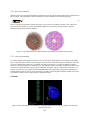
This matrix (grid3D) represents a subdivision of the space in N x M x L cubes (Figure 1). Each matrix entry stores
the the sum of the charges of the atoms in the corresponding region. Later, in the computation of electrostatic
interactions between all atom pairs, a simulated atom at the center of the box with this sum of charges as its charge
will be used by substituting the computations corresponding to all the atoms in that box.
Figure 1.The space occupied by the atoms is divided by 3 x 3 x 3 boxes. The appropriate row or column of boxes is
added to compute false color in the 2D projections.
3.1.2. distribution of charges
234