1
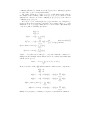
separate instruction memories but share a data memory. Such architectures are
common in control-dominated embedded systems where multiple heterogenous
processors perform separate tasks using a common memory to synchronise on
shared data structures.
The example starts by defining the type of instructions (records containing 4-bit opcodes and 12-bit operands), declaring 2 constants and specifying
the signatures of various (externally defined) memory functions. Bit-widths are
specified explicitly using notation X:n to indicate that variable X represents an
n-bit value. The bit-widths of function return values are also specified in this
way (unit indicates a width of 0).
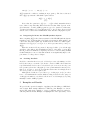
The function Shared memory takes three arguments: WriteSelect indicates
whether a read or a write is to be performed; Address specifies the memory
location concerned; Data gives the value to be written (this argument is ignored
if a read operation is performed). It always returns the value of memory location
Address.
Functions proc1 and proc2 define two simple 16-bit processors. Argument
PC represents the program counter, RX and RY represent processor registers and
A is the accumulator. The processor state is updated on recursive calls—neither
processor terminates.
The main function initialises the system by calling proc1 and proc2 in parallel with PC, RX, RY and A initialised to 0.
Since the SAFL code contains parallel non-terminating calls to proc1 and
proc2 both of which share a single resource, neither static nor relative scheduling are applicable (see Section 2): this example cannot be synthesised using
conventional silicon compilers.
Soft Scheduling is expressive enough to deal with non-terminating resources:
a circuit is synthesised which contains an arbiter protecting the shared memory
whilst allowing proc1 and proc2 to operate in parallel.
5.3
Parallel Tasks Sharing Graphical Display
Consider a hardware design which can perform a number of tasks in parallel
with each task having the facility to update a graphical display. Many real-life
systems have this structure. For example in preparation for printing an ink-jet
printer performs a number of tasks in parallel: feed paper, reset position of print
head, check ink levels etc. Each one of these tasks can fail in which case an error
code is printed on the graphical display.
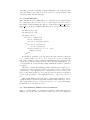
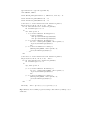
A controller for such a printer in SAFL may have the following structure:
extern display (data : 16) : unit
fun reset_head()
: unit = ...
if head_status <> 0 then
display(4) (* Error code 4 *)
else ...