1
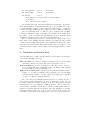
Typing
No dynamic checks required in object code.
Static
Not all valid programs pass type
checker.
Dynamic checking of argument
types required each time a function
Dynamic
is called.
All valid programs can be run.
Soft
Scheduling
No scheduling logic required in final circuit.
Not all valid programs can be
scheduled statically.
Scheduling logic required on each
shared resource in the final circuit.
All valid programs can be scheduled.
Less scheduling logic required
Fewer dynamic checks required
(some removed statically).
(some removed statically).
All valid programs can be schedAll valid programs can be run.
uled.
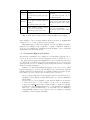
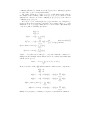
Fig. 1. An Informal Comparison Between Soft Scheduling and Soft Typing
static analysis to remove as many dynamic checks as possible. To highlight this
analogy we choose to call our method Soft Scheduling.
Although this paper considers the application of Soft Scheduling to hardware
synthesis, the technique is also applicable to software compilation. Aldrich et
al. [1] advocate a similar approach which uses static analysis to remove redundant
synchronization from Java programs.
1.1
Conventional High-Level Synthesis
The hardware community refer to high-level, block-structured languages as behavioural . At a lower level, structural languages describe a circuit as a set of
components, such as registers and multiplexers connected with wires and buses
(e.g. RTL Verilog [9]). High-level synthesis (sometimes referred to as behavioural
synthesis) is the process of compiling a behavioural specification into a structural
hardware description language.
A number of behavioural synthesis systems have been developed for popular
high-level languages (e.g. CtoV [20] and Handel [17]). Such systems typically
translate high-level specifications into an explicitly parallel flow-graph representation where allocation, binding and scheduling [6] are performed:
– Allocation is typically driven by user-supplied directives and involves choosing which resources will appear in the final circuit (e.g. 3 adders, 2 multipliers
and an ALU).
– Binding is the process of assigning operations in the high-level specification
to low-level resources—e.g. the + in line 4 of the source program will be
computed by adder 1 whereas the + in line 10 will be computed by the ALU.
– Scheduling involves assigning start times to operations in the flow-graph such
that no two operations will attempt to access a shared resource simultaneously. Mutually-exclusive access to shared resources is ensured by statically
serialising operations during scheduling.