1
Internal Calibrant Concentration
.
For high mass accuracy in LC/MS runs, use an internal standard to
calibrate each spot (for example, use the ACTH clip 18–39
(MH+ = 2,465) at ~ 25 fmol).
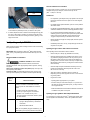
Ensure notch in insert is
aligned with the notch in the
holder
Guidelines
•
For acquisition, spot samples in any spot positions. Do not spot
beyond the perimeter of the CAL spots on the outer edges of
the insert.
•
For QSTAR system plate calibration, spot four corner positions
with CHCA matrix.
IMPORTANT! If the notch in the insert is not aligned with the notch
in the holder, the plate will jam when you load it in the system.
•
For QSTAR 2-point MS/MS calibration, spot one position with a
calibration standard such as Glu1-Fibrinopeptide B and matrix.
6. If needed, adjust the insert so that the notched edge fits snugly into
the notch in the holder by pushing your finger through the hole in
the bottom of the holder, then moving the insert by pushing on the
edges of the insert.
•
For Voyager Workstation OptiPlate calibration (5.1 series
software), spot every other row and all perimeter positions with
CHCA matrix and the calibration mixture specified in the
Voyager™ Biospectrometry™ Workstation User Guide.
•
Before handling the single-use sample plate, allow all spots to
dry completely.
•
Immediately before use, use dry, compressed gas to blow off
any fibers on the plate.
3
Spotting an Opti-TOF™ Plate
Wear powder-free gloves when handling inserts to avoid contaminating
the hydrophobic surface.
Spotting Using a Probot™ Micro Fraction Collector
IMPORTANT! Before spotting an Opti-TOF™ MALDI Plate System
plate, use dry, compressed gas to blow off fibers that may be on the
plate.
When spotting with a Probot Micro Fraction Collector:
Suggested Matrix Formulation
CHEMICAL HAZARD. Read the MSDS
before handling any chemical mentioned below, and follow the
handling instructions. Wear appropriate protective eyewear, clothing,
and gloves.
Alpha-cyano-4-hydroxycinnamic acid (CHCA) may cause eye, skin,
and respiratory tract irritation.
Acetonitrile (ACN) is a flammable liquid and vapor. Exposure may
cause eye and respiratory tract irritation and blood system damage.
Type of
Run
LC/MS
Matrix Formulation
QSTAR Hardware Manual
•
Install the Opti-TOF plate holder/insert assembly in the tray.
Position the holder/insert assembly with the notch to the
left-rear corner of the tray.
•
Align the tip with the registration marks in position A1.
Depending on the tip size, align with the inner or outer etched
ring in this position.
•
Program the Probot:
Spotting Using a SymBiot® XVI Sample Workstation
For information on spotting an Opti-TOF™ MALDI Plate System plate
with the SymBiot XVI workstation, refer to the SymBiot® XVI Online
Help.
Refer to the document appropriate for your system:
•
Install the Opti-TOF plate tray (available from Dionex) on the
xyz platform by aligning the holes in the tray over the pins in
the platform. Make sure the tray is flush with the platform by
pressing down on the four corners of the tray. The Opti-TOF™
MALDI Plate System Plate tray is designed to hold the holder/
insert assembly.
– Distance Between Rows and Distance Between Columns set
to 1.475 for a full plate of 576 spots.
2. Combine 1 mL of matrix with 13 µL of a
10 mg/mL solution of ammonium citrate to yield a
2% wt/wt addition.
Voyager™ Biospectrometry™ Workstaion
User Guide
•
– Final flow rate (LC eluent and matrix) of 1 to 2 µL/min for a
full plate of 576 spots. With fewer spots, you may be able to
use a higher flow rate.
7 mg/mL alpha-cyano-4-hydroxycinnamic acid
(CHCA) in a solution of acetonitrile and water
(75:25 v/v) with 2% wt/wt addition of ammonium
citrate:
•
Install a 180 µm or 360 µm tip (available from Dionex).
– Spotting pattern appropriate for your system.
1. Combine CHCA with acetonitrile:water
(75:25 v/v) to yield 7 mg/mL concentration.
Other
•
Note: To run OptiPlate (Voyager Workstation), you
need alpha-cyano-4-hydroxycinnamic acid (CHCA).
2