1
Appendix
Binary Words
In an effort to make this Applications Note useful to a broad range of readers with a variety of
skill levels, an overview of binary or digital communication seems appropriate. Binary is a
numbering system consisting of only ones and zeros. In the decimal (base ten) system, which
we’re all accustomed to, any single digit in a number can range from 0-9. Binary (base two)
limits your possible choices to either 0 or 1. This limitation makes binary ideally suited for
electronic counting. Each digit or bit can now be defined electrically in terms of 1 being “on” or 0
being “off”. In the case of TTL (transistor-transistor logic), “on” = +5 Volts and “off” = 0 Volts.
That being said, how do we count in binary? Each digit in a decimal number represents a power
of 10. As an example, the number 247 can be expressed as (2 x 10²) + (4 x 101) + (7 x 100) or
200 + 40 + 7. In binary each digit represents a power of 2. The binary number 100111 can be
expressed as follows:
(1 x 25) + (0 x 24) + (0 x 23) +(1 x 22) +(1 x 21) +(1 x 20) or 32 + 0 + 0 + 4 + 2 + 1 = 39.
All these ones and zeros flying around in say your computer need to be organized into packets
representing a meaningful number. These packets are called words. The number of bits in
each word is typically defined by the individual system. In the case of the M3000Si and
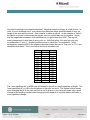
M3500Si encoders, each word is 36 bits and 38 bits long respectively. Table 1 contains each
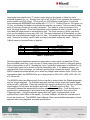
possible Binary number in a 4 bit long word and its decimal equivalent. Note that it is useful to
show the zeros at the beginning of the smaller numbers so that the full length of the word is
always clear.
Binary
0000
0001
0010
0011
0100
0101
0110
0111
1000
1001
1010
1011
1100
1101
1110
1111
Decimal
0
1
2
3
4
5
6
7
8
9
10
11
12
13
14
15
Table 7: 4 bit binary numbers
TN1301 – MicroE Serial Word
Page 7
© 2015 MicroE