1
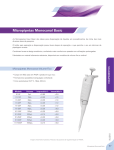
Pipettor User Manual Product Code Description Single Chanel Pipettor Variable 550.002.055 Volume 0.5 to 10ul 550.002.060 2 to 20ul 550.002.065 10 to 100ul 550.002.070 20 to 200ul 550.002.075 100 to 100ul 550.002.080 1 to 5ml 550.002.085 2 to 10ml Pipettor 8 Chanel 550.002.110 Volume 0.5 to 10ul 550.002.120 5 to 50ul 550.002.130 50 to 300ul Pipettor 12 Chanel 550.002.160 Volume 0.5 to 10ul 550.002.170 5 to 50ul 550.002.180 50 to 300ul Please read the User Manual carefully before use, and follow all operating and safety instructions! Technical specifications and outline are subject to change without prior notice. Version 1.1 [email protected] www.labco-online.com 1 Contents Introduction 3 Warranty 3 Delivery 3 1. Adjustable volume pipettes 4 2. Installing the pipette holder 5 3. Pipette components 6 4. Pipette operation 7 5. Pipetting Techniques 8 6. Pipetting recommendations 10 7. Storage 10 8. Performance test and recalibration 9. Maintenance 10.Trouble shooting 10 13 16 2 Introduction Your new hand held pipette is a general purpose pipette for the accurate and precise sampling and dispensing of liquid volumes. The pipettes operate on the air displacement principle and disposable tips. Warranty The pipettes are warranted for one year against defects in materials and workmanship. Should it fail to function in any period of time, please contact your local representative immediately. The warranty will not cover defects caused by normal wear or by using the pipette against the instructions gives in this manual. Each pipette is tested before shipping by the manufacturer. The Quality Assurance Procedure is your guarantee that the pipette you have purchased is ready for use. All pipettes have been quality tested according to ISO8655/DIN12650. The quality control according to ISO8655/DIN12650 involves gravimetric testing of each pipette with distilled water (quality 3, DIN ISO 3696) at 22℃ using the manufacturer’s original tips. Delivery This unit is supplied with 1 x main unit, Calibration tool, Tube of grease, User manual, Pipette holder, Tips & Quality control certificate. 3 1. Adjustable volume pipettes Volume Range 0.5-10µl 2-20μl Increment 0.1µl 0.5 μl Tips 10µl 200, 300μl 10-100μl 1μl 200, 300, 350μl 20-200μl 1μl 200, 300, 350μl 100-1000μl 1μl 1000μl 1000-5000μl 50μl 5m l 2-10ml 0.1ml 10ml Volume Range Increment Tips 8-ch 0.5-10μl 0.1μl 10μl 8-ch 5-50μl 0.5μl 200, 300, 350μl 8-ch 50-300μl 5μl 350μl 12-ch 0.5-10μl 0.1μl 10μl 12-ch 5-50μl 0.5μl 200, 300, 350μl 12-ch 30-300μl 5μl 350μl 4 2. Installing the pipette holder For convenience and safety always keep the pipette vertically on its own holder when not in use. When installing the holder, please follow the instruction below: 1. Clean the shelf surface with ethanol. 2. Remove the protective paper from the adhesive tape. 3. Install the holder as described in Figure 2A. (Make sure the holder is pressed against the edge of the shelf.) 4. Place the pipette onto the holder as shown in Figure 2B. Fig.2A Fig.2B 5 3. Pipette components Push button rod Grip cover Push button Tip Ejector Handle Display cover Push button rod Tip Ejector collar Grip cover Tip cone Push button Tip Ejector Handle Display cover Tip cone housing Tip ejector bar Tip cone Hard tip cone 6 4. Pipette operation Volume setting The volume of the pipette is clearly shown through the handle grip window. The delivery volume is set by turning the thumb button clockwise or anticlockwise (Fig.3). When setting the volume, please make sure that: The desired delivery volume clicks into place The digits are completely visible in the display window The selected volume is within the pipette’s specified range Using excessive force to turn the push button outside the range may jam the mechanism and damage the pipette. Sealing and ejecting tips Before fitting a tip make sure that the pipette tip cone is clean. Press the tip on the cone of the pipette firmly to ensure an airtight seal. The seal is tight when a visible sealing ring forms between the tip and the black tip cone (Fig.4). Each pipette is fitted with a tip ejector to help eliminate the safety hazards associated with contamination. The tip ejector needs to be pressed firmly downwards to ensure proper tip ejection (Fig.5). Make sure the tip is disposed of into a suitable waste container. 7 5. Pipetting techniques Forward pipetting Make sure that the tip is firmly attached to the tip cone. For best results the thumb button should be operated slowly and smoothly at all times, particularly with viscous liquids. Hold the pipette vertically during aspiration. Make sure that the liquid and container vessel are clean and that the pipette, tips and the liquid are at the same temperature. 1. 2. 3. 4. Depress the thumb button to the first stop (Fig.6B). Place the tip just under the surface of the liquid (23mm) and smoothly release the thumb button. Carefully withdraw the tip from the liquid, touching against the edge of container to remove excess. Liquid is dispensed by gently depressing the thumb button to the first stop (Fig.6B). After a short delay continue to depress the thumb button to the second stop (Fig.6C). This procedure will empty the tip and ensure accurate delivery. Release the thumb button to the ready position (Fig.6A). If necessary change the tip and continue with pipetting. 8 Reverse pipetting The reverse technique is suitable for dispensing liquids that have a tendency to foam or have a high viscosity. This technique is also used for dispensing very small volumes when it is recommended that the tip is first primed with the liquid before pipetting. This is achieved by filling and emptying the tip. 1) 2) 3) 4) Depress the thumb button all the way to the second stop (Fig.6C). Place the tip just under the surface of the liquid (2-3mm) and smoothly release the thumb button. Withdraw the tip from the liquid touching against the edge of the container to remove excess. Deliver the preset volume by smoothly depressing thumb button to the first stop (Fig.6B). Hold the thumb button at the first stop. The liquid that remains in the tip should not be included in the delivery. The remaining liquid should now be discarded with the tip or delivered back into the container vessel. 9 6. Pipetting recommendations 7. Hold the pipette vertically when aspirating the liquid and place the only a few millimeters into the liquid Pre-rinse the tip before aspirating the liquid by filling and emptying the tip 5 times. This is important especially when dispensing liquids which have a viscosity and density different from water Always control the push button movements with the thumb to ensure consistency When pipetting liquids at a temperature different from ambient, pre-rinse the tip several times before use. Storage When not in use it is recommended that your pipette is stored in a vertical position. 8. Performance test and recalibration Each pipette has been factory-tested and certified at 22℃ according to ISO8655/DIN12650. The following table shows the maximum permitted errors (Fmax) for manufacturers gives in ISO8655/DIN 12650, which further advises each user to establish their own maximum permitted errors (Fmax user). The Fmax user should not exceed the Fmax by more than 100%. 10 Note: Pipette specifications are guaranteed only with manufacturer’s tips. Performance test (Checking calibration) Weighing should take place at 20-25℃, constant to + 0.5℃. Avoid drafts. 1. Set the desired testing volume of your pipette. 2. Carefully fit tip onto the tip cone. 3. Pre-rinse tip with distilled water by pipetting the selected volume 5 times. 4. Carefully aspirate the liquid, keeping the pipette vertical. 5. Pipette distilled water into a tarred container read the weight in mgs. Repeat at least five times and record each result. Use an analytical balance with a readability of 0.01 mgs. To calculate the volume, divide the weight of the water by its density (at 20℃: 0.9982). This method is based on ISO8655/DIN12650. 6. Calculate the F-value by using the following Equation: =∣inaccuracy (μl) ∣+2×imprecision (μl) Compare the calculated F-value to the corresponding Fmax user. If it falls within the specifications, the pipette is ready for use. Otherwise check both your accuracy and, when necessary, proceed to recalibration procedure. 11 Recalibration procedure 1) 2) 3) Place the calibration tool into the holes of the calibration adjustment lock (under the thumb button) (Fig.7). Turn the adjustment lock anticlockwise to decrease and clockwise to increase the volume. Repeat performance test (Checking calibration) procedure from step 1 until the pipetting results are correct. 12 9. Maintenance To maintain the best results from your pipette each unit should be checked every day for cleanliness. Particular attention should be paid to the tip cone (s). The pipettes have been designed for easy in-house service. However, we also provide complete repair and calibration service including a service report and performance certificate(s). Please return your pipette to your local representative for repair or recalibration. Before returning please make sure that it is free from all contamination. Please advise our Service Representative of any hazardous materials which may have been used with your pipette. Note: Check the performance of your pipette regularly e.g. every 3 months and always after in-house service or maintenance. Cleaning your pipette To clean your Pipettor use ethanol and a soft cloth or lintfree tissue. It is recommended to clean the tip cone regularly. 13 In-house maintenance 1. Hold down the tip ejector. 2. Place the tooth of the opening tool between the tip ejector and the tip ejector collar to release the locking mechanism (Fig.8). 3. Carefully release the tip ejector and remove the ejector collar. 4. Place the wrench end of the opening tool over the tip cone, turning it anticlockwise. Do not use any other tools (Fig.9). The 5 ml tip cone is removed by turning it anticlockwise. Do not use any tools (Fig.10). 5. Wipe the piston, the O-ring and the tip cone with ethanol and a lint-free cloth. Note: Models up to 10μl have a fixed O-ring located inside the tip cone. Therefore, the O-ring cannot be accessed for maintenance. 6. Before replacing tip cone it is recommended to grease the piston slightly using the silicone grease provided. Note: Excessive use of grease may jam the piston. 7. After reassembling use the pipette (without liquid) several times to make sure that he grease is spread evenly. 14 Check the pipette calibration. 15 10. Trouble shooting Trouble Droplets left inside the tip Possible cause Unsuitable tip Unsuitable tip Foreign particles or volume too small Attach new tip plastic attached pipetted Use original tips Non-uniform wetting of the Tip incorrectly Leakage Solution between tip and tip cone Instrument contaminated or insufficient amount of grease on piston and O-ring Attach firmly Use original tips Clean the tip cone, attach new tip Clean and grease Oring and piston, clean the tip cone Grease accordingly O-ring not correctly positioned or Change the O-ring damaged 16 Trouble Possible cause Incorrect operation Calibration altered or unsuitable for the liquid Instrument damaged Push button jammed or moves erratically Solution Follow instruction carefully Recalibrate according to instructions Send for service Piston Clean and grease O- contaminated ring and piston, clean the tip cone Penetration of Clean and grease O- solvent vapors ring and piston, clean the tip cone Pipette blocked Liquid has Clean and grease O- aspirated penetrated tip cone ring and piston, clean volume and dried the tip cone too small 17 Trouble Possible cause Solution Tip ejector Tip cone and/or jammed ejector collar or moves contaminated Clean the tip cone and the ejector collar erratically 18 Page intentionally left blank 19 20