1
6
CHAPTER 2. STATE OF THE ART
• The price of the instrumentation is significantly higher than in the case of
a land-sited wireless sensor networks.
• There are added problems in deployment of and access to motes and the
need for flotation and mooring devices.
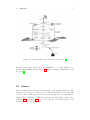
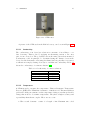
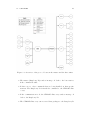
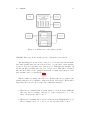
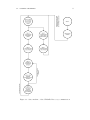
In Figure 2.1 a general overview of a sensor node can be seen. In the center
there is the CPU, which is a microprocessor, which processes all the data from
the sensors and takes care of the communication between the base station or
with other buoys. The rest of the system includes a module for RF transmissions, a power supply regulation and management system, a set of interfaces for
accessing the sensors, a module for amplification, conversion (analogue to digital)
and multiplexing of the data read from the sensors (surface and underwater), a
FLASH-type permanent read/write memory and a clock to act as a timer and
scientific instruments (e.g., improved meteorological packages, acoustic recording
packages, biological samplers, etc.).
Part of most buoys is above the surface of the water. This out-of-the-water part
always includes an antenna for RF transmission, optionally a harvesting system
(solar panel, Eolic generator, etc.) to supplement the power source, and in some
cases one or more external sensors essentially to monitor meteorological data
(wind speed, air temperature, atmospheric humidity, etc.). Figure 2.1 illustrates
the generic architecture of an autonomous buoy [2].
2.2
Communication
Network physical topology and density are entirely application-dependant. You
need to know the environment in which the buoy will be active. There are different possibilities to interact with the base station or with other sensor node in a
wireless sensor network (WSN). There are a lot of different communication technologies you can use. Every topology has its own characteristics, which determine
whether or not it is more suitable than others in terms of attributes of network
functionality such as fault tolerance, connectivity, etc. For communication it is
possible either to develop communications protocols on the data-linking layer using different medium access mechanisms (such as TDMA, FDMA and CSMA),
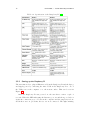
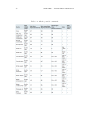
or else to use different wireless communication standards and technologies. The
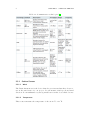
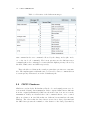
most important ones are summed up in Table 2.1.
For wireless communication, the sensor node incorporates a radio module,
which is chosen to suit the desired range. Sometimes, in order to increase the
range, range extenders for RF transceivers are incorporated, thus providing amplification to improve both output power and LNA (Low Noise Amplification).