1
Executive Summary
FPGA technology is a growing field in electrical engineering. Classes at Cornell University
teach the basics of the system, but lack tools to explore certain applications. This project involved the
development of an academic tool to enable the manipulation and investigation of high speed signals.
The goal of the project was to create a bi-directional hardware interface that fed analog values
from the outside world into a processor that displayed them on a screen and that created analog values
to be transmitted to the outside world. This was realized by a circuit board that housed digital-toanalog and an analog-to-digital conversion chips and an FPGA application that exercised those external
interfaces, and displayed the input channel on a VGA monitor.
The hardware design process involved making decisions about how many data to capture and
create and how they should be processed when they were in analog form. The software design process
involved making decisions about how to store the data and how to perform the digital processing.
Small data sizes were chosen to keep the system simple, and data were stored in a cheap static form for
display and a more expensive, easily manipulated form during acquisition. Analog processing was kept
to a minimum for reliability reasons, and digital processing was performed by logic elements rather
than by a fully architected CPU.
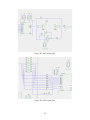
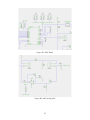
The hardware design was divided into two easily separable parts by data direction. The design
was largely straightforward, but schematic errors prevented it from being as versatile or robust as it was
intended to be. Software design was more complicated because the several systems were required to
interact. Each software module handled the operation of part of the system, but the control scheme
required that they monitor each other for timing and configuration information.
The outcome of the project was a success. The desired functionality was implemented in full,
and could be accurately demonstrated at speeds up to 2MHz. Attempts to achieve higher levels of
performance were made difficult by the structure of the design. Future projects will be able to make
good use of the results of this one.
3