1
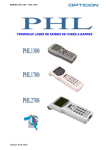
USER’S MANUAL PHL 1700
LASER TERMINAL
/ IRU 1600 CRADLE
CAUTION: This user’s manual may be revised or
withdrawn at any time without prior notice.
USER’S MANUAL PHL 1700 LASER TERMINAL / IRU 1600 CRADLE
CONTENTS
page
page
Copyright 2000, Opticon Sensors Europe B.V.
All rights reserved.
This manual may not, in whole or in part, be copied,
photocopied, reproduced, translated or converted to
any electronic or machine readable form without
prior written consent of Opticon Sensors Europe.
Limited warranty and disclaimers
By opening the package of this product you agree to
become bound by the liability and warranty conditions
as described below.
Under all circumstances this manual should be read
attentively, before installing and or using the product.
In no event, Opticon Sensors Europe will be liable for
any direct, indirect, consequential or incidental
damages arising out of use or inability to use both
the hardware and software, even if Opticon has been
informed about the possibility of such damages.
A serial number appears on all Opticon products.
This official registration number is strictly related to
the device purchased. Make sure that the serial
number appearing on your Opticon device has not
been removed. Servicing by our Repair Department
can only be carried out under warranty.
All Opticon products are warranted for a period of
one year after purchase, covering defects in material
and workmanship. Opticon will repair or, at its opinion,
replace products that prove to be defective in material
or workmanship under proper use during the warranty
period.
Opticon will not be liable in case modifications are
made by the customer. In such case the standard
repair charge will be applicable. The standard charge
for repair will also be applicable in case no defect is
found at all. These rules also apply for products that
are still under warranty. Therefore, you are advised to
have the product specifications always at hand.
Trademarks used are property of their respective
owners
PHL-ver4-00 / printed 12 00
1
INTRODUCTION
3
5
PIN OUT
17
2
INSTALLATION
4
UNPACKING
4
2.2
2.2.1
2.2.2
2.2.3
2.2.4
2.2.5
DETAILED VIEW
Dimensions of terminal
Details of terminal
Display of terminal
Dimensions of cradle
Details of cradle
5
5
5
6
7
7
5.4
RS232C cable for terminal PHL1700
Modem cable for terminal PHL1700
RS485 cable for network of cradle
IRU1600
RS232 cable for cradle IRU1600
17
17
2.1
5.1
5.2
5.3
17
17
6
SPECIFICATIONS
18
2.3
HANDLING
8
2.4
2.4.1
2.4.2
2.4.3
ASSEMBLY
Terminal
Cradle
Terminal on cradle
6.1
6.1.1
6.1.2
6.1.3
6.1.4
6.1.5
6.1.6
SPECIFICATIONS TERMINAL
Electrical specifications
Optical specifications
Physical specifications
Functionality
Environmental specifications
Supported symbologies
18
18
18
18
18
19
19
2.5
INSTALLING,
6.2
6.2.1
6.2.2
6.2.3
6.2.4
6.2.5
SPECIFICATION CRADLE
Cradle models
Electrical specifications
Functionality
Environmental specifications
Physical specifications
19
19
19
19
19
19
7
TROUBLESHOOTING
20
7.1
7.2
7.3
7.4
7.5
COMMUNICATION PROBLEMS
READ OPERATION PROBLEMS
BATTERY CHARGING PROBLEMS
TERMINAL PROBLEMS
CRADLE PROBLEMS
20
20
21
22
22
8
PRODUCT ORDERING
INFORMATION
23
2.5.1
2.5.2
2.5.3
2.5.4
2.5.5
2.5.6
2.5.7
PRECAUTIONS
9
9
9
10
REPLACING AND CHARGING
BATTERIES
10
Required batteries
11
When to replace or recharge the
main battery?
11
When to replace the backup
battery?
11
How to remove the main battery? 11
How to install the main battery
12
How to recharge the rechargeable
battery pack in the cradle?
12
How to (re)place the backup battery
in the terminal?
13
2.6
2.6.1
2.6.2
2.6.3
2.6.4
2.6.5
2.6.6
INSTALLING IN A SYSTEM
Connect cradle to computer
Connect cradle to modem
Connect network of cradles
Dip switch settings on cradle
Connect terminal to computer
Connect terminal to modem
14
14
14
14
15
15
15
3
OPERATION OF THE TERMINAL 15
4
SCANNING BAR CODES
16
4.1
4.2
4.3
SCAN POSITION
Reading the bar codes
If you have problems with the
read operation
16
16
The general use and functioning of the
terminal together with the cradle will be
described in this manual.
The exact behavior of the terminal
depends on the user application that is
running. For instructions about applications
please consult the documentation of
that software.
3
1
INTRODUCTION
This terminal is a compact, programmable
handheld terminal, and is well suited for a
variety of indoor portable applications. It has a
built-in laser scanner that can scan all popular
bar code labels at varying distances.
User’s applications can be downloaded to the
terminal to adapt the terminal to the user’s
situation.
Operating power is supplied by the main
battery. The main battery may consist of a
rechargeable Ni-MH battery pack (to be
charged in cradle), or dry cell batteries, either
non-rechargeable or rechargeable (to be
charged in an external charger).
The cradle can be equipped with a transceiver
function only, for terminals with dry cell batteries,
this will be sufficient. The cradle can also be
equipped with both transceiver and charger.
The charger is needed for terminals with a
rechargable battery pack.
The IrDA interface on the terminal enables
you to communicate with other devices that
use IrDA communication, like portable
computers, notebooks and organisers.
Additionally a RS232 cable can be used.
The RS232 cable can be used for direct
communication between the (host) computer
system and the terminal, for example to
download software to the terminal.
Please read this manual carefully
before using the terminal, to maximise
the efficiency of this terminal.
16
3