1
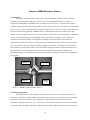
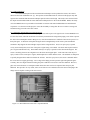
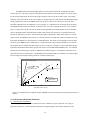
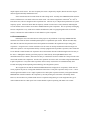
length. However, for RTD’s with few serpentine passes (in the case of our smallest sensor, n = 2), or small aspect
ratios, this approximation breaks down because electric current always flows in the path of least resistance. In other
words, a larger percentage of the current will flow along the inner corners of the serpentine, rather than along the
centerline and the outer corners. Keeping with the centerline approximation, the active sensor length can be written
as
l = n( a − w ) + w + ( n − 1) g + ( n − 1) w
(3.2)
l = na + ( n − 1) g
(3.3)
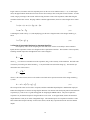
Combining this result with eq. (3.1) and simplifying gives the active length in terms of the design variables g, n,
and w
l = n 2 ( w + g) − g
(3.4)
3.4. Design of Serpentine Resistors for Constant Heat Flux
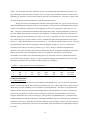
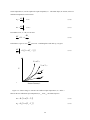
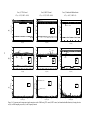
For simplicity, and to aid in comparing the effect that sensor size has on its ability to detect entrained
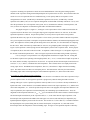
liquid, the three serpentine resistors were designed to have equal surface heat flux. The resistance of the serpentine,
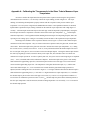
assuming constant temperature throughout the active sensor length, is
Rs =
χl
A cs
(3.5)
where Acs = wt is the cross-sectional area of the serpentine, and χ is the resistivity of the metal film. The bulk value
of resistivity for nickel given in the literature χ = 6.84 µΩ-cm has been used in this design [1]. The heat flux per
unit surface area of the sensor is
q& ′′ =
i s2 R s2
As
(3.6)
where is is the sensor current, and As is the surface area which can be expressed in terms of the design variables g,
w, and n
{
}
A s = wl = w n 2 ( w + g) − g
(3.7)
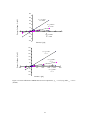
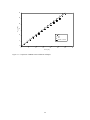
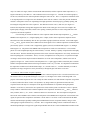
The concept of the sensor is to be able to evaporate, and detect individual liquid droplets. Barnhart has employed
P/DPA laser diagnostics to measure average droplet diameters of 50 microns after the dryout point of horizontal tube
evaporators [2]. This serves as a good starting point for designing the MEMS sensors. The power required to
evaporate a 50 µm diameter droplet of refrigerant R-22 is 0.017 mW. As an upper bound, assume the maximum
droplet diameter is 500 µm, an order of magnitude larger. The maximum power for evaporation would be 17 mW.
This assumes that a droplet will fully wet the sensor surface, and be fully evaporated before the arrival of another
droplet.
14