1
SPECIFICATIONS:
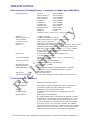
Down-Converter/Tracking Receiver (2 each, up to six bands up to 6000 MHz):
RF Input Frequency:
S-band (S):
2200-2400 MHz
NATO E-Band (E):
2185-2485 MHz
Upper L-Band (U):
1710-1850 MHz
Lower L-Band (L):
1435-1540 MHz
C1 band (C1):
4400-4940 MHz
C2 band (C2):
5091-5150 MHz
C2e band (C2e):
5091-5250 MHz
CIF band (CIF):
400-1150MHz
CIFe band (CIFe):
300-1150 MHz
P-band (P):
215-320 MHz
70 MHz (I)
70 MHz
(Custom RF bands available, please consult the factory)
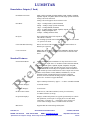
Input Level:
Maximum Input Level:
Tuner Resolution:
Frequency Accuracy:
Noise Figure:
IF Filters:
+10 dBm to threshold
+29 dBm (self-protection at startup)
50 KHz (consult factory for tighter resolution option)
0.001% typical, 0.002% max
5 dB (max); 3-4 dB (typical, near threshold)
SAW and FIR filters, default bandwidth auto- selected by “data rate, PCM
code and modulation format”, or user over-ride programmable filters.
Eight SAW pre-selection filters (0.25, 0.50, 1, 2, 5, 10, 20, 40 MHz)
Precision digital FIR filtering employed at demodulation input
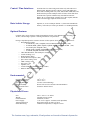
<10 KHz resolution bandwidth
Exceeds requirements for ARTM Tier II phase noise
(< -90 dBc/Hz typ at 10 KHz)
Programmable over any portion, -4V to +4V, Linear, Pos/Neg
CH1/CH2 & Combined
Selectable: 0.1, 1, 10, 100, 1000 mSec
Programmable between 0.1 and 6500 mSec
120 dB (+10 to -110 dBm)
> +10 dBm
DC to 50 KHz bandwidth, programmable output vs. AM depth
(Typical 2V p-p for 50% modulation depth in to 75 ohms)
CH1/CH2 & Combined
32 each lowpass filters
exceeds IRIG requirements, contact Lumistar for more information
Phase Noise:
AGC Slope and Range:
AGC Time Constants:
RF Input AGC Range:
Input Compression:
AM Demodulation:
AM Filtering:
Adj Channel Interference:
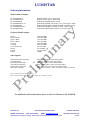
Pre-D and Post-D Combiners:
Combiner Types:
Digital Pre-D, Post-D, Pre & Post
Combining Modes:
Optimal Ratio (combining algorithm based upon measured S/N for
each channel), Equal Gain, or Best Channel Select modes
Polarization, Frequency and Spatial Diversity
> 2.6 dB typical for Optimal Select (equal RF input levels near
threshold)
50 KHz minimum for 30 dB fades.
The digital combiner employs a fast DSP-based algorithm to provide
“Optimal Ratio” combined signal based upon real-time CH1 v. CH2
“Signal to Noise” measurements. The IF combiner does not require
slow AGC information for combining decision and it is not a simple
“best-source selector” but a true diversity combiner. The combiner
operates with a break frequency of > 50 KHz with worst case multipath
fade scenarios (such as –sin/sin AM for CH1 vs. CH2). The combiner
supports polarization, frequency and spatial diversity applications.
Modes:
S/N Improvement:
Break Frequency:
The Lumistar name, logo, trademarks, IP and products are licensed to Harmonix Systems Inc.