1
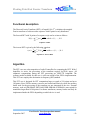
Floating Point Fast Fourier Transform V2.6 Functional description The Discrete Fourier Transform (DFT), of length N (N=2m), calculates the sampled Fourier transform of a discrete-time sequence with N points evenly distributed. The forward DFT with N points of a sequence x(n) can be written as follows: N 1 X (k ) n 0 x (n ) e j 2nk N with k = 0, 1, …, N-1 Equation 1: DFT The inverse DFT is given by the following equation: j 2nk 1 N 1 x ( n ) k 0 X ( k ) e N with n = 0, 1, …, N-1 N Equation 2 : Inverse DFT Algorithm The FFT core uses a decomposition of radix-2 butterflies for computing the DFT. With 5 butterflies in series, the processing of the transform requires log32(N) stages. All arithmetic computations during the FFT processing are IEEE-754 compliant. The software model available for this core is a bit true model of the FPGA implementation. This FFT core employs the decimation in frequency (DIF) method. This FFT core is designed for FFT computation larger or equal to 256 points and up to 1M points. Since FPGAs memory resources are limited and relatively small, the memory banks used for the processing of the transform are not integrated in the core. External memory, such as QDR SRAM, ZBT RAM, DDR SDRAM or SDRAM is most suited for transforms larger than 16384 points. For shorter transforms, memory banks can likely be implemented inside the FPGA depending on which device is used. September 2007 Fast Fourier Transform product manual www.4dsp.com -2-