1
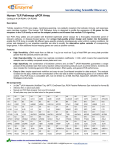
Accelerating Scientific Discovery Human Cancer Drug Target qPCR Array Catalogue # GA-C118A, GA-C118B Description Our PCR Array plates are pre-coated with EvaGreen-optimized primer assays for a thoroughly researched panel of relevant, pathway- or disease-focused genes. Our unique high-quality primer design and master mix formulation enable the PCR Array to amplify 96 different gene-specific products simultaneously under uniform cycling conditions. All primer sets designed by our expertise scientists are able to amplify the alternative splice variants of corresponding target genes. This Human Cancer Drug Target Array is designed to profile the expression of 88 key genes or targets for anticancer therapeutics and drug development. Features High Sensitivity: cDNA made from as little as 1 ng (or as much as 5 µg) of total RNA per array plate provides greater than 85 percent present call rates. High Reproducibility: the system has replicate correlation coefficients > 0.99, which means that experimental samples can be reliably compared across plates and runs. High Specificity: the combination of EvaGreen primers and 2x Elite qPCR MasterMix guarantees a single product of the predicted size from every reaction without secondary products such as primer dimers. Controls are also included for monitoring genomic DNA contamination, RNA quality, and general PCR performance. Easy to Use: simple experiment workflow and easy-to-use Excel-based template for data analysis. The analysis is based on the ΔΔCt method with normalization of the raw data to either housekeeping genes or an external RNA control. This PCR Array is compatible with, but not limited to, all ABI, Bio-Rad, Eppendorf, QIAGEN, Roche, and Stratagene instruments. TM Kit Components TM 2x Elite HotStart qPCR MasterMix (HotStart Taq, dNTP, EvaGreen Dye; ROX Passive Reference Dye included for format B) Adhesive films (1 piece each plate) Manual and PCR Data Analysis Tool (one CD included) 96-well plate array (see the table below for the genes included) A01 A02 A03 A04 A05 A06 A07 A08 A09 A10 A11 A12 ABCC1 AKT1 AKT2 ATF2 AURKA AURKB AURKC BCL2 BIRC5 CDK1 CDC25A CDK2 B01 B02 B03 B04 B05 B06 B07 B08 B09 B10 B11 B12 CDK4 CDK5 CDK7 CDK8 CDK9 CTSB CTSD CTSL1 CTSS EGFR ERBB2 ERBB3 C01 C02 C03 C04 C05 C06 C07 C08 C09 C10 C11 C12 ERBB4 ESR1 ESR2 FIGF FLT1 FLT4 GRB2 GSTP1 HDAC1 HDAC11 HDAC2 HDAC3 D01 D02 D03 D04 D05 D06 D07 D08 D09 D10 D11 D12 HDAC4 HDAC6 HDAC7 HDAC8 HIF1A HRAS HSP90AA1 HSP90B1 IGF1 IGF1R IGF2 IRF5 E01 E02 E03 E04 E05 E06 E07 E08 E09 E10 E11 E12 KDR KIT KRAS MDM2 MDM4 MTOR NFKB1 NRAS NTN3 PARP1 PARP2 PARP4 F01 F02 F03 F04 F05 F06 F07 F08 F09 F10 F11 F12 PDGFRA PDGFRB PGR PIK3C2A PIK3C3 PIK3CA PLK1 PLK2 PLK3 PLK4 PRKCA PRKCB G01 G02 G03 G04 G05 G06 G07 G08 G09 G10 G11 G12 PRKCD PRKCE PTGS2 RHOA RHOB TERT TNKS TOP2A TOP2B TP53 TXN TXNRD1 H1 H2 H3 H4 H5 H6 H7 H8 H9 H10 H11 H12 TP73 YY1 RPL13A B2M HGD1 HGD GAPDH GAPDH ACTB ACTB tuba1b HPRT1 Please consider the environment before printing. Tel: 1-240-683-5851 Fax: 1-240-683-5852 [email protected] www.eEnzyme.com Page 1 Accelerating Scientific Discovery Order Information We have two formats of 2x Elite TM qPCR MasterMix for different type of the realtime thermal cyclers. Format A is suitable for use with the real-time thermal cyclers that do not require a reference dye: Bio-Rad models CFX96, CFX384; Bio-Rad/MJ Research models Chromo4, DNA Engine Bio-Rad models iCycler, iQ5, MyiQ, MyiQ2, Opticon 2; Roche LightCycler 480 (96-well). qPCR Array Format A Human Cancer Drug qPCR Array trial size (Cat# GA-C118A1) Target 96-Well Plate Containing Dried Assays (Part# C118-120) 2 plates 12 plates Adhesive Film (Part# GA-005) 2 pieces 12 pieces 2 x 1.25 ml 12x 1.25 ml Human Cancer Drug Target qPCR Array (Cat# GA-C118A) TM 2x Elite qPCR MasterMix (HotStart Taq, dNTP, EvaGreen Dye) (Part# GA-135) Format B is suitable for use with the following real-time thermal cyclers: Applied Biosystems models 5700, 7300, 7500 (Standard and Fast), 7700, 7900HT (Standard and Fast), StepOnePlus, ViiA7 (Standard and Fast); Eppendorf Mastercycler ep realplex models 2, 2S, 4, 4S; Stratagene models Mx3000P, Mx3005P, Mx4000; Takara TP-800. qPCR Array Format B Human Cancer Drug qPCR Array trial size (Cat# GA-C118B1) Target 96-Well Plate Containing Dried Assays (Part# C118-120) 2 plates 12 plates Adhesive Film (Part# GA-005) 2 pieces 12 pieces 2 x 1.25 ml 12x 1.25 ml Human Cancer Drug Target qPCR Array (Cat# GA-C118B) TM 2x Elite qPCR MasterMix (HotStart Taq, dNTP, EvaGreen Dye, ROX Passive Reference Dye) (Part# GA-245) Storage o Keep in freezer (-20 C) and avoid exposure to light. Materials Required But Not Included The Reverse transcription reagents for making the cDNA from your prepared total RNA are not included in the array kit (Protocol and reagents from Invitrogen and Qiagen for reverse transcription have been tested and worked well along with this kit). High-quality, nuclease-free water. Do not use DEPC-treated water Low EDTA–TE buffer (0.1 mM EDTA) Important Notes before Use 1. Please read through this entire protocol before beginning your experiment. Please consider the environment before printing. Tel: 1-240-683-5851 Fax: 1-240-683-5852 [email protected] www.eEnzyme.com Page 2 Accelerating Scientific Discovery TM 2. The use of eEnzyme 2x Elite qPCR MastMix (included) is critical for obtaining the most accurate results from the PCR Array. 3. Make sure you have the correct PCR array plate format for your realtime PCR instrument to avoid damage. 4. The accuracy and precision of pipetting determines the consistency of the results. Make sure that all the micropipettors used are calibrated and not to introduce any bubbles into the wells of the PCR Array. 5. DEPC treated H2O should NOT be used. Use high-quality, nuclease-free H2O. Check with the supplier if not sure whether your RNase, DNase-free water has been treated with DEPC. 6. Exam the quality of your sample RNA before starting the experiment. TM 7. If precipitates are present in eEnzyme 2x Elite qPCR MastMix tubes, please contact a technical application scientist at 1-800-919-0755 or [email protected]. 8. Regarding the concern of genomic DNA contamination: our arrays are designed to skip at least one intron so that traces of contaminated genomic DNA in the sample, if there is any, will not be amplified. In addition, each pair of o primers are designed to have 60 C±1 annealing temperature, which guarantees that large-sized genomic DNA, if any, cannot be amplified. Workflow and Protocols 1. Make cDNA from your sample RNA. (refer to your reverse transcription kit manual, not included in the array kit.) TM 2. Thaw 2x Elite qPCR MasterMix on ice, vortex and briefly spin down. 3. Mix all following components in a tray for multi-channel pipetting. Carefully pipette precise 25 µl reaction mix to each of the 96 wells. Change pipet tips following each addition to avoid any cross-contamination. 2x Elite TM qPCR MasterMix 1250 µl Diluted cDNA 100 µl nuclease-free H2O 1150 µl Total Volume 2500 µl o Note: save the remainder of the cDNA synthesis reaction and store at -20 C for possible RNA quality analysis in later troubleshooting step. 4. Loading the PCR arrays: Please select your PCR Array Format for loading instruction. 4.1 Carefully remove the PCR Array from its sealed bag. 4.2 Dispense Experimental Cocktail to PCR Array Loading Reservoir to assist in loading (optional). 4.3 Add 25 µl of the Experimental cocktail to each well of the PCR Array, preferably from a reservoir with an eight- or twelve-channel pipettor. 5. Performing realtime PCR detection: Attention: Users of Bio-Rad and Eppendorf Realtime instruments - prior to initiating the run, make sure your instrument has been calibrated for using clear sticky film. Note: follow the manufacturer’s instruction for the proper operation and maintenance of your realtime instrument. 5.1. Carefully and tightly seal the PCR Array with the optical thin adhesive film. o 5.2. Centrifuge the plate for 1 full minute at 4 C at 1000g to remove bubbles. Visually inspect the plate from underneath of the plate to ensure no bubbles are present in each well. 5.3. Place the plate on ice while setting up the PCR cycler program below. 5.4. Place the plate in your realtime thermal cycler if recommended by your instrument’s user manual, use a compression pad with the optical film-sealed plate formats. o Note: PCR Arrays containing experimental cocktail may be store at -20 C wrapped in aluminum foil for up to one week until ready to run. 5.5. Enter and run the appropriate program for your realtime instrument. We provide a file to help customs easy to load software for both ABI and Bio-Rad realtime PCR instruments. Please consider the environment before printing. Tel: 1-240-683-5851 Fax: 1-240-683-5852 [email protected] www.eEnzyme.com Page 3 Accelerating Scientific Discovery Use a Two-step cycling program for the following instrumentation: Real Time PCR Instruments ABI:5700, 7000, 7300, 7500, 7700,7900HT StepOnePlus Bio-Rad: icycler, IQ5, MyiQ, MyiQ2, CFX96, CF384. Eplpendorf: Mastercycler ep realplex 2, 2s, 4, 4S Stratagene: Mx3000p, Mx3005p, Mx4000p Cycles Duration Temperature 1 5 min 95 C 40 15 seconds 95 C 1 min 58 C o o o o Attention: Bio-Rad CFx96 &CF384 users- adjust the ramp rate to 1 C/sec. 5.6. Calculate the threshold cycle (Ct) for each well using the instrument’s software. Note: for Roche Light Cycler 480 Users, there are two options available to analyze your data. Use the second derivate max setting and there is no need to set a threshold. i. To define the Baseline. Choose the Automated Baseline option if your instrument has the Adaptive Baseline Function (check with instrument manual or manufacturer if unsure). If it does not have the adaptive baseline function, you will need to set the baseline manually. Use the Linear View of the amplification plots to determine the earliest visible amplification. Set the instrument to use the readings from cycle number two (2) through two (2) cycles before the earliest visible amplification, but no more than cycle 15. The earliest amplification usually will be visible between cycles 14 and 18. ii. Manually define the threshold value by using the log view of the amplification plots and place it above the background signal but within the lower one-third to lower one half of the linear phase of the amplification plot. Important: ensure that the thresholds are the same across all PCR Array runs in the same analysis. The absolute position of the threshold is less critical than its consistent position across arrays. When the quality of the RNA sample adequately controlled, the cycling program executed properly, and the ppc thresholds defined correctly, the value of Ct should be 20±2 cross all of your arrays or samples. iii. Export the resulting threshold cycle values for all wells to a blank Excel spreadsheet for use with the PCR Array Data Analysis Template Excel. 6. Recommended Quality Control: Dissociation (Melting) Curve For instrument specific melt curve analysis settings, please refer to the corresponding instrument Setup Guide. o Note: If you decide not to obtain the dissociation curve immediately, save the plates in aluminum foil at -20 C as is, in case you need to do this operation at a later time for troubleshooting. When ready, simply warm the plate to room temperature, place it into your realtime instrument, and run the melting program described above. i. Be sure to visually inspect the plate after the run for any sign of evaporation from any of the wells. If evaporation is observed, make a note of which wells so that you may qualify your data analysis appropriately. ii. Do not open any previously run and stored PCR Array plate. Removing the adhesive film to see if PCR product is evaporated during PCR process. iii. Run a melting curve program immediately after the above cycling program, and generate a first derivative dissociation curve for each well in the entire plate using your instrument’s software. No o more than one peak should appear in each reaction at temperatures greater than 80 C. If your o instrument does not have a default melting curve program, run the following program instead: 95 C o o o o 1min. 65 C 2min (Optics off); 65 C to 95 C at 2 C/min (Optics ON). Please consider the environment before printing. Tel: 1-240-683-5851 Fax: 1-240-683-5852 [email protected] www.eEnzyme.com Page 4 Accelerating Scientific Discovery Gene Information Position A01 A02 A03 A04 A05 A06 A07 A08 A09 A10 A11 A12 B01 B02 B03 B04 B05 B06 B07 B08 B09 GeneBank NM_004996.3 NM_005163.2 NM_001014432.1 NM_001014431.1 NM_001626.4 NM_001243028.1 NM_001243027.1 NM_001880.3 NM_001256093.1 NM_001256091.1 NM_001256094.1 NM_001256092.1 NM_001256090.1 NM_003600.2 NM_198437.1 NM_198436.1 NM_198435.1 NM_198434.1 NM_198433.1 NM_004217.3 NM_001256834.1 NM_003160.2 NM_001015879.1 NM_001015878.1 NM_000633.2 NM_000657.2 NM_001168.2 NM_001012271.1 NM_001012270.1 NM_001786.4 NM_033379.4 NM_001170407.1 NM_001170406.1 NM_001789.2 NM_201567.1 NM_001798.3 NM_052827.2 NM_000075.3 NM_004935.3 NM_001164410.1 NM_001799.3 NM_001260.1 NM_001261.3 NM_001908.3 NM_147783.2 NM_147782.2 NM_147781.2 NM_147780.2 NM_001909.4 NM_001912.4 NM_145918.2 NM_001257973.1 NM_001257971.1 NM_001257972.1 NM_004079.4 NM_001199739.1 Symbol Name ABCC1 ATP-binding cassette, sub-family C (CFTR/MRP), member 1 AKT1 V-akt murine thymoma viral oncogene homolog 1 AKT2 V-akt murine thymoma viral oncogene homolog 2 ATF2 Activating transcription factor 2 AURKA Aurora kinase A AURKB Aurora kinase B AURKC Aurora kinase C BCL2 B-cell CLL/lymphoma 2 BIRC5 Baculoviral IAP repeat containing 5 CDK1 Cyclin-dependent kinase 1 CDC25A Cell division cycle 25 homolog A (S. pombe) CDK2 Cyclin-dependent kinase 2 CDK4 Cyclin-dependent kinase 4 CDK5 Cyclin-dependent kinase 5 CDK7 Cyclin-dependent kinase 7 CDK8 CDK9 Cyclin-dependent kinase 8 Cyclin-dependent kinase 9 CTSB Cathepsin B CTSD Cathepsin D CTSL1 Cathepsin L1 CTSS Cathepsin S Please consider the environment before printing. Tel: 1-240-683-5851 Fax: 1-240-683-5852 [email protected] www.eEnzyme.com Page 5 Accelerating Scientific Discovery B10 B11 B12 C01 C02 C03 C04 C05 C06 C07 C08 C09 C10 C11 C12 D01 D02 D03 D04 D05 D06 D07 D08 D09 D10 D11 NM_005228.3 NM_201284.1 NM_201283.1 NM_201282.1 NM_004448.2 NM_001005862.1 NM_001982.3 NM_001005915.1 NM_005235.2 NM_001042599.1 NM_000125.3 NM_001122742.1 NM_001122741.1 NM_001122740.1 NM_001437.2 NM_001040276.1 NM_001040275.1 NM_001214903.1 NM_001214902.1 NM_004469.4 NM_002019.4 NM_001160031.1 NM_001160030.1 NM_001159920.1 NM_002020.4 NM_182925.4 NM_002086.4 NM_203506.2 NM_000852.3 NM_004964.2 NM_024827.3 NM_001136041.2 NM_001527.3 NM_003883.3 NM_006037.3 NM_006044.2 NM_001098416.2 NM_015401.3 NM_018486.2 NM_001166420.1 NM_001166422.1 NM_001166419.1 NM_001166418.1 NM_001166448.1 NM_001530.3 NM_181054.2 NM_001243084.1 NM_005343.2 NM_176795.3 NM_001130442.1 NM_001017963.2 NM_005348.3 NM_003299.2 NM_000618.3 NM_001111285.1 NM_001111284.1 NM_001111283.1 NM_000875.3 NM_000612.4 NM_000207.2 EGFR Epidermal growth factor receptor ERBB2 V-erb-b2 erythroblastic leukemia viral oncogene homolog 2, neuro/glioblastoma derived oncogene homolog (avian) ERBB3 V-erb-b2 erythroblastic leukemia viral oncogene homolog 3 (avian) ERBB4 V-erb-a erythroblastic leukemia viral oncogene homolog 4 (avian) ESR1 Estrogen receptor 1 ESR2 Estrogen receptor 2 (ER beta) FIGF FLT1 C-fos induced growth factor (vascular endothelial growth factor D) Fms-related tyrosine kinase 1 (vascular endothelial growth factor/vascular permeability factor receptor) FLT4 Fms-related tyrosine kinase 4 GRB2 Growth factor receptor-bound protein 2 GSTP1 HDAC1 Glutathione S-transferase pi 1 Histone deacetylase 1 HDAC11 Histone deacetylase 11 HDAC2 Histone deacetylase 2 HDAC3 HDAC4 Histone deacetylase 3 Histone deacetylase 4 HDAC6 HDAC7 Histone deacetylase 6 Histone deacetylase 7 HDAC8 Histone deacetylase 8 HIF1A Hypoxia inducible factor 1, alpha subunit (basic helix-loop-helix transcription factor) HRAS V-Ha-ras Harvey rat sarcoma viral oncogene homolog HSP90AA1 Heat shock protein 90kDa alpha (cytosolic), class A member 1 HSP90B1 IGF1 Heat shock protein 90kDa beta (Grp94), member 1 Insulin-like growth factor 1 (somatomedin C) IGF1R IGF2 Insulin-like growth factor 1 receptor Insulin-like growth factor 2 (somatomedin A) Please consider the environment before printing. Tel: 1-240-683-5851 Fax: 1-240-683-5852 [email protected] www.eEnzyme.com Page 6 Accelerating Scientific Discovery D12 E01 E02 E03 E04 E05 E06 E07 E08 E09 E10 E11 E12 F01 F02 F03 F04 F05 F06 F07 F08 F09 F10 F11 F12 G01 G02 G03 G04 G05 G06 G07 G08 G09 G10 NM_001007139.4 NM_001042376.2 NM_001127598.1 NM_001185098.1 NM_001185097.1 NM_001098629.1 NM_001098627.2 NM_001098630.1 NM_032643.3 NM_001242452.1 NM_002253.2 NM_000222.2 NM_001093772.1 NM_004985.3 NM_033360.2 NM_002392.4 NM_002393.4 NM_001204172.1 NM_001204171.1 NM_004958.3 NM_003998.3 NM_001165412.1 NM_002524.4 NM_006181.2 NM_001618.3 NM_005484.3 NM_001042618.1 NM_006437.3 NM_006206.4 NM_002609.3 NM_000926.4 NM_001202474.1 NM_002645.2 NM_002647.2 NM_006218.2 NM_005030.3 NM_006622.3 NM_001252226.1 NM_004073.2 NM_014264.4 NM_001190801.1 NM_001190799.1 NM_002737.2 NM_002738.6 NM_212535.2 NM_006254.3 NM_212539.1 NM_005400.2 NM_000963.2 NM_001664.2 NM_004040.2 NM_198253.2 NM_001193376.1 NM_003747.2 NM_001067.3 NM_001068.2 NM_000546.5 NM_001126117.1 IRF5 Interferon regulatory factor 5 KDR Kinase insert domain receptor (a type III receptor tyrosine kinase) KIT V-kit Hardy-Zuckerman 4 feline sarcoma viral oncogene homolog KRAS V-Ki-ras2 Kirsten rat sarcoma viral oncogene homolog MDM2 MDM4 Mdm2 p53 binding protein homolog (mouse) Mdm4 p53 binding protein homolog (mouse) MTOR NFKB1 Mechanistic target of rapamycin (serine/threonine kinase) Nuclear factor of kappa light polypeptide gene enhancer in B-cells 1 NRAS NTN3 Neuroblastoma RAS viral (v-ras) oncogene homolog Netrin 3 PARP1 PARP2 Poly (ADP-ribose) polymerase 1 Poly (ADP-ribose) polymerase 2 PARP4 PDGFRA Poly (ADP-ribose) polymerase family, member 4 Platelet-derived growth factor receptor, alpha polypeptide PDGFRB PGR Platelet-derived growth factor receptor, beta polypeptide Progesterone receptor PIK3C2A PIK3C3 Phosphoinositide-3-kinase, class 2, alpha polypeptide Phosphoinositide-3-kinase, class 3 PIK3CA PLK1 Phosphoinositide-3-kinase, catalytic, alpha polypeptide Polo-like kinase 1 PLK2 Polo-like kinase 2 PLK3 Polo-like kinase 3 PLK4 Polo-like kinase 4 PRKCA Protein kinase C, alpha PRKCB Protein kinase C, beta PRKCD Protein kinase C, delta PRKCE PTGS2 Protein kinase C, epsilon Prostaglandin-endoperoxide synthase 2 (prostaglandin G/H synthase and cyclooxygenase) RHOA RHOB Ras homolog gene family, member A Ras homolog gene family, member B TERT Telomerase reverse transcriptase TNKS Tankyrase, TRF1-interacting ankyrin-related ADP-ribose polymerase TOP2A TOP2B Topoisomerase (DNA) II alpha 170kDa Topoisomerase (DNA) II beta 180kDa TP53 Tumor protein p53 Please consider the environment before printing. Tel: 1-240-683-5851 Fax: 1-240-683-5852 [email protected] www.eEnzyme.com Page 7 Accelerating Scientific Discovery G11 G12 H1 H2 H3 H4 H5 H6 H7 H8 H9 H10 H11 H12 NM_001126116.1 NM_001126115.1 NM_001126114.2 NM_001126113.2 NM_001126112.2 NM_001126118.1 NM_003329.3 NM_001244938.1 NM_003330.3 NM_182743.2 NM_182742.2 NM_182729.2 NM_001093771.2 NM_001261446.1 NM_001261445.1 NM_005427.3 NM_001126242.2 NM_001126241.2 NM_001126240.2 NM_001204192.1 NM_001204191.1 NM_001204190.1 NM_001204188.1 NM_001204185.1 NM_001204187.1 NM_001204184.1 NM_001204189.1 NM_001204186.1 NM_003403.3 NM_012423.3 NM_001270491.1 NM_004048.2 BSG-PAH01 BSG-PAH02 NM_002046.4 NM_001256799.1 NM_002046.4 NM_001256799.1 NM_001101.3 NM_001101.3 NM_006082.2 NM_000194.2 TXN Thioredoxin TXNRD1 Thioredoxin reductase 1 TP73 Tumor protein p73 YY1 RPL13A YY1 transcription factor Ribosomal protein L13a B2M HGD1 Beta-2-microglobulin Genomic DNA control HGD GAPDH Genomic DNA control Glyceraldehyde-3-phosphate dehydrogenase GAPDH Glyceraldehyde-3-phosphate dehydrogenase ACTB Actin, beta ACTB tuba1b Actin, beta Homo sapiens tubulin, alpha 1b (TUBA1B) HPRT1 Hypoxanthine phosphoribosyltransferase 1 Please consider the environment before printing. Tel: 1-240-683-5851 Fax: 1-240-683-5852 [email protected] www.eEnzyme.com Page 8