1
69
Adrianova et al. (1971), studied two different types of electrical current being modulated in an
alternating and pulsed bursts and another lower frequency and. The authors concluded that the
stream of 2,500Hz to be used according to provide greater pleasantness of stimulation to the patient.
D'Arsonval A., (1981) after experiments suggest that the alternating current voltage with a
fixed excitation neuromuscular could promote more intense in the frequencies from 1,250 to 1,500
Hz, making it more stable in the contraction frequency of 2,500Hz. Of 2,500Hz to 5,000Hz, the levels
of muscle contraction decreased exponentially.
The author also suggests that patients undergoing the training reported greater pleasantness
during the stimulation sessions when the applied current pulses had higher frequencies.
Thus, depending on the information described above can be concluded that:
- The studies presented in the material and Kots & Xvilon Adrianova, effectively support the use of
current Russian.
- Adrianova et al. (1971) concluded that the frequency of 1 kHz to about 2.5kHz should preferably be
used for higher power output when the muscles are stimulated in an indirect manner, peripheral
nerve stimulation. This hypothesis to direct stimulation is supported in a recent study by Ward and
Robertson (1998)
- The frequency 2.5 kHz should be used.
- The question of how much alternating current modulated to bursts of current Russian origin is more
effective for the production of muscular strength in relation to low frequency pulsed current is still
open pending further investigation.
- The regime 10/50/10 characteristic of Russian power was drawn from the use of a monophasic
pulsed current of low frequency and not from an AC-modulated bursts and average frequency which
holds Russian stimulation.
- The regime 10/50/10 was chosen for electrical stimulation through the current Russian as a function
of not causing reduced muscle strength during 10 minutes of stimulation.
- The initial studies using the current Russian support the use of the resource, but more studies are
necessary for some questions are elucidated completely.
-As regards the frequency of treatment per week does not seem suitable to take into account what
has been proposed by Russian authors stimulation breeders since the need of the number of sessions
varies from patient to patient depending on the condition being treated.
Electro stimulation - CARE AND CONTRAINDICATIONS
There is so far absolute contraindication to the use of electrical stimulation; however, some
precautions should be taken:
It does not apply to Pain Diagnosed: can motivate a more vigorous physical activity before a lesion is
recovered or mask serious illness.
Implanted electronic device: it is recommended that a patient with an implanted electronic device
(eg a pacemaker) is not subject to stimulation unless a specialized medical opinion has been
previously obtained.
Cardiac patients: may have adverse reactions. Be very careful attention and refold during application
of electrical stimulation.
DISRRITIMIAS: Monitor patients with ECG during the first sessions.
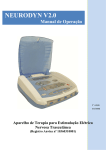
Instruction Manual - NEURODYN 10 chanells 9ª edition (07/2012)