1
and the pebbles will automatically construct a network topology. After deployment,
the robot can move to any pebble location in this network. Since infrared signals travel in a straight line, if one pebble has unobstructed line-of-sight to another pebble, the
robot can be expected to travel between these two pebbles. With our method, destinations are determined by pebbles, and thus it is easy to label destinations by associating
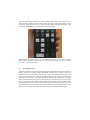
a pebble device ID with a name. In our current implementation, the user can easily do
this by putting physical labels on buttons on a remote control, for example, “kitchen”
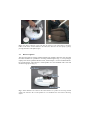
or “entrance” (Fig. 5). The user can select a labeled button for the target location. In
addition, our method explicitly prevents the robot entering into the area where the
user does not want the robot to do, because the robot moves by tracing the constructed
network trails. Although our method requires the user to place each pebble so that it is
within line-of-sight of neighboring pebbles, each pebble can provide LED feedback,
and the robot can provide voice feedback to confirm connection status. None of these
configuration processes require expert knowledge.
Our contribution is presenting a user-configurable method for robot navigation, rather than the system’s algorithms, communication technology, or network construction. LED and voice feedback helps the user to construct an appropriate network, and
we describe the interaction design between the user and the devices.
2
Related Work
Several positioning techniques have been proposed for indoor environment, where
GPS technology provides only limited performance. Radio-based fingerprinting [7] is
one of the trends in indoor positioning; in most cases, the system does not require
major changes to infrastructure because of the recent widespread presence of wireless
LAN [8]. Some other approaches calculate positions by installing sensors in the environment [9-13], including a commercial system [13]. Another popular approach is to
utilize cameras fixed in the environment [14]. Other approaches use passive tags to
calculate position. Saito et al. implemented an indoor marker-based localization system using coded seamless patterns [15]. Similar indoor localization systems have
been subsequently proposed using invisible markers installed on the ceiling [16].
These absolute positioning techniques can be used to determine robot position, but
navigating in the environment also requires environmental knowledge, in particular,
map information. Typically, registering such map information requires expert
knowledge and is not easy to reorganize after registration.
On the other hand, relative positioning by devices emitting beacon signals is another method of robot navigation. Similar to physical guides such as rails and lines,
the robot can trace signals to move among the devices. These devices also work to
understand environmental structure by detecting if the beacon signals reach others as
expected. There have been some work where a robotic system uses such beacon devices to determine the environment [17-20], and we share the basic idea of this previous work. However, the previous work does not discuss if an average user can deploy
such devices, which is our focus here. In contrast, a robot places the devices [17], or
robots themselves are the devices [18-20].