1
• generalization of the sensor data-type (from scalar-based to any type);
• idealistic communication and direct application communication;
• simple GUI for 2D world representation;
• concrete modules for: moving target, camera modelling, target tracking application.
We assume the reader to be familiar with the OMNeT++ environment and to know the basics about
the Castalia simulation model. The reference versions over OMNeT++ and Castalia are respectively the
4.1 and the 3.1. Documentations and tutorials about OMNeT++ can be found at the project documentation
page http://www.omnetpp.org/documentation. We particularly suggest to read the User Manual first and
then to use the API Reference when developing new modules. A copy of the Castalia user’s manual is
available at http://castalia.npc.nicta.com.au/documentation.php.
2
Overview
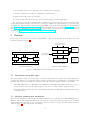
In this section, we present an overview of WiSE-MNet . The overall structure of the network and node
model is depicted in Figure 1.
to/from Physical Process
(WiseBasePhysicalProcess)
WiseBaseSensorManager
WiseBasePhysicalProcess
Node (Wise)
Node (Wise)
to/from other
WiseBaseApplication
WiseBaseApplication
Node (Wise)
Wireless Channel / Dummy Channel
(a) Network Model
Resource
Manager
Communication Module
Mobility
Manager
to/from Wireless Channel
to Wireless Channel
(b) Node (Wise) Model
Figure 1: WiSE-MNet network and node model overview
2.1
Generalized sensor data-types
The generalization of the sensor data-types is obtained by defining an abstract class WisePhysicalProcessMessage that has to be derived to define any type of physical process information. Accordingly, other
abstract classes have been modified to redefine some of the original Castalia modules. In particular:
• WiseBasePhysicalProcess, WiseBaseSensorManager and WiseBaseApplication that redefine respectively the base classes for the physical process, the sensor manager and the application layer;
• WisePhysicalProcessMessage, WiseSensorManagerMessage and WiseApplicationPacket information
exchange classes.
2.2
Idealistic communication mechanisms
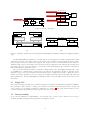
There are two “idealistic” communication mechanisms that have been introduced: the WiseDummyWirelessChannel and the DirectApplicationMessage. The first one changes the network properties (to idealistic)
seemingly from the application point of view, the second one is rather a “magic” direct information exchange
channel. Figure 3 represents the two mechanisms.
2