1
There were some important differences with the two manual types; other than that one
were written on paper and the other was online. The operations manual was not as
thorough as the one used in the Online Help, and the part describing the creation of
filters was not in the right chapter. This made it harder for those using the traditional
manuals to complete the test, then again the Online Help is supposed to make it easier
for the users to find the information they are looking for by combining the control and
operations manuals into a single manual. There were also other parts of the interface
that was not well enough explained, so both of the help types needs to be
complemented and rewritten, see the next chapter for more on this.
As mentioned in the result analysis (chapter 13) one of the test users said that she
preferred Online Help over the traditional manuals even though she seemed much more
at ease using the traditional manuals, i.e. she studied it more carefully. This could be
because she felt that she was supposed to answer Online Help and answering otherwise
could be seen as retrogressive. It could also be that the question itself was formulated in
a bad way, the question was “Which type of help do you generally like to use?” with
the options traditional manual or Online Help. This does not ask for which of the help
types she preferred in this test just which type she generally likes to use. So it is not
completely out of line to say that she may have been uncomfortable using the Online
Help in test, but she have no problem using Online Help for other applications.
Another thing that could have affect this result is that some of the participants knew the
supervisor that assisted in the test and knew that he really likes the concept of Online
Help. This could result in that they are more generous with the critic than they would
otherwise be. The tester mentioned above was one of these people.
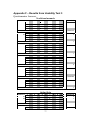
One may wonder if using numbered scales in the questionnaire is the right thing to get
the test subjects thoughts about the test. It is easy to compile but it can be hard for the
participants to translate their feelings to numbers. How do you really know the
difference between a ‘7’ or an ‘8’? Also the ‘1’ to ‘10’ scale that was used was chosen
so that there were no middle point, ‘5’ for example. This forces the person doing the
questionnaire to take sides, otherwise it very easy to just choose ‘5’ which in reality
really means “It is ok”. Now at least it is either a little bit good or a little bit bad. But it
is not always that the person answering notices this and chooses ‘5’ anyway because he
thinks that it is the middle number. This can explain that there were a lot of ‘5’ and ‘6’
answers for the group using the traditional manual.
Much of the result is a bit unclear and could perhaps have been made clearer if a larger
test had been held. The main issue was the lack of participants; six participants that
were divided into two groups seemed like a good idea and give a good enough result to
study. But for it to be more conclusive two or three more participants per groups may
have helped at lot. But since it was at the end of the vacation season at SMW it was
hard to get that many people during those two days. The reason that the test was held
around that time was because it was already overdue and the following week from
Wednesday to Wednesday was already booked for an opposition of another group’s
thesis. So in the end the test was as good as possible considering the circumstances.
63