1
Manual ASCO-P
1
Applications
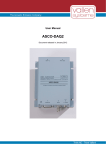
The ASCO-P (Acoustic Signal Conditioner with Peak Detector) lets you detect damage mechanisms, such
as crack formation, crack growth, fiber breakage, delamination, debonding of surfaces and others, as they
happen! This works with all brittle materials, e.g. fiber reinforced plastics, composites, ceramics, metals and
many more. In addition, the ASCO-P can detect and monitor leaks, partial discharge, particle impact, flow
turbulences, friction, corrosion and more.
The ASCO-P conditions the AE signal such that it can be recorded and evaluated by using a low-cost PC
plug-in data acquisition card and a minimum of software that shows voltage over time. With ASCO-P the
integration of AE measurements into an industrial application becomes straight forward and very
cost effective. The ASCO-P forms a very useful completion of your mechanical testing machine (tensile,
bending, scratch tests etc.) because it provides valuable information on the damage process in your sample
with very little effort.
2
Blockdiagram
The AE signal (delivered by a piezo-electrical AE-sensor) is fed-in over a BNC-connector and amplified by a
low noise preamplifier. A filter module rejects undesired frequency components. The high frequency signal is
rectified and the logarithm is obtained. This signal is smoothened by a low pass filter and presented at the
Output ASL (average signal level). In parallel, the logarithm signal is processed by a peak-stretcher which
holds even very short peak values for a defined time period and presents it at the Output APK (AE peak
amplitude). The log signal is compared against a threshold fed-in as analogue voltage (e.g. the analogue
output of a PC card). When the signal exceeds the selected threshold a pulse is generated, fed over an
optocoupler and presented at the pins Optocoupler+ and Optocoupler-. Depending on the application this
can trigger e.g. an alarm, or an image record, an event counter, or a more detailed analysis of the incoming
data.
3
Sensors
For the detection of rapid changes in the material, such as crack formation and growth, fracture, partial
discharge, etc., we recommend our sensor VS150-M which has the peak sensitivity at 150kHz. For the
detection of leak or friction in the range 25 to 80kHz, we recommend the VS30-V. For high frequencies up to
1.3MHz, e.g. from thin fiber reinforced materials or paper the VS700-D is well suited.
In order to meet special requirements, for instance high temperatures, different sensors have to be chosen.
Sensor and the model of the ASCO-P family have to be chosen according to the frequency range of interest.
Tel: +49 8178 9674-400
Fax: +49 8178 9674-444
file: ASCOmanE0803 page 2/12
Copyright © 2008, Vallen Systeme GmbH
Schäftlarner Weg 26a, 82057 Icking, (Munich), Germany
email: [email protected]
http://www.vallen.de