1
Doc:
UM1342
Issue: B
Date: 05/07/01
Page: 4/20
Author: PJM
1. Introduction
This manual is really aimed at people who have already used the LP1340 List
Processor or the T7 (seven trigger) variant and are familiar with the basic
principles of operation of Auxiliary Controllers in CAMAC Crates. Those who do
not have that experience should read the data sheet and this manual very
carefully before making a start. The best way to find out how to operate this
module is to start with the example given and then progress from there. Section
7 contains a lot of valuable information about the possible pitfalls in setting
this device to work and some more detailed information about how the hardware
actually works.
Users of the LP1340/T7 will find that this unit will run the same software as
that unit, except that bits 5-8 of the LAM registers will always be read as '1'
by the commands F(1) A(12,13,14), so they should be masked off by software.
After you have studied the data sheet on the module, this manual will outline
the basic principles of operation of the unit, what options are available and
how it differs from its predecessor, the LP 1340.
The major differences between this unit and the LP 1340 are as follows: a)
Larger Memories:
Data Store is 512K x 24 bits, optionally 1024K
Instruction Store is 8K x 16 bits and can be EEPROM.
b)
New Jump Instruction Format:
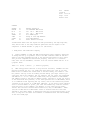
The new Jump Instruction Format is as follows:
|16 |15 |14 |13 |12 |11 |10 | 9 | 8 | 7 | 6 | 5 | 4 | 3 | 2 | 1 |
1
1
\ /
JUMP
JC2 JC1 JC0 A11
|
|
|
\
\
/
\/
JUMP CONDITION SPECIFIERS
A1
/
DESTINATION ADDRESS
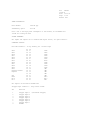
The Jump Condition Specifiers operate as follows: JC2
JC1
JC0
0
0
0
0
1
1
1
1
0
0
1
1
0
0
1
1
0
1
0
1
0
1
0
1
ACTION
Unconditional Jump
Jump if No Q response during last CAMAC cycle
Jump if data read greater than stored value
Jump if data read less than stored value
Jump unconditionally and await trigger
Jump if No Q and await trigger
Jump if data read equal to stored value.
Jump (unconditional) and restore Write Data Pointer.