1
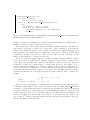
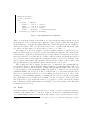
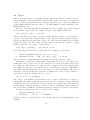
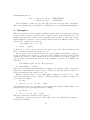
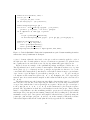
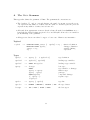
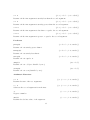
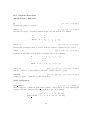
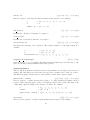
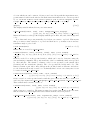
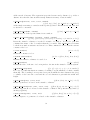
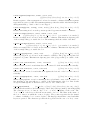
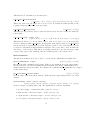
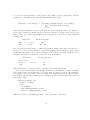
function primes(n) =
if n == 2 then [2]
else
let sqr primes = primes(ceil(sqrt(float(n))));
sieves = –[2*p:n:p]: p in sqr primes˝;
flat sieves = flatten(sieves);
flags = dist(t,n) <- –(i,f): i in flat sieves˝
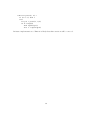
in drop(–i in [0:n]; flag in flags| flag˝, 2) ;
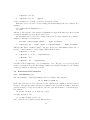
Figure 7: Finding all the primes less than n.
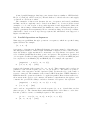
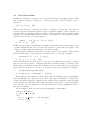
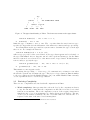
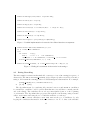
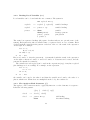
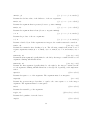
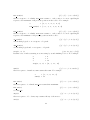
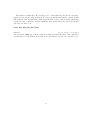
checks whether the ith character in w matches the ith position past the candidate index.
All candidates that do match are packed and passed into the recursive call of next char.
The recursion completes when the algorithm reaches the end of w. The progression of
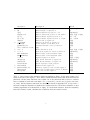
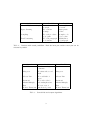
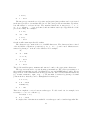
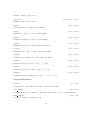
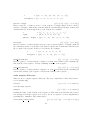
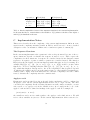
candidates in the "foo" example would be:
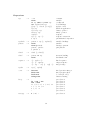
i
0
1
2
candidates
[0, 5, 8, 12]
[0, 5, 12]
[5, 12]
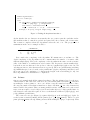
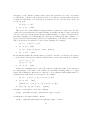
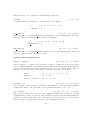
Lets consider the complexity of the algorithm. We assume #w = m and #s = n. The
depth complexity of the algorithm is some constant times the number of recursive calls,
which is simply O(m). The work complexity of the algorithm is the sum over the recursive
calls, of the number of candidates in each recursive call. In practice, this is usually O(n),
but in the worst case this can be the product of the two lengths O(nm) (the worst case can
only happen if most of the characters in w are repeated). There are parallel string-searching
algorithms that give better bounds on the parallel time (depth complexity), and that bound
the worst case work complexity to be linear in the length of the search string [15, 44], but
these algorithms are somewhat more complicated.
2.2
Primes
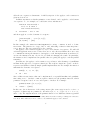
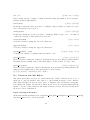
Our second example finds all the primes less than n. The algorithm is based on the sieve
√
of Eratosthenes. The basic idea of the sieve is to find all the primes less than n, and then
use multiples of these primes to “sieve out” all the composite numbers less than n. Since
√
all composite numbers less than n must have a divisor less than n, the only elements left
unsieved will be the primes. There are many parallel versions of the prime sieve, and several
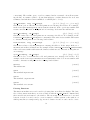
naive versions require a total of O(n3/2 ) work and either O(n1/2 ) or O(n) parallel time. A
well designed version should require no more work than the serial sieve (O(n lg lg n)), and
polylogarithmic parallel time.
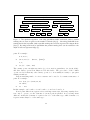
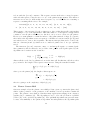
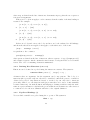
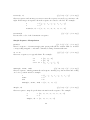
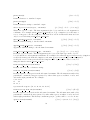
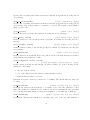
The version we use (see Figure 7) requires O(n lg lg n) work and O(lg lg n) depth. It
√
works by first recursively finding all the primes up to n, (sqr primes). Then, for each
prime p in sqr primes, the algorithm generates all the multiples of p up to n (sieves). This
18