1
1.
Introduction
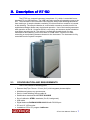
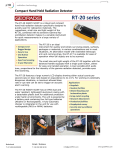
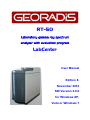
The RT-50 laboratory spectrometer is a 1024 channel gamma-ray spectrometer
with a cylindrical NaI/Tl (Sodium Iodide) scintillation detector (3‘‘diameter x 3‘‘ height),
enclosed in heavy lead shielding with a minimum wall thickness of 3.5 inches (9 cms).
A specially designed lid permits easy sample loading and removal. The analyzer unit
has an integrated high voltage supply, amplifier, analog - digital converter plugged
directly onto the detector socket. The RT-50 spectrometer unit operates under the
control of the system computer (PC) via a USB cable. The USB cable also supplies all
necessary power to the unit.
1.1.
APPLICATION RANGE OF THE RT-50
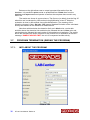
RT-50 is controlled from a standard PC using the LabCenter software program.
The LabCenter program calculates from measured gamma spectra concentrations of
natural radioactive elements K-40, U (natural) and Th (natural) or the activities of manmade elements - typically Cs-137, Co-60 and Am-241. The range of tested elements
can be extended by the use of suitable calibration standards.
Correct activity computation requires geometrical conformity with the calibration
standards. Size, mass, material and even the positioning of the sample in the detector
should be as similar as possible as those of the calibration samples to achieve the best
results and optimize system performance. A description of the basic supplied standards
can be found in chapter 4.2.
Use of heavy lead shielding (9 cm wall thickness) allows the RT-50 to reach very
low level detection limits of various radionuclides. The lid of the measuring chamber
must be kept closed during the measurement process.
1.2.
PREPARATION OF SAMPLES
Preparation of steel samples does not require any special procedures. The steel
calibration standards are designed to copy the typical geometries of samples
commonly used in the steel industry. The sample temperature must respond to the
detector temperature which means it must be equal to ambient room temperature.
Dust and slag samples must be milled and homogenized in suitable measuring
cans which must have a size similar to those of the dust calibration samples. The
weight of the sample should also be similar to the weight of the calibration sample and
within +/- 30 %. Measuring containers that are repeatedly used should be carefully
cleaned after each use to make sure there is no cross contamination of the
measurement sample.
1.3.
LIMITS OF DETECTION
Sensitivity of measurement – detection limit is influenced by several factors. In
addition to geometrical factors (shape of sample) the weight of the sample and
measurement time are also important.
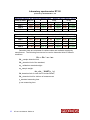
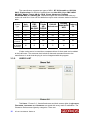
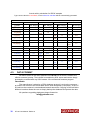
The following table gives the detection limits for most typical samples and
measurement times.
RT-50 User Manual Edition 8 5