1
CHAPTER 10. INTERNAL VALIDATION
the whole design space can only be obtained by an external validation of the approximation
fp itself, i.e., by testing it on a sufficiently large and properly selected test sample. The
task of selecting such a test sample is beyond the functionality of GTApprox. However,
if the user already has a test sample, applying the approximation to it and computing the
desired accuracy characteristics are straightforward operations, and the user should have no
difficulty in performing them.
10.3
Usage examples
10.3.1
Internal Validation for a simple and a complex functions
In this section we apply Internal Validation to two well–known two-dimensional test functions. The first is the Rosenbrock function,
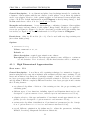
f1 px1 , x2 q “ 100px2 ´ x21 q2 ` p1 ´ x1 q2 ,
and the second is the Rastrigin function,
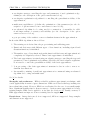
f1 px1 , x2 q “ 20 ` px1 ´ 10 cosp2πx1 qq ` px2 ´ 10 cosp2πx2 qq.
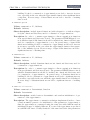
We consider the Rosenbrock function on the design space r´2.048, 2.048s2 and the Rastrigin
function on the design space r´5.12, 5.12s2 . It will be convenient, however, to map the
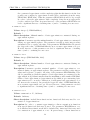
two design spaces, by rescaling, to the same unit cube r0, 1s2 , i.e., we set xk “ ´2.048 `
4.096x1k , k “ 1, 2, in the first case and xk “ ´5.12 ` 10.24x1k , k “ 1, 2, in the second, and
consider the two functions as functions of the variables 0 ď x11 , x12 ď 1.
We will perform Internal Validation of the approximation algorithm on these test functions, with a common training set chosen as a Latin Hypercube Sample of size 40, provided
by GT DoE.
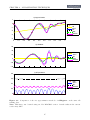
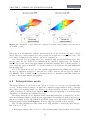
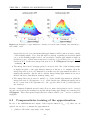
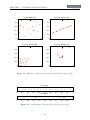
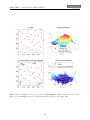
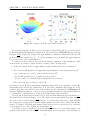
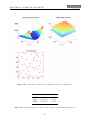
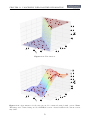
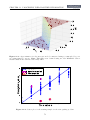
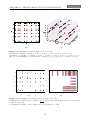
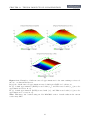
The graphs of the two functions are shown in Figure 10.1, a) and b), and the training set
is shown in Figure 10.1, c). Note that the Rosenbrock function is a quite simple function, and
we expect that 40 training points should be sufficient for a rather accurate approximation.
On the other hand, the Rastrigin function is a complex multimodal function with about 100
local minima/maxima. It is clear that 40 training points are far too few to resolve the high
frequency oscillations and hence achieve any reasonable approximation accuracy in this case.
We perform Internal Validation with default settings. According to formulae 10.1, the
training subsets then have size 36, the test subsets have size 4, and there are 3 training/validation iterations, for each of the two models.
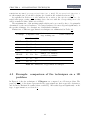
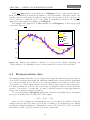
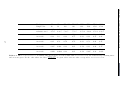
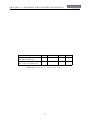
The results of the IV procedure are shown in Table 10.1. These results correctly reflect
our expectations. In the case of the Rosenbrock function, the RRMS error is significantly less
than 1, which confirms that the available training data allow to approximate the function very
accurately. On the other hand, the RRMS error for the Rastrigin function is approximately 1,
which shows that the training data is insufficient, and the advanced approximation algorithm
offers no improvement over the trivial approximation by the mean value.
10.3.2
Comparison of Internal Validation and validation on a separate test set
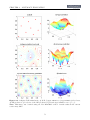
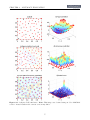
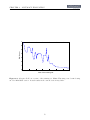
In this section we consider again the Rosenbrock and Rastrigin functions, and compare the
results of Internal Validation with the approximation errors obtained using an independent
test sample. To speed up the tests, GP is used as the approximation technique (see Section 4).
61