1
www.nordicsemi.no
WIRELESS HEADPHONES
nRF24Z1 headphone reference
design for CD quality audio streaming
Nordic Semiconductor’s nRF24Z1 is the ideal transceiver for linking wireless
headphones to portable music players. Nordic has now released a headphone
reference design to demonstrate the feasibility of the nRF24Z1 in this application
T
he Nordic Semiconductor nRF24Z1
single-chip 2.4 GHz, RF transceiver
is a wireless CD quality audio
streaming device suitable for
headphones communicating with CD-,
MP3- and Mini Disk-players.
The nRF24Z1 maintains 4 Mbit/s
bandwidth to stream true “lossless” digital
audio. The nRF24Z1 uses adaptive frequency
hopping to avoid clashes with other devices
operating in the 2.4 GHz band. The chip is
manufactured using low-cost 0.18 µm CMOS
fabrication, and is supplied in a 36-pin, 6 by
6-mm QFN package.
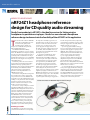
Nordic has produced a reference kit for
design engineers featuring functionality
similar to that of proprietary wireless
headphones. The reference kit demonstrates
the feasibility of the nRF24Z1 in music
players and provides comprehensive
guidance for the implementation of a
nRF24Z1-based design.
The hardware and published design files
aid customers who want to design their
own products based on the nRF24Z1. The
design files need only small alterations (for
example, to the printed circuit board (PCB)
form factor and placement of the user
interface buttons on the PCB) to convert
them to production-ready files.
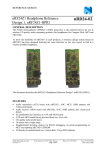
The reference design comprises an audio
transmitter (ATX) PCB, an audio receiver
(ARX) PCB and a daughterboard used for insystem programming and debugging. The
system is controlled by a microcontroller
(MCU) on the ATX board. Both the ATX
and ARX PCBs feature a user interface
comprising six push buttons and an LED.
The user interface can be easily modified.
In this application note we consider
how to avoid crosstalk, positioning and
impedance matching of the antennas for
optimum reception and reliable pairing.
Avoiding crosstalk
The nRF24Z1 is a radio transceiver using
packet-based transmission. Consequently,
4 NORDIC WIRELESS QUARTER JUNE 2006
the chip will constantly toggle between
transmit and receive modes. The current
draw in each mode is different and this
can give rise to a voltage ripple on the
power supply. If the ripple transfers to
the analogue audio element of the design
(i.e. the ADC, DAC and CODEC devices), a
persistent 250-430 Hz hum will be heard
through the earphones.
To avoid this contamination, when
the nRF24Z1 is used in combination
with ADC, DAC and CODECs it must be
considered part of the digital element. It
is very important to avoid power supply
noise generated by the nRF24Z1 (and
other digital circuitry) from reaching
the analogue supply pins and reference
voltage pins of the ADC, DAC and CODEC.
Star-routing directly from a low-noise
supply source (for example, a linear voltage
regulator) is highly recommended. The
nRF24Z1 should have its own power supply
line from the supply source. The ADC, DAC
and CODEC should also have their own
separate digital and analogue supply lines.
In some designs an LC filter (comprising
serial inductor and shunt capacitor) on the
analogue supply line to the ADC, DAC and
CODEC could also be required.
A power supply distribution strategy
based on star-routing from a linear voltage
regulator with supply decoupling for the
nRF24Z1, ADC and DAC devices has been
implemented on the ATX and ARX boards
of the reference design. This includes
a power supply distribution strategy,
supply decoupling, PCB layout and other
important design issues for the nRF24Z1,
plus the illustrated use of a Wolfson
Microelectronics ADC (WM8951L) and DAC
(WM8711L) in accordance with the relevant
datasheets for each device.
Good ground layout is just as important
as the power supply distribution strategy to
ensure the best possible performance both
from the nRF24Z1 and the ADC and DACs.
The ATX and ARX PCBs use a two-layer board
and available areas of each layer are covered
in the ground plane. The ground planes of
each layer are connected by via holes.
Nordic Semiconductor’s nRF24Z1 Headphone Reference Design