1
Lab 1: Introduction to Colorimetry
Background and Objectives
The visible light spectrum consists of a range of frequencies, each of which corresponds to a
specific color. Any visible light that strikes an object and becomes reflected (or transmitted to
our eyes) will contribute to the color appearance of that object. In the same way, the color of a
solution is a direct result of the wavelengths of light absorbed by the solution. So, if a solution
absorbs all of the frequencies of visible light except for the frequency associated with green
light, then the object will appear green.
Complementary colors - Green and red are "complementary" colors, as shown on the color
wheel below. A solution that absorbs mainly red light appears green and vice versa.
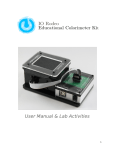
The objective of this lab is to build a colorimeter from electronic, mechanical, and software
components, and use it to investigate how different colored solutions absorb different
wavelengths of light.
22