1
NONMEM Users Guide: Introduction to NONMEM 7.3.0
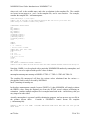
An existing chain file could actually be a raw output file from a previous analysis, with a list of
iterations. In the following example:
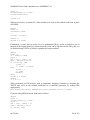
$EST METHOD=CHAIN FILE=example1_previous.txt NSAMPLE=0
ISAMPLE=-1000000000
could pick up the final result of the previous analysis, since ISAMPLE points to the iteration
number, and -1000000000 is the iteration number for the final estimate. Thus, the
CHAIN method in this usage is really just an input command to bring in values from a raw
output-type file format. Of course, users may have the chain file created by any program, not
just NONMEM, so long as it has the raw output file format, with delimiter specified by
DELIM/FORMAT (which is space by default).
(NM73) If the option ISAMPEND is set to a value greater than ISAMPLE, then NONMEM
will evaluate the objective function (using FOCEI method) for each sample between numbers
ISAMPLE and ISAMPEND in the file, and then select the one with the smallest objective
function. For example,
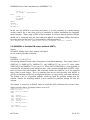
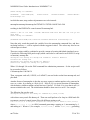
$EST METHOD=CHAIN FILE=random.txt NSAMPLE=20 ISAMPLE=1 ISAMPEND=20
randomly creates 20 sets of initial parameters, and selects the one with the lowest objective
function.
If METHOD=CHAIN is used, it must be the first $EST command in the particular $PROB.
Furthermore, because the settings it uses for FILE, NSAMPLE, ISAMPLE, IACCEPT, CTYPE,
and DF are functionally different from the way the other $EST methods use them, these settings
from METHOD=CHAIN are not passed on to the next $EST command, which must be an
estimation method. However, other parameters such as DELIM, FORMAT, SEED, AND
RANMETHOD will be passed on as default delimiter/format to the next $EST command.
However, the RANMETHOD does not propagate to the $CHAIN record.
DFS=-1 (DEFAULT, NM73)
As of NM73, the SIGMA matrix may be randomly created with an inverse Wishart distribution
centered about the initial SIGMA values, with degrees of freedom DFS for dispersion. If DFS=1 which is the default, then the method of earlier versions of NONMEM will be used, with the
cholesky elements uniformly varied over the interval (1-iaccept)*initial value and
(1+iaccept)*initial value. If DFS>one million, then SIGMA is fixed at the initial values. If
DFS=0, then the dimensionality of the entire SIGMA matrix is used as degrees of freedom.
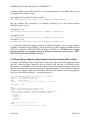
$CHAIN Record
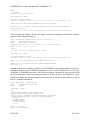
Any initial settings of THETA, OMEGA, and SIGMA that are read in by $EST
METHOD=CHAIN are applied only for the estimation step. The $SIML command will not be
affected, and will still use the initial settings given in $THETA, $OMEGA, and $SIGMA
statements, or from an $MSFI file. To introduce initial THETAs omegas and sigmas that will
cover the entire scope of a given problem, use the $CHAIN record:
nm730.doc
128 of 210