1
7
Computer operations
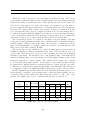
The answer to the question of what sampling frequency should be used gives us
Shannon’s theorem (also knows as Nyquist-Kotělnik-Shannon theorem). It defines
that a signal continuous in time, containing spectral components with the highest frequency 𝑓u�u�u� , can be clearly reconstructed from a sequence of evenly spaced
samples with a sampling frequency 𝑓u� greater than double 𝑓u�u�u� :
𝑓u� > 2𝑓u�u�u�
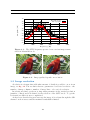
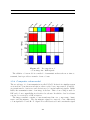
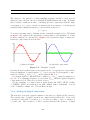
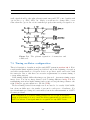
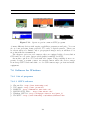
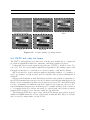
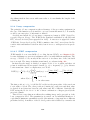
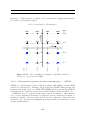
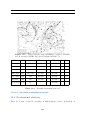
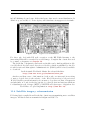
You can see the importance of Shannon’s theorem in the example below. The signal
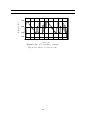
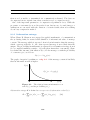
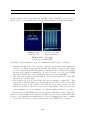
in figure 7.2a expresses the dependency between time 𝑡 and amplitude 𝐴. Using
Fourier’s analysis, we can find (see chapter 3.1.1), that the signal contains two
harmonic components, showed in 7.2b.
A
A
t
t
a) Surveyed signal
Figure 7.2:
b) Spectral components
Example of signal.
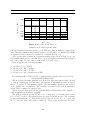
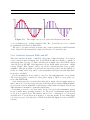
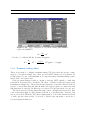
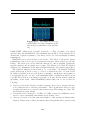
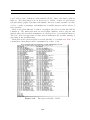
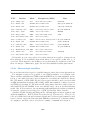
By using Fourier’s transformation, the signal can also be expressed as a dependency
between amplitude 𝐴 and frequency 𝑓 – signal spectrum. Both frequency components are evident 𝑓1 and 𝑓2 = 𝑓u�u�u� in the signal in fig. 7.3.
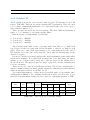
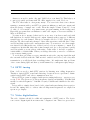
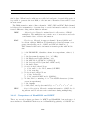
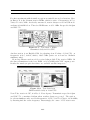
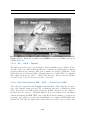
For explicit signal reconstruction the condition 𝑓u� > 2𝑓u�u�u� must be satisfied, see
fig. 7.4. If a sampling frequency is lower then 2𝑓u�u�u� then the higher frequency
components are lost. This error is called aliasing.
For the sampling of common narrow band signals like SSTV, RTTY, PSK31
or WEFAX, which are transferred via SSB channel with a bandwidth of about
2 500—3 000 Hz; a sample rate of 11,025 Hz is enough.
7.2.2 Analog-to-digital conversion
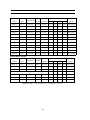
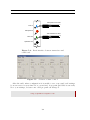
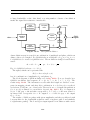
The next way of an analog signal continues to the analog-to-digital (A/D) converter.
The current value of signal converted into digital data in this device. Some A/D
converters works with a resolution 8 or 16 bits according to type or settings of
a sound card. The resolution of A/D converter indicates the accuracy of signal
68