1
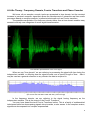
Basically, and most importantly to us, what Fourier discovered boils down to the general
rule that every sound, however complex, can be represented by a sum of sinusoid functions that
are combined to make up what we hear:
Fast Fourier transform (FFT): An efficient algorithm for calculating the discrete Fourier
Transform (DFT) – a transform for discrete (or digital) signal.
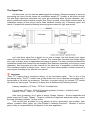
The FFT analysis can transform our time domain signal into a complex form (both
sonically and graphically), and later, the plug-in transforms that complex form into polar form or
arrays with magnitude and phase for convenient representation. In actuality, some of modules
proceed not only magnitude and phase arrays but work with real/imagery complex data and the
converts everything back into a polar form.
It is not necessary to understand fully how the FFT algorithm works to get the results you
need, and if you like, you can think of the FFT functions as a sort of "black box" that performs
the required functions necessary for you to manipulate your sound in new and creative ways.
To learn more about this subject, use www.google.com.
Phase Vocoding is a technique for sound design that was, until recently, impossibly DSPintensive to perform in real time in most native computer environments.
This method was introduced in 1966 and digitally implemented ten years later. It uses a
Short Time Fourier Transform (which we will abbreviate as STFT from here on) to convert the
audio signal to the complex Fourier representation. STFT means the FFT (see above) is taken
from small potions (buffers) of original sample – this is exactly how our plug-in works. Advanced
users interested in the science behind the magic may like to read Chapter 4: The science
behind it. Those who wish to get on with making sounds without the being bothered with such
things can should continue to the next sections...
7