1
Operation
Maintenance
Read all the safety instructions in this manual before operating any
Foredom Power Tool. Proper eye and face protection must be worn to
protect you from injuries caused by flying debris, chips, or sparks which
might result from the work being done.
It is very important to routinely clean and lubricate your Foredom Power
Tool, especially in areas that generate a lot of dust. Dirt and improper
lubrication are the most common causes of poor operation and excessive
wear. Always disconnect power tool before cleaning or servicing.
Your Foredom motor may be operated in a vertical or horizontal position, but it
should not be enclosed or confined so as to restrict air circulation. If the motor is
hung up above a workbench, be sure it is fastened securely to the wall or motor
hanger. The motor may develop a high operating temperature (up to 100oF +
ambient) after prolonged use, and it will be too hot to hold. This will not harm the
motor which is designed to operate at this temperature for prolonged periods.
Follow these guidelines for trouble-free use:
a 4″or larger radius, as shown to the right, should
be maintained for shafts on all motors. In its normal
curved position, the Series H can withstand 28 lbs. of
torque before breaking. All other Series can tolerate up to
12 lbs. of torque. There is no way to avoid ultimate wear
and under normal conditions a flexible shaft machine may
require several replacement shafts and sheaths during its
lifetime. (Follow shaft and sheath assembly instruction in the
Assembly section of this manual.)
Do not force the tool
Do Not
Do This!
1. Routine Cleaning of Universal Motors
Universal Motors need air circulation through the motor housing to remove
waste heat and cool the windings. Inlet and outlet slots provide the means for air
flow. However, dust and conductive debris (like metal filings and gold dust) can
enter in through these slots. If not cleaned regularly, dust could collect, making a
bridge between parts, causing an electrical short. Therefore, in high dust
environments, Foredom recommends cleaning the motor every 40 hours
of use. To remove dirt/dust buildup, brushes should be removed, cleaned and
replaced, and air should be blown through the motor.
2. Routine Cleaning and Lubrication of Flexible Shaft
The flexible shaft should be cleaned and lubricated once every 50 hours of use.
Expose the shaft by removing the handpiece and then the sheath. Apply a light
film of Foredom flexible shaft grease (Part No. 10006) along the entire length of
the shaft. Replace the sheath according to instructions in the Assembly and
Installation section of this manual. Once every 200 hours, the shaft should be
thoroughly cleaned with a solvent and lubricated.
3. Replacement of Motor Brushes
The motor brushes should be check for wear periodically. When new, they are
approximately 19mm long. They should be replaced when they have worn to
6mm. To remove brushes, disconnect motor power cord and unscrew the brush
caps. Be sure that the contour of the brush matches the armature when
replacing them.
Minimum
Operating
Radius
4. Replacement of Worn Shafts and Sheaths
Be sure to disconnect your power cord before servicing. Shafts and sheaths last
longer when they are used at a straight angle. If used at sharp angles or loops,
wear will occur at the points of greatest friction. There is no way to avoid ultimate wear, and under normal conditions a flexible shaft machine may require
several replacement shafts and sheaths during its lifetime. Follow replacement
instructions in Assembly section of this manual.
4″ radius
4″ radius
Do not bend at tight angle.
Shafts and sheaths last longer when they are
used without sharp bends. If used at angles or
loops, wear will occur at the points of greatest
friction. When operating your power tools be
careful not to bend the flexible shaft too much
at either the handpiece or motor shaft connections. Excessive heat and wear will occur if the
bend is too great.
Note: Ball Bearing Motors do Not Require Lubrication.
Let the speed of the tool do the work. Avoid using too much
pressure. Generally, slower speeds are used for rougher,
heavier work or when greater control over the accessory is
required for precise, delicate work. Higher speeds are used for
buffing, cutting and polishing. Read Accessory Recommendations on page 7 of
this manual.
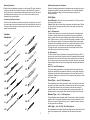
5. Handpiece Lubrication (See page 5 for handpiece photos.)
Numbers 7A and 7AD*: Unscrew the front housing which exposes the spindle.
Clean the spindle thoroughly with solvent. Apply several drops of Foredom oil
(part nos. 10005 or 10010) to the spindle and spread it over the spindle uniformly. This should be done each 20 hours of operation.
Voltage Decreases
Never operate a power tool during a perceptible power decrease. Turn off tool
and unplug until full power is restored.
Numbers 8, 8D*, 18, 18D*, 25, 25C, 30®, 35, and 44T: These handpieces have
been permanently lubricated with greased-shielded ball bearings and should
absolutely not be lubricated.
Always wear proper eye and face protection when operating
9
10