1
NA 501
500W
1
FM POWER AMPLIFIER
GENERAL DESCRIPTION
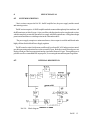
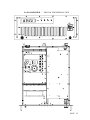
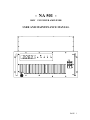
The NA 501 is a highly integrated broadband solid-state Mos-Fet FM amplifier of 500W rated
power, fitted in a 4 unit 19" rack, which do not require any specific calibration to operate in the 87.5 ÷
108 MHz frequency range.
Its compact size, high efficiency, wide mains range acceptance, low maintenance requirements
and broadband construction, make this amplifier ideal in medium power repeaters, in unattended
posts, in N+1 systems and as a reserve.
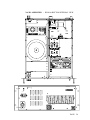
Its sturdy, modular mechanical and electrical construction guarantees a high MTBF and an
easy maintenance. The modules are easily identifiable and inspectable with few interconnections
each with the other, through multi-pole connectors.
The nominal RF output power is obtained over the full FM range with a mere 8W drive and is
particularly stable against time, temperature and frequency variations being ALC regulated, with a front
panel adjustment. The output power may be varied from a minimum level to the nominal level and the
frequency varied over the full FM range, without retouching the drive power or any other adjustment
than the ALC control.
The output stage has a reverse intermodulation figure, which is lower than standard bipolar
construction, due to the all Mos-Fet design and approaches that of tube equipment.
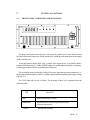
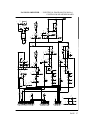
A simple metering and alarm section completes the amplifier, permitting an easy check of
the functioning with few, unambiguous readings. Power readings and control are externally
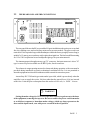
available on a remote I/O port, for an external controller. A suitable one may be supplied on
request to permit full remote control of the Unit from the studio or another service centre.
The whole assembly is designed in accordance with the CCIR, FCC and tighter international
norms and conforms to the recent, strict
requirements for EMI susceptance and emission.
This equipment complies in particular to ETSI EN300.384 and EN 300.447
Broadcast and EMI/EMC standards, EN60065 and EN60215 safety
standards and FCC parts 73 & 74.
PAGE 3