1
Introduction
This Patient Manual will acquaint you with AirSep’s
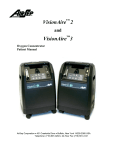
VisionAire 2 and VisionAire 3 Oxygen Concentrators.
Make sure you read and understand all of the
information contained in this guide before operating
your concentrator. Should you have any questions,
your Equipment Provider will be happy to answer
them for you.
Why Your Physician Prescribed Oxygen
Many people today suffer from a variety of heart,
lung, and other respiratory diseases. A significant
number of these patients can benefit from
supplemental oxygen therapy for respiratory care at
home, in the hospital, or at a medical facility.
Oxygen is a gas that makes up 21% of the room air
we breathe. Our bodies depend on a steady supply
to function properly. Your physician has prescribed
supplemental oxygen therapy because your body is
not able to get enough oxygen from room air. Oxygen
is a non-addictive drug, and your physician prescribed
a flow sufficient to improve your condition.
Please keep in mind that unauthorized oxygen therapy
can be dangerous. You must seek medical advice
before you use this unit. The Equipment Provider who
supplies your oxygen equipment will demonstrate how
to set the prescribed flow rate.
What is an Oxygen Concentrator?
Oxygen concentrators were introduced in the mid1970s and have become the most convenient, reliable
source of supplemental oxygen available today.
Without an oxygen concentrator, the average patient
would require a delivery of 12 bottles/cylinders
of oxygen each month. Your oxygen concentrator
produces all the oxygen you need, with no deliveries
required.
The air we breathe contains approximately 21%
oxygen, 78% nitrogen, and 1% other gases. In the
VisionAire 2 or VisionAire 3 unit, room air passes
through a regenerative adsorbent material called
molecular sieve. This material separates the oxygen
from the nitrogen and other gases. The result is a
constant supply of high concentration supplemental
oxygen that is delivered to the patient.
Note: There is never a danger of depleting the
oxygen in a room when you use your VisionAire 2 or
VisionAire 3 unit.
8 — MN165-1 H
Operator Profile:
AirSep’s Stationary Concentrators are intended
to supply supplemental Oxygen to users suffering
from discomfort due to ailments which affect the
efficiency of ones lungs to transfer the oxygen in
air to their bloodstream. Users can benefit from
supplemental oxygen therapy for respiratory care at
home, in the hospital, or at a medical facility. Oxygen
Concentrator use requires a physician’s prescription,
and are not intended for life support use.
Although Oxygen therapy can be prescribed for
patients of all ages the typical oxygen therapy patient
is older than 65 years of age and suffers from chronic
obstructive pulmonary disease (COPD). Patients
typically have good cognitive abilities and must be
able to communicate discomfort. If the user is unable
to communicate discomfort, or unable to read and
understand the concentrator labeling and instructions
for use, then use is recommended only under the
supervision of one who can. If any discomfort is felt
while using the concentrator, patients are advised
to contact their healthcare provider. Patients are
also advised to have back-up oxygen available (i.e.
cylinder oxygen) in the event of a power outage or
concentrator failure. There are no other unique skills
or user abilities required for concentrator use.