1
The CRC(XM) is listed to UL-864, the fire alarm standard, to UL294, the access control system unit standard, and to UL-609/
ULC-S303 burglar alarm standards. This raises the level of the
access control components up to the high standards of fire alarm
equipment and permits fire, security, and access control functions
to be fully integrated while assuring all listing and code requirements are met.
The CRC’s flexibility supports three different versions of anti–
passback: strict, timed, and logged. Strict anti-passback requires
the use of an exit reader and will not permit reuse of a card until
it has been used to exit the area. In order to eliminate the need
for an exit reader, the timed anti-passback mode prohibits the
reuse of the card for a predetermined time period. This virtually
eliminates users passing a card back to a second user, this is the
origin of the anti-passback feature. The logged anti-passback
mode permits access, but logs any violation to history for future
employee counselling.
When an area is served by more than one door, a networked
system is required to provide support for two-man rule operation,
muster operation, and strict anti-passback. The network coordinates user information between CRCs that serve a common area.
ACDB-KE Keyless Entry Applications
The CRC provides effective support for standalone applications in
conjuction with EST’s ACDB-KE keyless entry software package.
ACDB-KE can accommodate up to 31 doors. It offers many of
the standard access control features found in the ACDB including cardholder-specific access privileges, multiple access levels,
customizable schedules, and holiday rules.
ACDB-KE offers no security functions. However, CRC Form-C
relays can be configured to trigger external door openers, or they
can be programmed to interface with third-party security systems.
To achieve security functionality, the relay can be set to change
state if no rex, valid card read, or unlock timer is in effect when the
door is opened. When connected to a security system, this allows
the use of the door position contact as a security input.
ACDB-KE communicates with the CRC via hard-wired RS-232 to
RS485 converters.
Database Management
ACDB-KE standalone keyless entry systems communicate with
CRCs via hardwired RS-232 to RS-485 converters.
Engineering Specification
Synergy Enabled Applications
The Card Reader Controller (CRC) shall provide the power and
electronics required to monitor and control a single door, both
entry and exit readers; all necessary support for request to exit
devices, automatic door openers, and locking mechanisms. All
access decisions shall be made by the CRC. Decisions made by
a centralized controller shall not be considered as equal. Each
CRC shall maintain all schedules and holiday schedules for up to
<8,000><36,000> cardholders. Upon loss of communication with
the security/access control module, the CRC default mode shall
provide 100% functionality utilizing all schedules and holiday data
stored in its memory, and shall not grant access solely by matching facility codes. Each controller shall retain <5,000><20,000>
history events in its memory. History events shall be uploaded
to the access control database program under manual and/or
automatic control.
The CRC shall be capable of connecting to any credential reader that
Page 3 of 6
uses the standard Wiegand output protocol format, and shall support PIN# input through a keypad (using 8-bit Dorado format) that is
integral to the reader. It shall be possible to program a PIN schedule
such that a PIN number is only required at specific times (eg. weekends and evenings) to gain access and <is><is not> required during
regular business hours. The controller shall provide two configurable
supervised input circuits for use as request to exit devices, security
inputs, or manual “buzz in” control. The controller shall provide a set
of form “C” relay contacts to activate an automatic door opener when
a valid card with the handicapped option enabled is presented to the
reader. Other relay functions shall be programmable
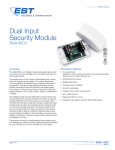
The CRC shall be housed in an attractive enclosure suitable for
surface mounting near the door without detracting from interior
aesthetics. Power for the CRC shall be <16VAC provided by a local
class 2 plug-in transformer> <24 VDC supplied by the integrated
network> <The controller shall be equipped with a standby battery and integral charger, to minimize the effects of a loss of power.
The battery shall be capable of operating a lock strike for up to four
hours.> The controller shall provide 12 VDC @ ½ amp to operate
the door locking mechanism. The lock control voltage shall be configurable as either energize to access or de-energize to access.
As a multi-function component of a truly integrated system, the
card reader controller shall be listed according to Underwriter’s
Laboratory Standards: <UL-294 Access Control System Units,
UL-864 Control Units for Fire-Protective Signaling Systems,
and UL-1610 Central-Station Burglar-Alarm Units><ULC-S527,
UL-294, ULC-S301>. Controllers not having all of the specified
agency listings will not be considered as equal.
The card reader controller shall be a Edwards model <CRC (8,000
cardholder)><CRCXM (36,000cardholder)>.
ACDB-KE Applications
The Card Reader Controller (CRC) shall provide the power and
electronics required to monitor and control a single door, both
entry and exit readers; all necessary support for request to exit
devices, automatic door openers, and locking mechanisms. All
access decisions shall be made by the CRC. Each CRC shall
maintain all schedules and holiday schedules for up to 8,000
cardholders.
The CRC shall be capable of connecting to any credential reader
that uses the standard Wiegand output protocol format, and shall
support PIN# input through a keypad (using 8-bit Dorado format)
that is integral to the reader. It shall be possible to program a PIN
schedule such that a PIN number is only required at specific times
(eg. weekends and evenings) to gain access and <is><is not>
required during regular business hours. The controller shall provide
two configurable supervised input circuits for use as request to exit
devices, security inputs, or manual “buzz in” control. The controller
shall provide a set of form “C” relay contacts to activate an automatic
door opener when a valid card with the handicapped option enabled
is presented to the reader. Other functions shall be programmable
The CRC shall be housed in an attractive enclosure suitable for
surface mounting near the door without detracting from interior
aesthetics. Power for the CRC shall be <16VAC provided by a local
class 2 plug-in transformer> <24 VDC supplied by the listed power
supply> <The controller shall be equipped with a standby battery
and integral charger, to minimize the effects of a loss of power. The
battery shall be capable of operating a lock strike for up to four
hours.> The controller shall provide 12 VDC @ ½ amp to operate
the door locking mechanism. The lock control voltage shall be configurable as either energize to access or de-energize to access.
The card reader controller shall be a Edwards model CRC.
85001-0528
D ATA S H E E T
Not to be used for installation purposes. Issue 6