1
Straw spreading was good. The straw spreaders spread the
straw evenly over about 16 ft (4.9 m).
Ease of Operation and Adjustment: Operator comfort in the
Sperry New Holland TR85 was fair. Operator comfort was reduced
by the loud cab noise caused by rotor and concave vibration when
harvesting. The cab was relatively dust free. The heater and air
conditioner provided comfortable cab temperatures. The seat and
steering column could be adjusted to suit most operators. The
cab windows provided clear visibility forward and to the sides. The
view of the incoming windrow was partially blocked. The rear view
mirrors did not provide adequate depth perception. Instrumentation
was good. They monitored most important functions and had
built-in warning systems. They worked well and were helpful. The
digital display and loss monitor were inconvenient to view while
harvesting, Controls were good. Most controls were conveniently
located, responsive, and easy to use.
Loss monitor performance was fair. Only shoe loss was
monitored and since shoe loss was usually very low, it was of
little use. The reading was only meaningful if compared to actual
losses observed at various loss levels.
Lighting for night time harvesting was good, although the
upper console did not have adequate lighting. The warning
ashers were not clearly visible from behind during the day.
Handling was good. Although the steering was moderately
stiff the combine steered well and was very maneuverable in the
eld and on the road.
Ease of adjusting the combine components was good, while
ease of setting them to suit crop conditions was very good. The
return tailings were inconvenient to check.
Ease of unplugging was fair. The rotors were dif cult to
access. The table auger was inconvenient to reverse. Ease of
cleaning was fair. Dirt and chaff collected under the engine and on
top of the rotor housing. Chaff and dirt had to be cleaned regularly
from behind the rasp bars.
Ease of lubrication was good. The fuel inlet was high. Most
grease ttings were easily accessible. Ease of performing most
general maintenance and repair was good.
Engine and Fuel Consumption: The engine started easily
and ran well. It had adequate power for easy-to-thresh crops
but was underpowered for hard-to-thresh crops. Its average fuel
consumption for the season was about 6.7 gal/h (30.4 L/h). Oil
consumption was signi cant but not excessive.
Operator Safety: Operator safety was good. The Sperry New
Holland TR85 was safe to operate if normal safety precautions
were taken and warnings heeded.
Operator Manual: The operator manual was good. It provided
much useful information but had several incorrect references.
Mechanical History: A few mechanical problems occurred
during the test.
RECOMMENDATIONS
It is recommended that the manufacturer consider:
1. Modi cations to reduce threshing vibration and prevent
material build-up behind the rasp bars.
2. Modi cations to provide positive locking of the grain tank
extensions.
3. Modi cations to provide faster grain unloading.
4. Supplying additional rear view mirrors to improve depth
perception.
5. Relocating the digital display for more convenient observation
while harvesting.
6. Improving upper console lighting.
7. Modi cations to improve the ease of adjusting the stone
ejection roller.
8. Modi cations to improve the ease of adjusting the chaffer
extension sieve.
9. Supplying a safe, more convenient apparatus for sampling
the return tailings while harvesting.
10. Modi cations to provide convenient header unplugging.
11. Modi cations to improve visibility of the warning/signal lights
from the rear.
12. Including feeder house removal instructions in the operator
manual.
13. Revising the operator manual to clearly identify all lubrication
points and to correct referencing errors.
14. Correcting the suggested chaffer sieve and cleaning sieve
settings for wheat.
15. Modi cations to improve the ease of header drive belt removal
and installation.
16. Modi cations to protect the header wiring harness.
Senior Engineer: G. E. Frehlich
Project Manager: L. G. Hill
Project Technologist: R. M. Bartel
THE MANUFACTURER STATES THAT
With regard to recommendation number:
1. Future models will have a new rotor design, which will greatly
reduce vibration and material build-up behind the rasp bars.
2. Changes to the locking device on the grain tank extensions
are being considered.
3. Faster grain unloading is being evaluated for future models.
4. Different types and con gurations of mirrors are being
evaluated and will be introduced on future models.
5. The digital display will be relocated on future models.
6. Improved console lighting will be incorporated on future
models.
7. We will consider changing this.
8. We will consider changing this.
9. No changes are planned.
10. A feeder and header reverser will be available in the very near
future.
11. Changes will be made in this area on future models.
12. These instructions will be included in a revised manual. They
are presently included in the Service Manual.
13. These areas will be corrected in the revised manual.
14. Suggested settings will be revised in the new manual.
15. This area has been redesigned beginning with 1984
productions.
16. The wire harness has been rerouted beginning with the 1984
productions.
GENERAL DESCRIPTION
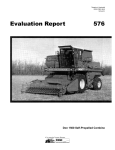
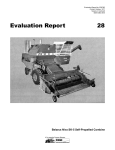
The Sperry New Holland TR85 is a self-propelled combine
with two longitudinally-mounted rotors, threshing and separating
concaves, discharge beater and a cleaning shoe. Threshing occurs
mainly at the front section of the rotors while separation of grain
from straw occurs throughout the full length of the threshing and
separating concaves and at the rear beater grate. The grain is
cleaned at the shoe and the return tailings delivered to the front
of the rotors. A stone ejection roller is mounted within the feeder
housing.
The test machine was equipped with a 175 hp (131 kW) eight
cylinder, naturally aspirated, diesel engine, a 13 ft (4.0 m) header,
a 10 ft (3.0 m) Victory pickup, a straw spreader, and other optional
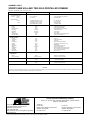
equipment listed on page 2.
The Sperry New Holland TR85 has a pressurized operator
cab, power steering, hydraulic wheel brakes, and a hydrostatic
traction drive. The separator, header and unloading auger drives
are manually engaged. Header height and unloading auger swing
are hydraulically controlled. Rotor, pickup, cleaning fan and feeder
speeds and concave clearance are adjusted from within the cab.
Cleaning shoe settings are adjusted on the machine. There is no
provision to safely and conveniently inspect the return tailings while
operating. Important component speeds and machine and harvest
functions are displayed on electronic monitors.
Detailed speci cations are given in APPENDIX I.
SCOPE OF TEST
The Sperry New Holland TR85 was operated for 176 hours
while harvesting about 1540 ac (623 ha) of various crops. The crops
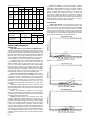
and conditions are shown in TABLES 1 and 2. During the harvest, it
was evaluated for rate of work, quality of work, ease of operation and
adjustment, operator safety, and suitability of the operator manual.
Mechanical failures were recorded.
Page
3