1
CoaxialIWaveguide
Measurement
Accessories
Catalog Now
Ava ilabIe
.
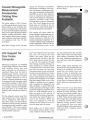
The latest edition of H P s Coaxial
and Waveguide Measurement Accessories Catalog is now available with
product and applications information
on more than 400 products operating
from dc to 110 GHz. Seventeen product
sections include attenuators, detectors, couplers, filters, power sensors,
scalar analyzer accessories, noise figure equipment and even 75 ohm
accessories.
More than 27 pages of this 112 page
Life Support for
Your Home
Computer
Mainframe computers are swaddled
in specialized computer rooms where
heat, humidity, smoke, dust, and
static electricity are eliminated or
controlled. Excess heat can lead to
microprocessor burnout, smoke and
dust to garbled data, and low humidity and static electricity to loss of
memory. Personal computers are prey
to the same ills, but few people would
buy $3,000 machines if they had to
hermetically seal the family garage
as a computer sanctum. Fortunately,
PCs don’t have to be treated that
tenderly. Still, elementary caution is
due.
Put the computer system away from
open windows, heat vents, radiators,
and air conditioners. This helps reduce dust, smoke, and other airborne
particles as well as control variations
in temperature and humidity. A good
rule of thumb: if the room is uncomfortable for humans, it will probably
also discomfort computers.
2
BENCH BRIEFS
catalog are devoted t o microwave
measurement techniques and reference information, summarizing common scalar techniques of attenuation
and SWR, as well as other measurements in component and system test
such as power, frequency, noise figure,
spectrum, waveform, carrier noise
and modulation analysis. Waveguide
and Coax band designations and
flange data are included in the reference section, along with 9 pages of
associated equipment descriptions.
address on the rear page of this issue
of Bench Briefs.
/1
This catalog will prove useful for
design engineers, production test personnel, quality assurance and metrology engineers, field-test and
system-maintenance engineers. It is
available without charge (publication
number 5954-6401) from the HP literature distribution center at the
Leave the computer on for the entire
day, even if it will be used only
briefly a few times. There are two
reasons for this; the first is the disc
drive. Each time you power the unit
on and off, the heads go through
their homing or position-seeking routines, resulting in a certain amount
of mechanical wear. The fewer times
you cycle the power, the less wear.
The second reason is that continually
heating up and cooling down circuits
can widen undetected hairline fractures in chips, leading to the kinds of
glitches that disappear at the repair
shop but reappear when you’re in the
middle of creating text or program
code. Computers are designed to use
little electricity, so power bills from
all-day operation aren’t high. A good
reason for keeping a brand-new computer on: most electronic parts, if
they are going to fail, will do so
within the first ten hours of operation,
well within the typical 90 days covered by the warranty. When you
leave your computer on, lower the
intensity of the monitor so as not to
burn an image onto the screen.
Don’t smoke, eat, or drink around
the computer system. Smoke is especially insidious because tobacco tar
WWW.HPARCHIVE.COM
can jam between the disc and disc
head, which reads and stores data,
thus leading to misreads. Dust has
the same vandalistic propensities, so
use a dust cover when the equipment
isn’t on.
1
Power surges, static electricity and
brownouts are also gremlins that can
disrupt your equipment. We recommend that you contact local user
groups to learn of particular area
idiosyncrasies, such as extremely low
humidity resulting in high static
electricity. Place an antistatic mat
on the floor to eliminate static electricity, which can cause gaps in your
data.
What if you live in an area where
power surges are common? To guard
against too much electricity, which
can burn the system’s insides, buy a
surge suppressor, which can cost $50
to $100. These devices absorb most
power surges that come from utilities
or electrical storms. During severe
lightning storms, however, surges
a r e so powerful they can burst
through telephone lines and electrical
cords even when a computer system
is turned off.
JANUARY-MARCH 1987
3