1
heavy canvas or leather apron. It will protect
you from dust, debris and chips as well as
help prevent injury if the handpiece slips off
the workpiece. It will also help prevent loose
clothing from getting caught in a rotating
cutter, bur or other accessory.
•
Never use or continue to use any
accessory which appears to be damaged,
loose, vibrating, or out of balance. Inspect
each accessory for cracks or flaws before
using it. Avoid knots, imperfections in the
wood or metal objects like nails, which
could damage or catch the accessory.
•
Always insert the shank or arbor of an
accessory or mandrel into the collet or
chuck of the handpiece as far as possible in
order to provide proper support and tighten
the collet or chuck securely.
•
Never use excessive side pressure which
may bend or break the shank or arbor of an
accessory. Let the speed of the accessory
do the work.
•
Do not stall the motor by jamming or using
excessive pressure on the accessory. This
can result in damage to the motor or
flexible shaft.
•
Never operate the motor with the outer
sheath removed from the flexible shaft.
•
Never modify the shielded plug on the
TX or LXH motor cord in order to plug it
into a Non-TX or Non-LX speed control or
AC electrical wall outlet. Use only TXR,
SXR, or EMX speed controls with all
Series TX, TXH, LX, or LXH motors.
•
Always disconnect the power cord before
servicing the motor or removing the flexible
shaft or sheath.
•
Never operate your power tool during a
perceptible power decrease. Turn power
tool off and do not use until power is
fully restored.
•
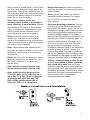
Use proper grounding procedures. This tool
should be grounded while in use to protect
the operator from electric shock. The tool is
equipped with an approved 3-conductor cord
and a 3-prong grounding type plug to fit the
proper grounding receptacle. The green (or
green and yellow) conductor in the cord is the
grounding wire. Never connect the green (or
green and yellow) wire to a live terminal. If
your unit is for use on less than 150 volts, it
has a plug that looks like sketch A below.
An adapter (sketches B and C) can be used for
connecting plugs as shown in sketch A to
2-prong receptacles. The green colored rigid
ear, lug, etc., extending from the adapter must
be connected to a permanent ground such as
a properly grounded outlet box. Some jurisdictions, including Canada, prohibit the use
of 3 to 2 prong adapters. Where prohibited,
they should not be used. Use only 3-wire
extension cords that have 3-prong grounding
type plugs and 3-pole type plugs and 3-pole
receptacles that accept the tool’s plug. Always
disconnect the power cord before servicing
the tool. Never use in an area where
flammable vapors are present.
3