1
Bearing self study guide
Expanding your knowledge
of bearings and related
components.
$10.00
Table of contents
Introduction ............................................................. 2
Chapter 1
History of bearings......................................................... 3
The parts of a bearing..................................................... 3
Review ................................................................................. 5
Chapter 2
The bearing ...................................................................... 7
Review ................................................................................. 9
Chapter 3
Operation conditions ....................................................11
Internal bearing clearance ............................................11
Shaft and housing conditions .......................................12
Review ...............................................................................14
Chapter 4
Roller bearing types .....................................................16
Tapered roller bearing....................................................16
Cylindrical roller bearing ................................................17
Needle roller bearing .....................................................18
Review ...............................................................................19
Chapter 5
Ball bearing types .........................................................21
Single row ball bearing ................................................22
Angular contact ball bearing.........................................22
Double row ball bearing ................................................23
Ball thrust.........................................................................23
Review ...............................................................................24
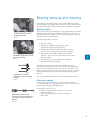
Chapter 8
Installation ......................................................................38
Pre-installation ................................................................38
Press fitting, mounting ..................................................39
Clutch release bearing:
Special mounting procedures .......................................40
Installation checklist........................................................41
Review ...............................................................................42
Chapter 9
Bearing adjustment......................................................44
Review ...............................................................................46
Chapter 10
Bearing lubrication .......................................................48
Lubrication selection ......................................................49
Grease lubrication ...........................................................50
General recommendations ............................................51
Review ...............................................................................52
Chapter 11
Bearing maintenance...................................................54
Review ...............................................................................56
Chapter 12
Hub units.........................................................................26
Hub installation guide ....................................................27
Review ...............................................................................31
Troubleshooting .............................................................58
Brinelling ..........................................................................58
Contamination .................................................................59
Fretting..............................................................................59
Peeling .............................................................................60
Spalling .............................................................................60
Misalignment ...................................................................61
Electric Arcing ..................................................................62
Seizing...............................................................................62
Review ...............................................................................64
Chapter 7
Glossary of terms................................................66
Chapter 6
Bearing removal & cleaning.......................................33
Bearing removal..............................................................33
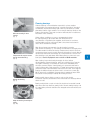
Cleaning bearings ...........................................................35
Review ...............................................................................36
Introduction
This book, produced for use by SKF distributors and customers, should prove
of practical value to mechanics, maintenance superintendents and anyone
who can benefit from a thorough understanding of roller and ball bearings.
It will explain:
• How to remove, inspect, and install bearings;
• How to improve performance with proper lubrication
and maintenance techniques;
• How to spot bearing failures, correct them and
prevent them from happening again.
This self-study guide is programmed to increase performance
productivity. Each chapter consists of a logical organization of material,
technical diagrams and a short quiz to help you retain what you study.
How to use this study guide
Start by carefully reading the text portion of each chapter. Make notes
or underline if you wish; this can help you remember what you’ve read.
Study at your own pace. Nobody is going to grade or score the
chapter reviews.
The chapter quizzes are an important phase in self-study learning
since they are intended to reinforce the material covered. The quiz questions
are straightforward multiple choice and true and false. There are no “trick
questions.” Your answers can easily be checked within the context of the
chapter.
Answer the questions at the end of each chapter before moving on.
If you are unsure about an answer to a question, check in the chapter
and review that portion again.
2
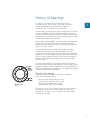
History of bearings
For centuries, man had to rely on his own power to push
or pull large objects over the earth. The concept of a bearing –
to lessen friction between an object and the surface over
which it is moved – is nearly as old as man himself.
1
The first solution to relieving some of this sliding friction was recorded
as early as 3,500 B.C. It was then that Mesopotamians were using
one of the first bearings known to man, an invention called the wheel.
Where the wheel and axle touched, they put a bearing made of leather
or wood and lubricated it with animal fat.
Ancient drawings from 1,100 B.C. show the Assyrians and Babylonians
moving huge rocks for their monuments and palaces with rollers,
illustrating the basic bearing principle – to lessen friction. But this was
sliding – not rolling – friction.
The roller and ball bearings of today may bear little resemblance
to their predecessors but the concept has remained the same:
to lessen friction. Today, bearings are used in almost every imaginable
application, such as roller skates and bicycles, where two surfaces are
turning or moving against each other. They are used in thousands of
ways, from the minute internal workings of a clock to large turbine
engines in a ship.
The bearings with which we are concerned fit two basic categories –
ball and roller. We will discuss both categories, and cover bearing types,
installation, operating conditions, maintenance and troubleshooting. In
addition, we will feature one particular type – the tapered roller bearing
– which has numerous fleet applications.
The parts of a bearing
A bearing’s smooth performance is assured by a combination
of four basic working parts (fig. 1):
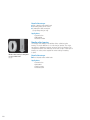
Bearing parts
(fig. 1)
• Outer race (also called outer ring or cup)
• Inner race (also called inner ring or cone)
• Rolling elements (either balls or rollers)
• Separator (also called cage or retainer)
The outer race, or cup, is the bearing’s exterior ring. Since it protects
the bearing’s internal parts, it must be machined smoothly and
accurately. The inner race, or cone, is the part of the bearing that
sits directly on the shaft.
3
The rolling elements, shaped as balls or rollers, provide the cushion that
eases the moving friction of the shaft within its housing. These elements
keep the outer and inner races separated and enable them to move smoothly
and freely. The shape of the rolling elements depends on the type of load,
operating conditions and particular applications. It is the rolling elements
that distinguish the two basic bearing categories – ball bearings and roller
bearings.
There is a groove called the ball path on both the inner and outer races of
ball bearings in which the balls roll. For roller bearings, the rollers roll on the
flat surface of each race. This surface is called the roller path.
Finally, the separator is a metal retainer that holds the balls or rollers.
Positioned between the inner and outer races, the separator keeps
the rolling elements evenly spaced (fig. 2).
Ball bearing
components
(fig. 2)
Ball bearing
The most popular type of ball bearing has a single row of balls.
In addition to the single row design, there also are double row, angular
contact and ball thrust bearings. The characteristics and uses of each type will
be covered in Chapter Five.
Roller bearing
One variation of roller bearings – the tapered roller – is used extensively
for fleet, automotive and other vehicular applications. Its construction differs
significantly from ball bearings and other types of roller bearings.
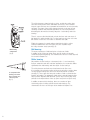
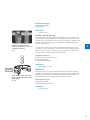
In a tapered roller
bearing, all center
lines converge at a
common point.
(fig. 3)
The rolling elements and both races slant inward, much like a cone.
If you extend a line along the surface of the races and rollers, and also draw
one through the bearing’s axis, those lines would all meet at a common
point (fig. 3). Those same lines along the surfaces of ball or cylindrical roller
bearings are parallel. The advantage of this design is that the tapered rollers
have a positive alignment with the shaft. That is, each roller will align itself
perfectly on the tapered faces of the cup (outer race) and cone (inner race).
In addition to tapered roller bearings, there are a number of other
roller bearing types including cylindrical and needle bearings. The
characteristics and uses of each type will be detailed in Chapter Four.
4
Chapter 1 Review
To take this test simply place a card or sheet of paper under the first question.
After you’ve read it (and answered it to yourself), slide the paper down below the
next question. The correct answer to the first problem will appear directly to the right
of the new question. Be sure not to skip any of the questions. This learning technique assures
more than four times the normal retention rate for even this technical subject.
1
1. The bearing’s smooth performance is assured by the _______________.
N A. inner and outer race
N B. rolling elements
N C. separator
N D. all of the above
1. D
2. The _______________ is the part of the bearing that sits directly
on the shaft.
N A. outer race
N B. inner race
N C. cage
N D. cup
2. B
3. The cone is another name for the _______________.
N A. separator
N B. inner race
N C. cup
N D. retainer
3. B
4. The outer race _______________.
N A. is the bearing’s exterior ring
N B. protects the bearings internal parts
N C. must be machined smoothly and accurately
N D. all of the above
4. D
5. The _______________ is a metal retainer that keeps the rolling
elements evenly spaced.
N A. seal
N B. separator
N C. bearing
N D. outer race
5. B
6. The rolling elements consist of _______________.
N A. balls or rollers
N B. retainer or cage
N C. ring or cup
N D. ring or cone
6. A
5
7. The shape of the rolling elements depends on the _______________.
N A. type of load
N B. operating conditions
N C. particular applications
N D. all of the above
7. D
8. The most popular type of ball bearing has a triple row of balls.
N True
N False
8. F
9. The concept of a bearing is to lessen the friction between an
object and the surface over which it is moved.
N True
N False
9. T
10. One variation of roller bearings – the tapered roller – is used
extensively in fleet, automotive and other vehicular applications.
N True
N False
10. T
11. The rolling elements distinguish the two basic bearing types –
ball bearings and roller bearings.
N True
N False
11. T
12. In a tapered roller bearing, the center lines do not converge
at a common point.
N True
N False
12. F
13. The separator, which retains the balls or rollers, is also called the cage.
N True
N False
13. T
14. The roller path is the flat surface of each race on which the rollers roll.
N True
N False
14. T
15. The separator keeps the rolling elements evenly spaced.
N True
N False
15. T
6
The Bearing
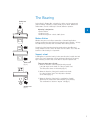
Radial load
(fig. 1)
As described in Chapter One, a bearing is a device used to support and
guide a rotating, oscillating, or sliding shaft, pivot or wheel. Whenever a
shaft rotates, it needs a bearing for smooth, effective operation.
A bearing is designed to:
• Reduce friction
• Support a load
• Guide moving parts – wheel, shafts, pivots
2
Reduce friction
Whether they are used in fleet, automotive or industrial applications,
bearings perform the same function and have the same objective – to keep
the shaft moving smoothly and consistently while reducing friction.
A bearing’s rolling internal mechanism greatly reduces the effort and
energy it takes to slide or move an object over the surface. This is why the
invention of the bearing is so important.
Support a load
A shaft will try to push the bearing in the same direction in which the load
moves. The load is dependent on both weight and direction. If the wrong
type of bearing is used it may not be able to carry the required load.
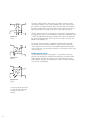
Thrust load
(fig. 2)
There are three types of loads:
1. When the direction of the load (weight being moved)
is at right angles to the shaft, it is called a “radial” load.
The load pushes down on the bearing (fig. 1).
2. When the direction of the load is parallel to the shaft,
it is called a “thrust” load. The load pushes sideways
on the bearing (fig. 2).
3. When the direction of the load is a combination of radial
and thrust, the load pushes down sideways on the bearing.
This combination is called an “angular” load (fig.3).
Angular load
(fig. 3)
7
The word “radial” means in the direction of a radius: moving from the
circumference inward, or the center outward. In this case it moves from
the outside in. A radial load pushes down, from the outer race inward to
the balls, cage and inner race at the center of the bearing. The load is at
right angles (90º) to the shaft on which it is being supported. (fig. 4).
Radial load
(fig. 4)
“Thrust” means a pressure or pushing force exerted by one part against a
touching part. Pressure is exerted sideways, pushing the shaft either right
or left. This shaft movement then pushes the inner race of the bearing in
the same sideways direction. The line of pressure, that is, the load, runs
parallel to the shaft (fig. 5).
An “angular” load is actually a combination of radial and thrust loads.
As the load moves at an angle toward the shaft, it pushes against the
corner of the inner race. Pressure is transmitted diagonally, through the
corner of the race, cage and rolling elements, to the opposite corner of the
outer race (fig. 6).
Guide moving parts
Thrust load
(fig. 5)
Angular load
(fig. 6)
The arrows above show how
a load is dispersed through
the balls or rollers of a
bearing.
8
The third function, to guide moving parts, is a result of the other two
functions. By supporting a load while reducing friction, a bearing guides
shaft operation. It assists the movement of crucial shafts, wheels and
pivots. Without a bearing, the rotating part could not continue operating
on a smooth, constant basis.
Chapter 2 Review
To take this test simply place a card or sheet of paper under the first question. After you’ve
read it (and answered it to yourself), slide the paper down below the next question. The correct
answer to the first problem will appear directly to the right of the new question. Be sure not to skip
any of the questions. This learning technique assures more than four times the normal retention
rate for even this technical subject.
2
1. A bearing is designed to _______________.
N A. reduce friction
N B. support a load
N C. guide moving parts such as wheels, shafts and pivots
N D. all of the above
1. D
2. A bearing’s rolling internal mechanism _______________ the effort
and energy it takes to slide or move an object over a surface.
N A. greatly increases
N B. greatly reduces
N C. has no effect on
N D. has little effect on
2. B
3. Bearings are used in _______________ applications.
N A. fleet
N B. automotive
N C. industrial
N D. all of the above
3. D
4. An angular load is _______________.
N
N
N
N
A. a combination of a radial load and a thrust load
B. a thrust load
C. a radial load
D. self-aligning
4. A
5. In a radial load, the load is _______________.
N A. parallel to the shaft
N B. at right angles to the shaft
N C. angular with respect to the shaft
N D. none of the above
5. B
6. In a _______________ load, the load is parallel to the shaft.
N A. angular
N B. thrust
N C. radial
N D. none of the above
6. B
9
7. A shaft will try and push the load in the opposite direction in which
the load moves.
N True
N False
7. F
8. The load is only dependent on its weight.
N True
N False
8. F
9. If the wrong type of bearing is used, it may not be able to carry
the required load.
N True
N False
9. T
10. “Load” refers to the direction in which the bearing moves.
N True
N False
10. F
11. A bearing guides shaft operation.
N True
N False
11. T
12. A shaft does not need a bearing for smooth, effective operation.
N True
N False
12. F
13. A bearing assists the movement of crucial shafts, wheels and pivots.
N True
N False
13. T
14. Bearings cut down on the energy needed to move an object
over the surface.
N True
N False
14. T
10
Operating conditions
Tolerance
When it comes to size, finish and diameter requirements, all bearings
of like type must meet AFBMA (Anti-Friction Bearing Manufacturers
Association) standards, regardless of bearing manufacturer or the ultimate
use of the bearing. In tapered roller bearings, for example, cups and cones
are interchangeable. No matter how sophisticated or refined the production
method, there are variances in manufacturing that will affect the bearing’s
dimensions.
3
Tolerance is the amount of deviation from prescribed nominal dimensions
permitted by the industry. For example, if the nominal bore dimensions
of bearing “x” (bore being the inside diameter for the inner race) is
1.838 ˝, and the tolerance is +0, -.0003 ˝, the actual size of the bore
must be within the parameters established by tolerance levels. That is, the
actual dimension of the bore could be as small – but no smaller – than
1.8377 ˝. It also can be no larger than 1.838 ˝, since bearing “x” cannot
accommodate a larger diameter (fig. 1).
Bore Diameter
(fig. 1)
Bearing
“x”
Tolerance
+0, -.0003 ˝
Bore Diameter
1.838 ˝
Bore Can Be
1.8377-1.838 ˝
Our tolerance here (+0, -.0003 ˝ ) is only one example for a particular
bearing “x” and is not representative of all bearings. In addition to the
bore, there also are tolerance levels prescribed for the bearing’s outer race
diameter, as well as for the width of both the outer and inner races.
In addition to the variance allowed for the bore diameter, there is
also a variance permitted for the bearing’s radial runout. That is the
running accuracy of the inner and outer races. Radial runout is measured
for each race separately.
Internal bearing clearance
Bearings need clearance
between rolling elements
and races for proper
operation.
(fig. 2)
Clearance is necessary so that the rollers have room to turn without
building up excessive heat and friction during operation. The amount the
inner race moves as opposed to the outer race, under a given radial or
thrust load, is called bearing clearance. This can be measured by how
much space there is between the internal parts during operation (fig. 2).
11
Roller bearings need a small amount of space – internal clearance – to
prevent excess heat build-up when the rollers turn at higher operating
speeds. For the best performance under radial loads, ball bearings should
have minimal clearance. This is because the groove in both races of a ball
bearing is designed to provide ample clearance.
Cage clearance
In tapered roller bearings, there should be enough clearance in the housing
for the cage as well, because if the cage rubs against the housing it can
cause the rollers to drag. If the clearance is not sufficient, the cage may
become distorted and worn, resulting in misalignment and slanting of
rollers. Premature bearing failure then becomes possible.
Seat components
(fig. 3)
Bearing seats
Bearing races are mounted on areas called “seats.” The cup seat
is the housing (fig. 3), while the cone seat is the shaft. Within these two
seats are upward extensions on which the races rest. They are called
“shoulders.”
Alignment
The bearing cup and cone seats – the shaft and housing – must be
properly aligned. Misalignment will reduce the capacity and life of the
bearing proportionately to the amount of misalignment (fig. 4).
The inner race
of this bearing is not
aligned properly.
(fig. 4)
Here’s what happens. When the bearing is misaligned, the rollers
will not carry the load along its entire length. They will carry the load, but
only on a small portion near or at the ends of the rollers. This causes a
concentration of load in a small area on the inner and outer race, which
could result in chipping and early bearing failure (fig. 5).
Shaft and housing conditions
To assure proper bearing performance, the condition of the area
in which the bearing sits – the shaft and housing – is pivotal.
Since the seat – the shaft as well as the housing – supports the bearing,
there must be good surface-to-surface contact. When either seat has a
rough finish or is not round, the bearing does not have the surface contact
area necessary for proper performance.
Inner race damage from
misalignment.
(fig. 5)
12
There should be no high spots or burrs. Any high spot in the housing will
cause a corresponding high spot in the race. The high spot then will cause
the load to concentrate in that small area. If the roller continues to hit this
area, premature bearing failure will result. A burr on the shoulder or dirt
on the shaft also can prevent the race from being seated properly. This
may affect bearing adjustment (fig. 6).
Correct fit and surface characteristics within both the shaft
and housing are as important as surface conditions to bearing
performance. If either race fits too loosely, the race will creep
or turn during operation. This will wear down the shaft and/or housing,
and change the bearing adjustment.
This high spot
was caused by a burr
in the bore.
(fig. 6)
3
Operating temperature
Type of load, shaft speed, and amount of friction all contribute
to one of the most critical conditions for operation – temperature. Each
component of the bearing must be constructed of materials that not only
handle the load but also accommodate temperature fluctuations.
Not all heat is due to environment. The bearings themselves
may cause excessive heat, because of:
1. Too heavy of a load, resulting in deformed races and rollers;
2. Friction between the rolling elements, retainer and races;
3. Excessive churning, from too much lubricant;
4. Surface friction, from too little lubricant (fig. 7).
Heat damage can be
caused by inadequate
lubrication.
(fig. 7)
Lubrication
Using the right type and amount of lubricant for the job is another factor
critical to bearing performance. Whenever bearing use causes excess
friction, heat rises accordingly. Regular lubrication helps relieve the heat
that results from bearing friction. Lubrication will be covered further in
Chapter Ten.
13
Chapter 3 Review
To take this test simply place a card or sheet of paper under the first question. After you’ve read it
(and answered it to yourself), slide the paper down below the next question. The correct answer to
the first problem will appear directly to the right of the new question. Be sure not to skip any of the
questions. This learning technique assures more than four times the normal retention rate for even
this technical subject.
1. _______________ is necessary so that rollers have room to turn without
building up excessive heat and friction during operation.
N A. Internal bearing clearance
N B. A snap ring
N C. Alignment
N D. None of the above
1. A
2. Bearing races are mounted on _______________.
N A. grooves
N B. seats
N C. cages
N D. loads
2. B
3. Bearings themselves can cause excessive heat as a result of _______________.
N A. too heavy of a load
N B. friction between the rollers and lubricant
N C. too much or too little lubricant
N D. all of the above
3. D
4. In a tapered roller bearing, the _______________, also called the cage,
is constructed with an open space over each roller.
N A. separator
N B. inner race
N C. cone
N D. cylinder
4. A
5. Roller bearings need a small amount of space, called _______________, to
prevent excess heat build-up when the rollers turn at higher operating speeds.
N A. alignment
N B. internal bearing clearance
N C. cage clearance
N D. none of the above
5. B
6. Operating temperature is dependent on _______________.
N A. type of load
N B. shaft speed
N C. cage clearance
N D. none of the above
6. D
14
7. Cups and cones are interchangeable in _______________.
N A. roller bearings
N B. ball bearings
N C. tapered roller bearings
N D. all of the above
7. C
8. When the bearing is misaligned, the load is concentrated in a
small area on the _______________.
N A. races
N B. rollers
N C. both of the above
N D. none of the above
3
8. A
9. The bearing cup and cone seats – the shaft and housing – need
not be properly aligned.
N True
N False
9. F
10. Too heavy of a load can result in deformed races and rollers.
N True
N False
10. T
11. Heat damage can be caused by inadequate lubrication.
N True
N False
11. T
12. Insufficient cage clearance can cause premature bearing failure.
N True
N False
12. T
13. Misalignment may result in chipping and premature bearing failure.
N True
N False
13. T
14. Regular lubrication helps relieve friction.
N True
N False
14. T
15. The groove in both races of a ball bearing is designed to hold
the lubricant.
N True
N False
15. F
15
Roller bearing types
There are two broad categories of rolling bearings – ball and roller.
In this chapter, we will discuss roller bearing types, including:
• Tapered Rollers
• Cylindrical Rollers
• Needle Rollers
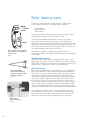
There are two styles of roller bearings: those with “non-tapered” rollers
(cylindrical and needle) and those with “tapered” rollers.
The most apparent difference between the two types is the shape
of the rollers and the curvature of the races. In a non-tapered roller
bearing, the centers of each part run parallel to one another (fig. 1). In the
tapered roller, if the imaginary lines were run through the outer race and
inner race, they would taper off and eventually coincide at a point even on
a line extended through the bearing’s center (fig. 2).
One example of a non-tapered
roller bearing is the cylindrical
roller bearing.
(fig. 1)
Other differences between non-tapered and tapered rollers, such
as operating conditions, load capacity and shaft direction, will be explained
in this chapter.
Tapered roller bearing
In profile, the tapered roller bearing resembles the wide edge of a cone
rather than a circle. There are two major benefits to this design. First, true
rolling motion is obtained. Secondly and more importantly, the bearing can
handle all loads – radial, thrust or both – in any combination.
Lines extending the
tapered roller bearing’s
inner and outer races will
eventually coincide.
(fig. 2)
Benefits/advantages
g The first benefit of the tapered roller bearing is its cone shaped design.
Each roller in the bearing can align itself perfectly between the tapered
faces of the cup and cone, without guidance by the cage. That is a major
development in bearing design and operation. The large end of each
roller has been ground so that it is square against the rib along the back
of the inner race (fig. 3). Without the “rib,” rollers would be forced from
the cage (fig. 4). As each roller revolves about the cone, a wide area of
contact is made between the large end of the roller and the rib. This wide
area of contact compels each roller to maintain accurate alignment. With
each roller perfectly aligned between the two races, the bearing works to
maximum productivity. Each roller has an equal share in the total workload.
The separator, also called the cage, is constructed with an open space
over each roller. There are grooves cut in the sides of the roller pockets
that correspond to the curvature of the roller when it is in the cage. This
permits the rollers to turn evenly, unhampered by cage interference.
Rib restrains
rollers in bearing.
(fig. 3)
16
g The second benefit – the bearing’s ability to support radial
and thrust loads simultaneously – is a result of its internal design.
A radial load on a tapered bearing produces both a radial and
thrust reaction. The rib restrains the rollers and counteracts the load.
That is why adequate lubrication and proper end play adjustment are
necessary to prevent excess operating temperatures. When carrying
simultaneous loads, the bearing should be adjusted toward another
bearing capable of carrying thrust loads in the opposite direction.
g One construction feature makes tapered roller bearings unique from
Without proper restraint the
rollers would be forced from
the cage.
(fig. 4)
most other designs: the races are separable (fig. 5). When mounted, the
inner race (cone) and rollers are assembled as one unit and the outer race
(cup) as another. Industry standards in size and design permit cups and
cones to be interchanged when necessary.
4
Applications
Tapered roller bearings are used in automobiles, trucks, tractors,
and various farming vehicles, including:
• Transmissions
• Transfer cases
• Rear axle shafts
• Differentials
• Front wheels
• Trailer wheels
Cylindrical roller bearing
Tapered roller bearing races
are separable.
(fig. 5)
The cylindrical type consists of four basic roller bearing parts: inner race,
outer race, cage and rollers. The cylinder shaped rollers are kept evenly
spaced by the cage, which guides their turning movement on the flat
surface of the two races (fig. 1).
Some types have flanges or ribs, projecting from the edge of one or both
of the races. This supports the rollers while permitting limited free axial
movement of the shaft in relation to the housing.
17
Benefits/advantages
g
g
g
High capacity under radial loads
Accurate guiding of the rollers
Limited free axial movement
(single flange design only)
Applications
• Transmissions
• Differentials
• Rear Axle Shafts
Needle roller bearing
The needle roller bearing is a variation of the cylindrical roller
bearing. The main difference is in roller design capacity. The rollers
are thinner in diameter, but there are more rollers per bearing. Full
complement needle roller bearings do not have a cage. In this type of
bearing one roller pushes against the other holding everything
in place.
Needle roller bearing is designed
to carry radial loads.
(fig. 6)
Benefits/advantages
g Good capacity under radial loads
Applications
• Transmissions
• Alternators
• Steering gears
• Universal joints
18
Chapter 4 Review
To take this test simply place a card or sheet of paper under the first question.
After you’ve read it (and answered it to yourself), slide the paper down below the next question.
The correct answer to the first problem will appear directly to the right of the new question. Be
sure not to skip any of the questions. This learning technique assures more than four times the
normal retention rate for even this technical subject.
1. An example of a non-tapered roller bearing is the _______________.
N A. cylindrical roller bearing
N B. needle roller bearing
N C. both of the above
N D. none of the above
4
1. C
2. The construction feature which makes tapered roller bearings
unique is that the races are _______________.
N A. attachable
N B. separable
N C. self-aligning
N D. none of the above
2. B
3. The advantage of the tapered roller bearing is that _______________.
N A. each roller has a share in the total workload
N B. each roller can align itself perfectly between the tapered
faces of the cup and cone, without guidance by the cage
N C. its wide contact area compels each roller to
maintain accurate alignment
N D. all of the above
3. D
4. Cylindrical roller bearing applications include _______________.
N A. transmissions
N B. differentials
N C. rear axle shafts
N D. all of the above
4. D
5. A tapered roller bearing has the ability to handle _______________.
N A. all loads in any combination
N B. radial loads only
N C. thrust loads only
N D. none of the above
5. A
19
6. The rib _______________ the rollers in a tapered roller bearing.
N A. lubricates
N B. turns
N C. restrains
N D. none of the above
6. C
7. Some cylindrical roller bearings have flanges or ribs, projecting
from the edge of one or both of the races.
N True
N False
7. T
8. Needle roller bearings have rollers thicker in diameter,
with fewer rollers per bearing, than cylindrical roller bearings.
N True
N False
8. F
9. Cylindrical and needle roller bearings are examples
of “tapered” roller bearings.
N True
N False
9. F
10. Adequate lubrication and proper end play adjustment
are necessary to prevent excess operating temperatures.
N True
N False
10. T
20
Ball bearing types
As a group, ball bearings have many uses in trucks, cars, and
off-the-road vehicles. Some of the most common are in steering
assemblies, transmissions and differentials. In other applications, such
as heavy-duty wheel hubs, they have been replaced by roller bearings.
In addition to the inner and outer races, rolling element
and separator, there are three accessory components frequently used with
ball bearings:
Snap rings mount ball
bearings in the housing.
(fig. 1)
• Snap rings
• Shields
• Seals
Snap rings are separate components used to locate ball bearings
in the housing (fig. 1). They hold the bearing in place the same way
a shoulder on the shaft or in the housing would.
Shields prevent dirt from
getting in the bearing.
(fig. 2)
5
Shields are circular rims that cover the open space between the two races,
on one or both sides of the bearing (fig. 2). They are attached to the edge
of only one race, with clearance left at the inner race. Shields prevent dirt
and particles from getting in the bearing, while letting excess lubrication
flow through the bearing and escape if necessary.
A seal is a metal-based ring lined with a single, double or triple
lip made of rubber, elastomers, synthetic or non-synthetic materials (fig.
3). It is a barrier designed to retain lubricants while excluding moisture,
fine dirt, dust, or other contaminants from damaging the bearing. Unlike
shields, seals prevent lubricants from leaking out of the bearing.
Operation
Though ball bearings and roller bearings share the same objective – to
lessen friction – their strategies are quite different. The mechanical forces
underlying ball bearing operation are simple to understand.
Seals prevent lubricants from
leaking out of the bearing.
(fig. 3)
When a ball bearing is inactive and still, the load applied will be distributed
evenly through the races and balls on the contact area. Once the bearing
is nudged by a moving load, the ball starts to roll. Material in the race
bulges out in front of the ball, then flattens out behind the ball. The ball
flattens out in the lower front quadrant, then bulges in the lower rear
quadrant (fig. 4). This process continues for each ball as long as the load is
in motion.
Continual metal-to-metal contact between the balls and races will
eventually wear down the parts and result in bearing failure. So even
in doing its job – to lessen friction between two surfaces – the bearing
creates its own internal friction. This is one reason why lubrication within
the bearing is critical in relieving friction.
Metal bulges out in front of
the ball when a load is applied to
the bearing.
(fig. 4)
21
There are four different ball bearing types used in
automotive and fleet applications:
• Single row
• Angular contact
• Double row
• Ball thrust
Ball bearing components
(fig. 5)
Single row ball bearing
The single row is one of the most popular ball bearing designs.
A crescent-shaped cut in both the inner and outer races forms
a wide groove in which a single row of balls roll (fig. 5). Though designed
primarily for radial load capacity, this bearing can support substantial thrust
loads in either direction, even at high operating speeds (fig. 6). Careful
alignment between the shaft and housing is critical to its performance.
The bearing is available with seals and shields for extra protection against
contaminants, plus retention of lubricant.
The single row ball bearing
supports the thrust load in either
direction.
(fig. 6)
A variation of the single row bearing is the maximum capacity bearing.
Additional balls can be assembled in the bearing for greater radial load
capacity (fig. 7). However, the extra loading area limits the bearing’s thrust
load capacity.
Benefits/advantages
g
g
Good performance under radial loads
Deep groove permits thrust load capacity
in either shaft direction
g Assures contaminant-free operation when
seals are mounted on the bearing
Applications
The maximum capacity bearing is
a variation of the single row ball
bearing.
(fig. 7)
• Transmission
• Alternator
• Differential
• Steering gear
• Air conditioner clutch
Angular contact ball bearing
The angular contact ball bearing features two high thrust supporting
shoulders – one on the inner race, the other at the opposite side on the
outer race. The two shoulders form a steep contact angle slanted toward
the bearing’s axis, assuring the highest thrust capacity and axial rigidity.
This design can support a heavy thrust load in one direction, sometimes
combined with a moderate radial load (fig. 8).
An angular contact ball bearing
supports the load between
opposite shoulders of the inner
and outer races.
(fig. 8)
22
Benefits/advantages
g
g
High thrust capacity
Axial rigidity
Applications
• Clutch release
Double row ball bearing
Arrows show how load lines
converge at the angle of contact in
a double row bearing.
(fig. 9)
The double row ball bearing combines the design principles of the single
row and angular contact bearings. Like the angular contact bearing, it has
grooves in the outer and inner races which are positioned so that the load
lines through the balls form either an outwardly or inwardly converging
angle of contact (fig. 9).
The two rows of balls assure a lower axial displacement than the single
row design. That is, the bearing is less likely to become misaligned on the
shaft or in the housing. The double rows can support heavy radial loads
and work well under thrust loads in either direction.
5
Benefits/advantages
g Thrust capacity in either
g High radial capacity
g Less axial displacement
direction
Applications
• Air conditioner clutch
Ball thrust
A ball thrust bearing offers high
thrust capacity with minimal axial
displacement.
(fig. 10)
Designed primarily for clutch release applications, the ball thrust bearing
has high thrust capacity. The load line runs parallel through its balls to the
shaft axis, so there is little axial displacement (fig. 10). Flat shoulders on
the shaft and housing are recommended under heavy loads.
Benefits/advantages
g
g
High thrust capacity
Minimal axial displacement
Applications
• Clutch release
23
Chapter 5 Review
To take this test simply place a card or sheet of paper under the first question. After you’ve read it
(and answered it to yourself), slide the paper down below the next question. The correct answer to
the first problem will appear directly to the right of the new question. Be sure not to skip any of the
questions. This learning technique assures more than four times the normal retention rate for even
this technical subject.
1. A seal is a barrier designed to _______________.
N A. retain lubricants
N B. exclude contaminants
N C. both of the above
N D. neither of the above
1. C
2. Ball bearings are often used in _______________.
N A. transmission
N B. differentials
N C. steering assemblies
N D. all of the above
2. D
3. In a single row ball bearing, a crescent-shaped cut in the _______________
forms a wide groove in which a single row of balls roll.
N A. shield
N B. inner and outer races
N C. separator
N D. all of the above
3. B
4. A ball thrust bearing and a _______________ bearing are used
primarily in clutch release applications.
N A. single row
N B. angular contact
N C. double row
N D. all of the above
4. B
5. _______________ prevent lubricants from leaking out of the bearing.
N A. Seals
N B. Shields
N C. Snap rings
N D. None of the above
5. A
6. _______________ are circular rims that cover the open space
between the two races, on one or both sides of a ball bearing.
N A. Snap rings
N B. Shields
N C. Retainers
N D. None of the above
6. B
24
7. _______________ bearings are used for clutch release applications.
N A. Single row ball
N B. Ball thrust
N C. Tapered roller
N D. Needle roller
7. B
8. Snap rings are used to _______________ ball bearings in the housing.
N A. lubricate
N B. relieve friction from
N C. hold
N D. all of the above
8. C
9. The maximum capacity bearing is a variation of the single row bearing.
N True
N False
5
9. T
10. A ball thrust bearing offers low thrust capacity with maximum
axial displacement.
N True
N False
10. F
11. An angular contact ball bearing supports the load between opposite
shoulders of the inner and outer races.
N True
N False
11. T
12. Both single row and double row ball bearings are used in
air conditioner clutch applications.
N True
N False
12. T
13. The ball thrust bearing was designed primarily for clutch
release applications.
N True
N False
13. T
14. Seals mount ball bearings in the housing.
N True
N False
14. F
15. Ball bearings do not have rolling elements or separators.
N True
N False
15. F
25
Hub units
In the 1970’s, the twin blows of expensive fuel and inexpensive
imports led the US auto industry to move to front wheel drive vehicles.
Incorporating the front driving mechanism into the hub and suspension
greatly complicated the adjustment and maintenance of conventional
tapered bearing sets. This led to the development of the hub unit, an
easy to install, pre-adjusted, and lubricated for life bearing assembly.
These precision engineered, more expensive units had the advantage of a
pre-adjusted internal clearance which minimizes wheel wobble, premium
grease and seals providing maintenance free operation, and longer service
life. Hub units come in 3 styles – Gen. 1, Gen. 2, and Gen. 3.
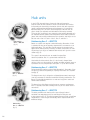
Hub bearing
Gen.1 - ABS/TCS
(fig. 1)
Hub bearing Gen. 1 – ABS/TCS
Based on a double row angular contact ball bearing, Generation 1 Hub
is optimized for the special operating characteristics encountered on car
wheel applications. The unit offers specific support the moment load is
applied to the bearing during cornering. The main components, an outer
ring and two inner rings, are matched with the ball set to give the correct
clearance (fig. 1).
The cages for the two ball rows are made from glass fiber
reinforced polyimide. Gen. 1 is greased and sealed for life.
Used mainly for driven wheels, Gen. 1 is also found in integral drum
designs on the non-driven wheels of smaller cars. With assembly space at
a premium, the very compact taper units (Gen. 1 T’s) are often selected.
Hub bearing Gen. 2 – ABS/TCS
Hub bearing
Gen. 2 - ABS/TCS
(fig. 2)
Designed with the experience gained with Generation 1, Generation 2 has
an outer ring with an integral flange, replacing the function of a separate
hub (fig. 2).
The flanged outer ring is designed as a lightweight structural component;
outer ring raceways are induction hardened for bearing performance. The
flange is tough with threaded holes or studs and a spigot to center and
mount brake and wheel.
The dimensions of the flange and spigot are to customer requirements.
Gen. 2 is typically used with a rotating outer ring for non-driven front or
rear wheels.
Hub bearing Gen. 3 – ABS/TCS
The third-generation hub bearing units carry a flange for wheel
and brake rotor attachment and a second flange for fixing the unit
to the suspension (fig. 3). This fully integrated system provides a significant
simplification in corner design and handling when compared with more
traditional designs.
Hub bearing
Gen. 3 – ABS/TCS
(fig. 3)
26
The dynamic load carrying capacity is maximized by the use of
a separate inner ring for the inboard ball row. This ring is mounted with an
interference fit. The outer flange is bolted to the suspension. The rotating
inner ring, with its tough flange, spigot and threaded holes or studs, is
designed for mounting of the brake and wheel.
Gen. 3 is greased and sealed for life, and used for both driven and
non-driven wheel applications. For driven wheel applications, torque is
transmitted to the inner ring via an involute spline.
Hub units – fitting guidelines
Fitting instructions for hub bearing replacement
in passenger cars.
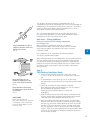
Inspect the knuckle for signs of
fatigue or distortion of the bore.
Replace it if in doubt.
(fig. 1)
When mounting or adjusting hub bearings, it is extremely
important for the safety of the vehicle, as well as for the operation
of the bearings, that the shop manual for the vehicle concerned
is followed in detail.
6
Due to differences in car construction, the following guidelines
are only of a general technical nature.
When replacing bearings, it is essential that the correct mounting methods
are used, that the proper tools are used, and that the clean procedures
are observed in handling and installing all components, particularly the
bearings. Do not open the bearing package until you are ready to install
the bearing. Let the rust preventive compound remain in the bearing
during mounting.
Gen. 1:
FWD Bearing Installation Guide
1. Loosen the axle nut while the vehicle is still on the ground.
Do not re-use the old nut. Never use an impact gun on the axle
nut.
Press the bearing into the
knuckle by applying force only
to the outer ring of the bearing.
(fig. 2)
Press the hub into the bearing
by applying force only to the inner
ring and hub.
(fig. 3)
SAFETY NOTE
Never reuse the axle nut.
Most self-locking nuts are deformed
to hold torque loads and therefore
lose their holding ability once they
have been used.
2. To avoid damage to components, be sure to use the proper
specialized pullers to remove the CV joint, hub and knuckle from the
bearing.
3. Inspect all components for signs of fatigue or damage.
Check bearing mounting bore for distortion or out-of-roundness.
Any irregularities will improperly load the
bearing and cause premature failure, so replace if in
doubt (fig. 1).
4. Clean the bearing area in the knuckle and hub to facilitate smooth
insertion. A light coating of lubricant can be applied to the knuckle
cavity and hub to ease installation and inhibit corrosion.
5. When press-fitting the bearing into the knuckle, be sure to apply
pressure only to the outer ring (fig. 2). When pressing the hub into
the inner ring, force must only be applied to the inner ring and the
hub (fig. 3). The inner ring must not move in relation to the outer
ring. The application of force to the wrong part of the bearing will
render it useless by severely damaging the balls and raceways. After
each step, check for binding or damage by rotating the bearings to
be sure it turns smoothly.
27
Press-fitting locks the bearing radially but to lock it axially,
be sure to install the snap ring where required.
6. On older or higher mileage vehicles, consider installing a new
CV Joint boot as a good preventive measure. Manufacturers recommend
replacement after 60,000 miles.
7. Lightly lubricate and then carefully align the splines of the CV shaft with
the splines of the hub to prevent damage. Using the proper tool, pull the
axle yoke into the hub and seat against the bearing. Install a new axle
nut, using the specific torque nut for that application. With the vehicle
on the ground, do the final torquing to the OEM specifications. This
assures the proper mating of the split inner rings of the bearing needed
to achieve the proper internal clearance. (These torque specifications are
now contained in the SKF Torque Specification Guide #457377).
For specific mounting instructions, refer to the vehicle manufacturer’s service
manual for that model.
Gen. 2:
FWD Bearing Installation Guide for rear hub
1. Lift vehicle and remove rear wheel(s). Remove axle nut. Check axle nut for any
thread damage and replace if needed. Loosen adjusting nut on parking brake
lever, if necessary.
2. Remove disc brake caliper from back plate and disc rotor from hub (if equipped
with disc brakes).
3. Remove brake drum from hub and disconnect brake pipe from wheel cylinder
(if equipped with drum brakes).
4. Disconnect ABS speed sensor if equipped. Remove hub-mounting bolts.
Remove rear brake shoes, stabilizer bar or other components that may
interfere with hub removal. Remove hub separating axle hub
and bearing if needed.
5. Installation is done in the reverse order. Be sure mounting surface is clean.
Check other components for damage. Make sure torque specifications are used
for all components as needed, including hub mounting bolts and axle nut.
Note: Two piece axle and hub assemblies
may need to be pressed apart.
Note: Some models equipped with ABS tone
rings may need the tone ring switched over
from the old hub unit to the new hub unit.
For specific mounting instructions, refer to the vehicle manufacturer’s service
manual for that model.
28
Gen. 3:
FWD Bearing Installation Guide for front hub
1. Lift vehicle and remove front wheel(s). Remove caliper
and secure it aside.
2. Remove brake disc rotor. Remove cotter pin and axle nut. Check axle
nut for any thread damage and replace if needed.
3. On models equipped with ABS, disconnect sensor connector
if needed. Using steering linkage puller, loosen upper arm
ball joint nut. Always be careful not to damage ball joint of toothed
rotor (if equipped). Shift knuckle to outside to maintain clearance
between hub mounting bolts and drive shaft.
4. Remove hub mounting bolts. Remove front hub assembly. Check
other components for wear.
5. To install, reverse removal procedures. Install mounting
bolts and torque to specification. Slide CV shaft stub through hub
assembly. Install axle nut and torque to specifications.
6
For specific mounting instructions, refer to the vehicle manufacturer’s
service manual for that model.
Hub sealing problems
The function of the seal is to keep the grease inside the bearing
and to avoid the entrance of water, dust and dirt, which will cause corrosion
and premature bearing failure.
Appearance of a moderate amount of grease leakage is acceptable – this
helps protect the seal lips from external agents such as dirt.
Appearance of a new bearing
in conformance with drawing
specifications.
Seal in an oblique position due to
wrong fitting during mounting into
the knuckle.
Seal standing out from inner and
outer ring due to wrong fitting.
Detail of picture at left
showing grease leakage.
29
Impact damage
All bearings are sensitive to shock and impact. You should never use a
hammer in fitting a bearing. SKF recommends only proper fitting tools be
used.
Remember, the wheel bearing is a safety component!
Also, before re-fitting the bearing in a knuckle, be sure that the bearing
seat is clean and lightly lubricated.
30
The wrong position of the
seal flinger is due to improper
fitting on the knuckle and spindle.
Always verify lineup of the inner
and outer rings.
Close-up showing damage
to the spindle and incomplete
fitting of the inner ring to
the spindle.
ABS sensor ring is broken
as a result of an external agent
while car is running.
ABS cup is broken due to incorrect
handling or improper fitting.
Chapter 6 Review
To take this test simply place a card or sheet of paper under the first question. After you’ve read it
(and answered it to yourself), slide the paper down below the next question. The correct answer to
the first problem will appear directly to the right of the new question. Be sure not to skip any of the
questions. This learning technique assures more than four times the normal retention rate for even
this technical subject.
1. A front wheel drive hub unit is _______________.
N A. easy to install
N B. pre-adjusted
N C. lubricated for life
N D. all of the above
1. D
2. The integral design hub incorporates the _______________ into the
bearing unit.
N A. CV joint
N B. mounting carrier
N C. brake rotor
N D. tie rod end
6
2. B
3. After the old bearing has been removed, the mounting bore in the knuckle
should be _______________.
N A. checked for out-of-roundness
N B. thoroughly cleaned
N C. lubricated with a light coat of lubricant (grease)
N D. all of the above
3. D
4. When press-fitting the bearing into the knuckle, pressure should be applied _______________.
N A. only to the outer ring
N B. only to the inner ring
N C. both a and b
N D. neither a or b
4. A
5. The axle nut must be torqued to the proper specification to _______________.
N A. lock the bearing in place
N B. assure the proper mating of the split inner rings
N C. maintain proper internal bearing clearance
N D. all of the above
5. D
6. The two types of design used in a non-integral hub unit are a double-row
angular contact ball bearing and a pair of tapered roller bearings mounted
in tandem.
N True
N False
6. T
31
7. The non-integral hub design does not require the pressing of the drive
hub into the bearing bore.
N True
N False
7. F
8. On a driven wheel the drive flange may be splined to the drive shaft.
N True
N False
8. T
9. Gen. 3 hubs do not incorporate the ABS sensing unit if vehicle
is equipped with ABS braking system.
N True
N False
9. F
10. A self-locking axle nut should not be reused because the threads
lose their holding ability once they have been used.
N True
N False
10. T
11. On older or high mileage vehicles it is not necessary to replace
the CV joint boot as a good preventive measure.
N True
N False
11. F
12. The final torquing of the axle nut should be done with the vehicle
on the ground.
N True
N False
12. T
32
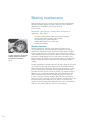
Bearing removal and cleaning
Proper bearing removal and cleaning can mean the difference between
good performance and bearing failure. If done incorrectly, either procedure
can damage the bearing, shaft or housing before installation even begins.
Bearing removal
An arbor press may be used
for bearing removal.
(fig. 1)
There are a number of recommended tools and methods that assure safe,
reliable bearing removal. Using hammers and drift pins, or an uneven
application of force, for example, can cause as much damage to the shaft
and housing as to the bearing itself.
Safe bearing removal tools include:
1. Arbor press (fig.1);
2. Mechanical (or hydraulic) jaw-type pullers that
grip parts by their press-fit edges (fig.2);
3. Mechanical (or hydraulic) push-pullers that use forcing
screws to push or pull parts out of the housing (fig.3);
Jaw pullers grip the outer race to
remove the bearing.
(fig. 2)
Push-pullers, manual or
hydraulic, are safe for bearing
removal.
(fig. 3)
4. Slide hammer pullers with a weighted sliding handle.
It strikes a “stop” on its own rod and removes parts from
blind holes (fig.4);
7
5. Special purpose pullers for timing gears, crankshaft
sprockets, flywheel pilot bearings.
Selecting the right puller for bearing removal depends on how
well the part can be gripped, how much reach and spread (height and
width) are needed, and how much power or force is required. To aid in
bearing removal, accessories such as extensions for jaw and cross-block
pullers, attachments that split bearings, and shaft protectors are also
required.
Here are some suggested methods for safe, reliable bearing removal.
Arbor press method
An arbor press applies great force, so it requires little manpower
to remove bearings. It is a good method to use where one or both races
have been press-fit during installation (fig.1).
Slide hammer pullers, which
can remove parts from blind holes,
also may be used to remove the
bearing.
(fig. 4)
An arbor press can be set up to:
• Support the bearing while the press forces the shaft
out of the bearing, or;
• Support the shaft while the bearing is being forced
off the shaft.
33
To remove a bearing with a press-fit inner race, first support the
inner race on the press base plate with a bar or ring. Using the press,
apply force only to that race (fig. 5). This should loosen the race and
force the shaft out of the bearing. With two separable races, such as
tapered roller bearings, both races may have been press-fit and should be
loosened. Never apply force to the slip fit race or the cage.
Bearing pullers
Bearing pullers should be used when the shaft is too large, obstructed or
inappropriate for removal with an arbor press.
Mount the puller so that the grip is firm and the puller is square
with the surface. Again, apply force only through the press-fit race. The
bearing should start to give and be easy to pull out of the housing (fig. 6).
Apply force only to the
press-fit race.
(fig. 5)
With either the bearing pullers or the arbor press, be sure to cover the
parts around the bearing to prevent them from damage. Be sure to wear
safety goggles to protect yourself against eye injury.
Methods not recommended
Hammering the inner race and flame heating the bearings are
two commonly used, but dangerous, methods of bearing removal.
The practice of hammering or prying to force removal can be costly and
dangerous. The blunt force of the hammer can damage the shaft as well as
the bearing. Even when a wood block is used to muffle the blow, splinters
and wood chips can get into the housing and damage the bearing.
Using a torch to remove parts is even more dangerous. In addition to the
possibility of igniting grease, oil or gas, the intense heat and open flame
can weaken component parts and cause subsequent failures.
Pull the bearing off the shaft.
(fig. 6)
34
Cleaning bearings
Rinse the bearing in clean
solvent.
(fig. 7)
Compressed air may be used to
dry the cleaned bearing.
(fig. 8)
Soak the bearings in a metal basket suspended in a clean container
or tank holding a recommended solvent, overnight if possible. If a basket is
not available, suspend the bearings with a wire or place them on a metal
plate at the bottom of the container. Do not rest the bearings directly on the
bottom of the bucket. (They may not clean as efficiently due to sediment on
the bottom of the container.)
Under ordinary conditions you can use recommended solvents
for cleaning bearings. Oils heavier than SAE 10 should not be
used. Gasoline or high flash point naphthas should never be used; they
are flammable as well as carcinogenic (that is, they have been known to
cause cancer if handled or inhaled).
After dirt and grease are removed, rinse the bearings in another
clean bucket of solvent (fig. 7). The bearings should then be thoroughly dried.
The safest method is natural air-drying. Compressed air, which is free from
condensed moisture, may be used to blow out the bearings, but only after all
dirt and chips have been removed (fig. 8). If compressed air is used, do not
allow bearings to spin and always wear safety glasses to protect your eyes
from injury. Caution: Equipment must conform to OSHA standards.
7
After cleaning, inspect the bearing thoroughly for nicks, leftover
dirt and damage. Inspected bearings, which are considered “good” may be
used again. However, if re-assembly can not be done immediately they
should be protected. Dip the cleaned bearings in a protective lubricant or
coat all surfaces with a light grease (fig. 9). Rotate each bearing to work the
grease thoroughly in and around the roller and on the races. Then wrap the
bearings in waterproof paper and place each in a clean box or carton (fig.
10). If cartons are not available, just wrap them in waterproof paper. Mark
the outside of each package to identify the bearing enclosed.
Grease the bearing.
(fig. 9)
Bearings which have a shield or a seal on only one side should
be washed, inspected, and handled in the same manner as bearings without
shields or seals.
Bearings with shields or seals on both sides should not be washed. Instead,
wipe them off to keep dirt from getting inside. Smooth rotating bearings can
be coated with a protective lubricant, then wrapped and stored until they are
used again.
Wrap the bearing in waterproof
paper.
(fig. 10)
35
Chapter 7 Review
To take this test simply place a card or sheet of paper under the first question. After you’ve read it
(and answered it to yourself), slide the paper down below the next question. The correct answer to
the first problem will appear directly to the right of the new question. Be sure not to skip any of the
questions. This learning technique assures more than four times the normal retention rate for even
this technical subject.
1. Improper bearing removal and cleaning can damage the _______________.
N A. shaft
N B. bearing
N C. housing
N D. all of the above
1. D
2. The _______________ is a safe bearing removal tool.
N A. arbor press
N B. drift pin
N C. hammer
N D. chisel
2. A
3. Bearing pullers should be used when the shaft is _______________
for removal with an arbor press.
N A. too large
N B. inappropriate
N C. obstructed
N D. all of the above
3. D
4. The safest method of drying bearings is _______________.
N A. compressed air
N B. natural air
N C. heat
N D. all of the above
4. B
5. If bearings cannot be reassembled immediately, they should be
protected by _______________.
N A. wrapping them in waterproof paper
N B. coating the surfaces with a light grease
N C. storing them in a clean container
N D. all of the above
5. D
6. Under ordinary conditions, use _______________ for cleaning bearings.
N A. gasoline
N B. recommended solvents
N C. SAE 15 or heavier weight oil
N D. all of the above
6. B
36
7. When an arbor press or a bearing puller is used for bearing removal,
force should only be applied to the bearing’s _______________.
N A. slip-fit race
N B. cage
N C. shaft
N D. press-fit race
7. D
8. To clean bearings, soak them in a _______________.
N A. metal basket
N B. container with the bearings suspended from a wire or on a plate
N C. both A. and B.
N D. none of the above
8. C
9. Hammering the inner race and flame heating the bearings are safe
methods of bearing removal.
N True
N False
9. F
10. Inspected bearings which are considered “good” should not be used again.
N True
N False
7
10. F
11. Bearings with shields or seals on both sides should be washed
and stored until ready for use again.
N True
N False
11. F
12. Bearings should be allowed to spin when using compressed air.
N True
N False
12. F
13. Bearings with a seal or shield on one side only should be washed,
inspected and handled the same way as bearings without shields or seals.
N True
N False
13. T
14. Using a torch to remove bearings can weaken the component parts
and cause subsequent bearing failures.
N True
N False
14. T
15. Force can be applied to the slip-fit race and the cage.
N True
N False
15. F
37
Installation
Cleanliness, proper tools, and specific mounting guidelines are needed to
assure proper installation as well as long-lasting bearing performance.
Improper bearing installation is a common cause of premature bearing
failure.
Pre-installation
Check the shaft and housing
A bearing cannot operate properly if the shaft or housing is not
in good condition.
Before mounting the bearing, be sure shaft and housing bore dimensions
are within recommended tolerances. The bearing seat in the housing bore
should be perfectly round and not tapered. The shaft and housing also
should be clean and free from nicks and burrs (fig. 1).
Extra care should be taken when mounting a bearing in a solid housing.
Before any installation pressure is applied, the outer race should be
perfectly square with the housing bore.
The housing must be thoroughly
cleaned before installing the
bearing.
(fig. 1)
Check the seal
Check the seal, which will be mounted on the shaft. Also check the shaft.
Its condition is just as crucial to correct seal placement as it is to bearing
operation.
Be sure to follow proper seal installation guidelines and use only the
recommended tools. Always replace used seals with new ones. Use the
same seal design and size as the original. A seal installed next to the
bearing is a sure way to prevent fine dirt, dust, moisture and contaminants
from reaching the bearing, while also retaining lubricant.
Bearing assembly
With all parts ready for assembly – bearing, shaft and housing –
installation can now begin.
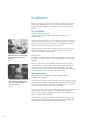
The work area should be clean
before you take the bearing
out of its package.
(fig. 2)
Do not remove the bearing from its container until you’re ready to install it.
Everything must be clean – tools, hands, work area, shaft and housing (fig.
2). Then take the bearing out of its protective wrapper, place it on clean
paper and cover it with a lint free cloth or oiled paper.
The protective grease or oil coating on the bearing should not be removed.
This protective coating was put on by the manufacturer to prevent
corrosion, dirt or dust from damaging the bearing before and during use
and is compatible with all lubricants.
Coat the bearing, housing and shaft with the same lubricant being used
in the machinery in which it will be placed. This will ease mounting and
prevent rust from building up at the press-fit contact area.
38
Press-fitting the bearing
Press-fit refers to the amount of interference between the race and the
seat: the inner race with the shaft, and the outer race with the housing.
If the inner race is press-fit then it will rotate with the shaft.
If the outer race is to be press-fit then it will rotate with the housing. One
example is in a truck’s front wheel hub. Here, the inner race is mounted
with a slip fit on the shaft, while the outer race is press-fit (fig. 3).
A press-fit is accomplished by stretching the inner race over a shaft slightly
larger than the bore of the bearing. Press-fits that are too tight can also be
damaging to the bearing. Too tight a fit squeezes the two races together,
preventing the balls or rollers from turning correctly and causing excess
heat and wear. The result is premature bearing failure.
This wheel hub has the bearing’s
inner races mounted with a slip fit.
(fig. 3)
In applications where only one race is press-fit, the other race gets
a slip-fit – or a slightly looser fit. This slip-fit is just as important as the
press-fit. When the race is too loose, it will creep up on the
shaft or in the housing causing it to slam into the surface on which it is
stationed. This results in friction, overheating, excessive wear and contact
erosion between the shaft and inner race, or housing and outer race.
Mounting the bearing
Start the bearing on the shaft with the rounded corner of the bearing
going on first. Fit a clean pipe over the shaft so that it rests only on the
race being press-fit. Be sure the bearing is square on the shaft. Then apply
pressure to the press-fit race only. Push the press-fit race firmly against
the shoulder on the shaft. If the cup is to be press-fit, for example, apply
pressure only to that race as you drive it into the housing.
8
Arbor press
The arbor press is one of the best means of mounting bearings
and races (fig. 4). Its action is rapid and pressure can be applied
continuously. During bearing installation be sure to support the inner race
with two flat bars placed between the inner race and the press’s adaptor
plate. Special precautions should be taken when using the arbor press to
align the race squarely on the shaft. Too much pressure exerted by the
press could easily cause the race to crack or the shaft to become severely
scored. Accessory equipment such as drive plates, tubing or pipes, which
will carry the force through the press-fit race, should be used whenever
possible.
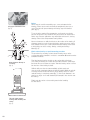
An arbor press may be used for
bearing installation.
(fig. 4)
39
Use proper installation tools.
(fig. 5)
Drivers
Drivers may be used for assembling cups, cones and tapered roller
bearings. Drivers assure easier assembly by straightening the cups or
cones. They also will prevent damage to bearing cages and internal
parts (fig. 5).
To use the driver method, first separate the cup from the cone. Apply
pressure to the races only, and drive each into position. Be careful not to
hit the cage. Pressure against the cage will distort and loosen it, causing
slanting of the rollers and premature bearing failure.
Never use hammers or drift pins directly on the surface of the bearing. If
a hammer must be used to mount the bearing, apply pressure to a drive
block, adapter sleeve, pipe or tube placed above the bearing. Direct blows
to the bearing can cause cocking, denting, cracking and bearing
failure (fig. 6).
Clutch release bearing: a special mounting procedure
The procedure for mounting a clutch release bearing onto a carrier
or sleeve that will be installed in a vehicle is somewhat different from other
installation methods.
Never hammer directly on
a bearing.
(fig. 6)
First, lubricate the bearing shoulder on the carrier with a few drops
of oil. Place the bearing on a clean drill press table, with the clutch finger
face down. Be sure all parts are square. Start the bearing carrier or sleeve
into the bore of the bearing by hand.
Shift the drill press into the lowest available spindle speed, and
close the chuck completely without the drill bit installed. While the spindle
is turning, feed the chuck into the bore of the bearing carrier or sleeve
until the bearing is completely seated (fig. 7). If the chuck diameter is too
small or too large, use a small shanked pilot clamped in the chuck to seat
the bearing.
Finally, pack the carrier or sleeve with grease before installing
it in the vehicle.
Turn the clutch release
bearing while installing the
sleeve.
(fig. 7)
40
Installation checklist
1. Work only with clean tools, clean hands and clean surroundings
to avoid damage to the bearing.
2. Shaft seat and housing bore should be clean, smooth,
with the correct dimensions.
3. Leave bearings in the package until ready for assembly.
Do not wash off the lubricant covering them.
4. Lubricate the race being press-fit, and shaft or housing seat on
which it will sit.
5. Start the bearing on the shaft with the rounded corner
of the race going on first.
6. Apply even, driving pressure directly only to the race being press-fit.
Be sure that pressure is straight and square.
7. Never hammer directly on races or rollers. Do not use a wooden or
soft metal mallet, as chips or splinters may enter the bearing.
8. Use smart, quick taps rather than heavy ones.
9. Be sure all driving accessories and fixtures have straight, square ends.
10. Drive races solidly up against the shoulder of the shaft and housing.
8
11. Pre-lube bearing prior to installation.
41
Chapter 8 Review
To take this test simply place a card or sheet of paper under the first question. After you’ve read it
(and answered it to yourself), slide the paper down below the next question. The correct answer to
the first problem will appear directly to the right of the new question. Be sure not to skip any of the
questions. This learning technique assures more than four times the normal retention rate for even
this technical subject.
1. When mounting a bearing, the _______________ of the bearing should
be started on the shaft first.
N A. rounded corner
N B. outside edge
N C. ball or roller
N D. cage
1. A
2. Installing a _______________ next to the bearing will prevent contaminants
from reaching the bearing while also retaining lubricant.
N A. inner race
N B. seal
N C. shaft
N D. housing
2. B
3. Direct hammer blows to the bearing can cause _______________.
N A. cocking
N B. denting
N C. bearing failure
N D. all of the above
3. D
4. The protective grease or coating applied to the bearing by the manufacturer _______________.
N A. should not be removed
N B. prevents corrosion
N C. is compatible with all lubricants
N D. all of the above
4. D
5. The _______________ method of bearing installation straightens
the cups and cones and prevents damage to bearing cages and internal parts.
N A. slip-fit
N B. heat
N C. driver
N D. press-fit
5. C
42
6. Coating the bearing, housing or shaft with the same lubricant used
in the machinery will _______________.
N A. ease mounting
N B. prevent rust from building up at the press-fit contact area
N C. both of the above
N D. none of the above
6. C
7. Premature bearing failure can result when the press-fit race is
installed _______________.
N A. too tight
N B. too loose
N C. both of the above
N D. none of the above
7. C
8. A bearing will operate properly even when the shaft and housing
are not in good condition.
N True
N False
8. F
9. Improper bearing installation is a common cause of premature
bearing failure.
N True
N False
8
9. T
10. A bearing should not be removed from its container until it is ready
for installation.
N True
N False
10. T
11. It is unnecessary to replace used seals with new ones.
N True
N False
11. F
12. A wooden hammer or soft mallet may be applied directly on
the races or rollers.
N True
N False
12. F
43
Bearing adjustment
Once the bearing is seated on the shaft and in the housing,
it is necessary to recheck installation and adjust the bearing
so it operates properly for the application. Bearing adjustment
recommendations vary per manufacturer, vehicle and use. Before starting
any bearing adjustments, check the service manual.
First, be sure the bearing is seated squarely on the shaft, and has
not been cocked or misaligned during mounting. Then check the end play
(fig. 1). For tapered roller bearings, as in most applications, the best setting
has free running clearance with no appreciable end play.
Dial indicators are used to check
the amount of end play in the
bearing.
(fig. 1)
In general, the bearings in wheels, transmissions, and similar applications
are set with free running clearance. Bearings in wheels for automobiles,
farm vehicles, and tractors are set with free running clearance or end play
of .001˝ to .010 ˝. It is a good idea to check the service manual for proper
adjustment procedures.
Sometimes it is necessary to hold shafts, gears or spindles absolutely rigid
in order to obtain proper performance. This can be done by pre-loading
the bearing, without affecting its capacity for radial or thrust loads.
Preloaded bearings are used in pinions, differentials or other cases where
the shaft must be held rigid. Check manufacturer manuals for torque
recommendations. The amount of preload or the amount of end play
in the bearing will depend on the bearing’s overall function.
Bearing adjustment methods
Since bearing adjustment can be as critical as installation to bearing
performance, it is not surprising why so many manufacturers provide
adjustment guidelines. Two of the most common methods follow.
Wheel bearing
The diagram above shows
a single adjusting nut in place
in the wheel hub.
(fig. 2)
44
Single adjusting nut
While rotating the wheel, tighten the adjusting nut until there is a slight
bind and all bearing surfaces are in contact. Then back off the adjusting
nut 1/6 to 1/4 turn to the nearest locking hole, until the wheel rotates freely
with .001 ˝ to .010 ˝ end play, or clearance. Lock the nut at this position
(fig. 2).
Wheel bearing
Double adjusting nut
Again, rotate the wheel and tighten the inner nut until there
is a slight bind and bearing surfaces are in contact. Then back off the inner
nut 1/4 to 1/3 turn and allow the wheel to rotate freely. Install a lockwasher,
and tighten the jam, or outer nut. There should be .001 ˝ to .010 ˝ of end
play. Lock the outer nut at this position (fig. 3).
Note: Some procedures call for the adjusting nut to be tightened
to specific torque specifications. Always check the manufacturer’s service
manual for specific recommendations.
This diagram shows a wheel bearing
adjustment with a double adjusting
nut.
(fig. 3)
With either adjustment method, proper procedures must be followed. If
not, bearing adjustment may be too tight or too loose, which can cause
overheating and damage the bearing.
Different devices for adjusting bearings are available such as torque
wrenches and dial indicators. Selection depends on the bearing type
and the application in which it’s being used. Basically, these devices hold
the bearing in proper position, support the race, provide the end play or
clearance needed and assure that the bearing is not misaligned, cocked or
operating improperly.
9
45
Chapter 9 Review
To take this test simply place a card or sheet of paper under the first question.
After you’ve read it (and answered it to yourself), slide the paper down below the next question.
The correct answer to the first problem will appear directly to the right of the new question. Be
sure not to skip any of the questions. This learning technique assures more than four times the
normal retention rate for even this technical subject.
1. Bearings in wheels for _______________ are set with free running clearance
or end play of .001 ˝ to .010 ˝.
N A. automobiles
N B. farm vehicles
N C. tractors
N D. all of the above
1. D
2. Preloaded bearings are used in _______________.
N A. differentials
N B. cases where the shaft must be held rigid
N C. pinions
N D. all of the above
2. D
3. The most common method(s) of wheel bearing adjustment include
_______________.
N A. double adjusting nut
N B. single adjusting nut
N C. both of the above
N D. none of the above
3. C
4. When installing bearings, check that the shaft seat and housing bore are _______________.
N A. clean
N B. smooth
N C. the correct dimensions
N D. all of the above
4. D
46
5. Pack the carrier or sleeve with grease before installing it in the vehicle.
N True
N False
5. T
6. The single adjusting nut method requires that the wheel rotates freely
with .001˝ to .010 ˝ end play or clearance.
N True
N False
6. T
7. Hammering directly on races and rollers with a steel mallet is
recommended for bearing installation.
N True
N False
7. F
8. Start the bearing on the shaft with the rounded corner of the
race going first.
N True
N False
8. T
9. If bearing adjustment is too tight or too loose, damage to the
bearing may occur.
N True
N False
9
9. T
10. Some double adjusting nut methods call for the adjusting nut
to be tightened to specific torque specifications. They should be
checked in the manufacturer’s service manual.
N True
N False
10. T
47
Bearing lubrication
Lubrication – coating the contact surfaces of the bearing shaft and
housing with grease or oil – is one procedure used in almost every step of
bearing storage and operation. With their protective coating against rust
and corrosion, lubricants are applied to bearings during storage, during
assembly and mounting, during operation, before removal, and after
cleaning. Lubricants have four major purposes:
• Reduce friction and wear
• Dissipate heat
• Protect surfaces from dust and corrosion
• Help seals protect bearings
Reduce friction
Bearings are constantly moving during operation. Their moving
races and rollers rub against each other as well as the housings around
them. In application of high speeds and under heavy loads, bearings build
up tremendous friction. Too much friction will wear down the surfaces
by rubbing together. This results in premature failure and damage to the
bearing, shaft and housing.
Lubricants reduce friction. When applied on and around the entire bearing,
lubrication smooths rubbing action and saves bearing parts from early
failure (fig. 1). Lubricants protect the shaft and housing in the same way.
Lubricants reduce friction,
protecting the bearing from
damage.
(fig. 1)
Dissipate heat
Heat is caused by bearing friction. With shaft speed and load conditions
also contributing to friction, it is not hard for overheating to occur. Heat
wears down contact surfaces between the races and shaft and housing
seats.
By dissipating, or carrying away this heat, lubricants can prevent
temperatures from reaching a point where they can cause severe wear and
destruction.
Protect surfaces from dust and corrosion
The smallest amount of moisture, dirt or dust can cause the metal
in bearing parts to corrode. Because bearings must be clean and smooth
in order to operate properly, corroded bearings are useless.
For this reason, bearing lubrication starts during the packaging process.
Immediately after production, a new bearing is coated with oil or grease
so it will not be harmed by moisture or dust that can accumulate during
storage and handling prior to installation. Lubrication also protects against
corrosion that can occur between the tight press-fit of a race with the
bearing seat.
48
Help seals protect bearings
Seals installed on the shaft next to the bearing retain lubricants in
the housing and prevent dirt or dust from getting in (fig. 2). Not only will
these contaminants nick and scratch a bearing, they also wear down the
shaft and housing. A thick coating of lubricant is a barrier to contaminants,
assisting the seal in lubricant retention and dirt exclusion.
Lubricant selection
Lubricant selection depends on a combination of factors: the type of
housing, operating temperature, operating speed and any particular
requirement of that bearing type. In all cases, the best guide for
proper selection of a lubricant is the recommendation of the vehicle’s
manufacturer.
There are two lubricant types – grease and oil. Due to the design
of equipment and the conditions under which it must operate,
grease is the more widely used lubricant. Various types of grease
are available and should be selected carefully.
Note placement of the grease seal
against the bearing in the wheel
hub shown above.
(fig. 2)
There are certain guidelines to follow when selecting the right lube for the
job. For example, open bearings are only lubricated with a film of oil or
light grease to protect them from corrosion before use. They must also be
lubricated while running. Sealed and shielded bearings are grease packed
from the factory and are sealed for life. The lubrication used in ball and
other bearing types is usually a sodium or lithium based grease or oil.
As a general rule, bearings run the coolest, and with the least amount of
friction, when a minimum amount of the lightest-bodied lubricant that will
keep bearing surfaces apart is used.
Use a heavier lubricant only if:
• Operating conditions require it;
• The load is too heavy for the lube;
• It is specifically called for in the application.
10
Heavy penetration grease will normally increase friction.
49
Wheel bearing grease specification
Here are some general recommendations in selecting the grease
for wheel bearing uses. The grease should be smooth textured, consist
of soaps and oils, and be free of filler and abrasives. Recommended are
lithium complex (or equivalent) soaps, or solvent refined petroleum oils.
Additives could inhibit corrosion and oxidation. The grease should be
non-corrosive to bearing parts with no chance of it separating during
storage or use.
Using the correct amount of lube is essential. Failure to correctly lubricate
the bearing or maintain proper lubrication may result in bearing damage,
causing a wheel to lock.
To lubricate the bearing, force grease around the outside of the bearing;
between the rollers, cone and cage. Pack more grease in the wheel hub.
The depth of the grease should be level with the inside diameter of the
cup. The hubcap should also be filled with grease (fig. 3).
Grease lubrication features
To lubricate the bearing, force
grease around the outside of the
bearing and between internal
parts.
(fig. 3)
1. Reduces maintenance time. There are no minimum grease levels to
maintain, so lubrication cycles are less frequent.
2. Is confined to the housing or bearing. This means a simpler seal
design can be used to retain lubricant and exclude dirt.
3. Grease is more viscous than oil lubricants.
Oil lubrication
Since it is thinner than grease, oil needs more frequent lubrication
intervals. Generally, oil is used to lubricate bearings in high temperature
and/or high speed applications. It is used in heavy-duty fleet, automotive
and agricultural vehicles.
Gear drivers, for example, work well with oil lubricants. For hypoid gears,
where both the gears and bearings used in the units require lubrication,
S.A.E. grades No. 90 and No. 140 oil are normally used. For extremely
cold operating conditions (around -40ºF to -60ºF), a lighter No. 80 grade
is used. At high temperature and for heavy-duty applications, use the S.A.E.
140 grade. For extremely heavy loads and extremely high temperatures,
S.A.E. 250 is recommended.
Be sure not to mix vehicle motor oil with gear oils, as they could
be incompatible.
50
Oil lubrication features
1. The correct amount of oil lubricant is easier to control
than grease.
2. Oil lends itself more to the lubrication of all parts.
3. Oil flows better in lower and higher temperatures than grease.
General recommendation
Whatever type of lube – grease or oil – is selected, be sure to remember
some very fine points that will help a bearing to continue performing well,
or cause it to fail.
1. Never wash the protective lubricant off new bearings.
2. Use clean lubricants contained in clean, air-tight cans or drums.
Store them in a cool, dry area. Dirt, dust or moisture in the lube
can lead to eventual bearing failure.
The depth of the oil should
be level with the inside diameter
at the cup.
(fig. 4)
3. Use only the lubricant called for in the job. No substitutes
or interchanges (grease instead of oil, for example) should be made
unless specified by the equipment manufacturer.
4. Do not overfill the housing (fig. 4). Too much grease or oil can seep
out of overfilled housings, past seals and closures. The lube that
escapes can collect dirt and cause damage to the bearings.
5. Too much lubricant can also cause overheating. This is particularly
true of bearings running at high speeds, where the churning of the
lubricant will cause the bearing to run too hot.
10
51
Chapter 10 Review
To take this test simply place a card or sheet of paper under the first question.
After you’ve read it (and answered it to yourself), slide the paper down below the next question.
The correct answer to the first problem will appear directly to the right of the new question. Be
sure not to skip any of the questions. This learning technique assures more than four times the
normal retention rate for even this technical subject.
1. Lubricants are applied to bearings _______________ to protect against
rust and corrosion.
N A. during storage, assembly, mounting and operation
N B. before removal
N C. after cleaning
N D. all of the above
1. D
2. Use a heavier lubricant only if _______________.
N A. operating conditions require it
N B. the load is too heavy for the lube
N C. it is specifically called for in the application
N D. all of the above
2. D
3. Grease used for wheel bearings should be _______________.
N A. non-corrosive to bearing parts
N B. smooth textured
N C. made up of soaps and oils
N D. all of the above
3. D
4. Too much bearing lubrication can cause _______________.
N A. contamination
N B. overheating
N C. leakage
N D. all of the above
4. D
5. Oil is generally used to lubricate _______________ applications.
N A. high temperature
N B. high speed
N C. heavy-duty fleet, automotive and agricultural vehicles
N D. all of the above
5. D
6. Grease lubrication features include _______________.
N A. reduced maintenance time
N B. less leakage than oil
N C. confines itself to the housing or bearing
N D. all of the above
6. D
52
7. When lubricating bearings, the depth of the grease should be
_______________ the inside diameter of the cup.
N A. level with
N B. higher than
N C. lower than
N D. none of the above
7. A
8. Lubrication does not protect against corrosion occurring between the tight
press-fit of a race with the bearing seat.
N True
N False
8. F
9. SAE 250 is the recommended oil lubrication for extremely heavy loads
or high temperatures.
N True
N False
9. T
10. Lubricants do not reduce friction or protect bearings from damage.
N True
N False
10. F
11. Sealed and shielded bearings are grease packed and sealed for life.
N True
N False
11. T
10
12. Since grease is thinner than oil, oil requires less frequent lubrication
intervals.
N True
N False
12. F
13. Vehicle motor oil and gear oils can be mixed.
N True
N False
13. F
14. Oil flows better in lower and higher temperatures than grease.
N True
N False
14. T
15. Applying the correct amount of grease lubricant is easier to control
than oil.
N True
N False
15. F
53
Bearing maintenance
Now the bearing has been selected, assembled, mounted, adjusted and
lubricated. Assuming that the procedures have been done carefully to
manufacturer’s specifications, the bearing should do
its job correctly.
But how well – and how long – a bearing wears also depends on
maintenance. This includes:
• Inspection of the bearing, shaft, and housing for damage;
• Double checking the mounting and assembly;
• Re-lubrication at suggested intervals;
• Making adjustments as necessary; and
• Cleaning the bearing.
Regular inspection
A simple inspection can provide
valuable insight into bearing
performance and failure.
(fig. 1)
Regular schedules for inspection of the bearing should be set up
on an individual basis. Follow the timetable suggested by the vehicle
manufacturer. Inspection includes checking for anything that could affect
bearing operation (fig. 1). Look for nicks, grooves and polished surfaces
on the shaft and in the housing. Check surface color. Are there rust spots?
Generally, any bands that are blue or brown signal overheating of the
bearing; whether it’s caused by poor lubrication, tight fit or misalignment.
Check to see that the bearing, shaft and housing fit squarely, without
cocking.
As far as maintenance schedules, there are two basic categories of bearing
use. The first includes gear drives, transmissions and similar equipment
where the bearings are designed to last as long as the machine or gears.
As long as the bearings are sealed and lubricated well, they should be
inspected only when the unit is down for repairs or a complete overhaul.
Otherwise, it is recommended that the gear drives, transmissions and
similar equipment be flushed out annually with kerosene or light oil,
to clean out any dirt or foreign materials that may have collected. Also,
whenever the unit is down for a long period of time, old lubricants should
be removed and replaced with fresh oil or grease. This prevents any
moisture or foreign matter which might have been in the old lubricant for
settling. It also prevents pitting or corrosion in the bearings.
54
The second maintenance schedule group includes bearings which must be
removed on a frequent basis. In wheel bearings packed with grease, for
example, the grease should be changed and the seals replaced at regular
intervals. The recommended practice is to repack the wheel bearings
in automobiles every 20,000-30,000 miles. Wheels in trucks, trailers,
farming and other vehicles may go for longer or shorter periods depending
on design and use. They should never run more than a year without
repacking. Remember, when the wheel bearings are repacked, the old
seals must be replaced.
Double checking installation and adjustment
In checking installation, compare your method with the steps detailed in
Chapter Eight. Do the same with bearing adjustment.
Check lubrication
Check lubrication levels so that friction, excess heat and corrosion are not
building up to bearing failure levels. Also, be sure lubrication levels have
not been exceeded, and that the lube specified for the job is the one being
used. This was detailed in Chapter Ten.
Cleaning the bearing
Finally, remove the bearing for inspection. Clean or replace them when
necessary, or according to manufacturer recommendations. Complete
bearing removal and cleaning were explained in Chapter Seven.
During your bearing maintenance procedures, you may spot problems
that can cause bearing failure or damage to the surrounding parts.
Troubleshooting – from spotting the problem to solving it – will be covered
in Chapter Twelve.
11
55
Chapter 11 Review
To take this test simply place a card or sheet of paper under the first question.
After you’ve read it (and answered it to yourself), slide the paper down below the next question.
The correct answer to the first problem will appear directly to the right of the new question. Be
sure not to skip any of the questions. This learning technique assures more than four times the
normal retention rate for even this technical subject.
1. Bearing maintenance includes _______________.
N A. inspecting the bearing, shaft and housing for damage
N B. cleaning the bearing
N C. re-lubricating
N D. all of the above
1. D
2. Bearing inspection schedules should be based on _______________.
N A. mileage
N B. the manufacturer’s timetable
N C. both of the above
N D. none of the above
2. C
3. For proper operation, the _______________ must fit squarely.
N A. bearing
N B. shaft
N C. housing
N D. all of the above
3. D
4. When wheel bearings are replaced, the seals must be _______________.
N A. cleaned
N B. replaced
N C. repaired
N D. checked
4. B
5. Blue or brown bands on a bearing generally indicate _______________.
N A. overheating
N B. rust
N C. inadequate lubrication
N D. shaft nicks
5. A
6. In _______________ , the grease should be changed and the seals
replaced at regular intervals.
N A. sealed bearings
N B. gear drives
N C. wheel bearings packed with grease
N D. machine gears
6. C
56
7. Automotive wheel bearings should be replaced every 45,000-55,000 miles.
N True
N False
7. F
8. A simple inspection can provide valuable insight into bearing
performance and failure.
N True
N False
8. T
9. Check to see that the bearing, shaft and housing fit squarely,
without cocking, during regular inspections.
N True
N False
9. T
10. When a unit is down for a long time period, it is unnecessary
to replace the oil or grease.
N True
N False
10. F
11. Wheels should never run more than a year without repacking.
N True
N False
11. T
12. The seals should be replaced when bearings are repacked.
N True
N False
12. T
11
13. Lubrication levels can cause friction, excess heat and corrosion
to build up to bearing failure levels.
N True
N False
13. T
57
Troubleshooting
Ball and roller bearings are designed for longevity. Their life expectancy,
based on metal fatigue, can usually be calculated if general operating
conditions are known. Bearing failures not caused by normal material
fatigue are called premature failures. The causes may range from improper
lubrication to incorrect mounting, to poor condition of shaft housing or
bearing surfaces.
Premature bearing failure can be avoided. That’s the objective of this
chapter: to identify the visible “danger” signs on bearing, shaft and housing
surfaces. These signs of bearing damage include:
• Brinelling
• Contamination
• Fretting
• Peeling
• Spalling
• Misalignment
• Electric Arcing
• Seizing
Brinelling
Brinelling refers to indentations pressed into the bearing race,
so tiny that they are hardly visible to the eye (fig. 1). These indentations,
although minor, usually precede more serious, deeper cuts and dents that
ultimately result in bearing failure.
Brinelling found on the race causes corresponding dents on the balls or
rollers. Though less visible than those on the race, the brinelling on balls or
rollers is more noticeable in its interference with bearing movement.
Brinelling found on the
bearing race usually causes more
serious dents on the balls or
rollers.
(fig. 1)
Causes
Brinelling on the high part of the race shoulder is often caused by
pressure against the unmounted – rather than the press-fit – race during
installation. Hammering the bearing during installation or removal may
cause brinelling on the shoulder of the race.
Brinelling also is caused by bearing impact during operation.
In a wheel, for example, a bearing set with excessive end play may not
resist the impact and pounding action as the wheel goes over uneven or
rough roads. The rapid short impact pounds the rollers into the races,
causing brinelling and even fracturing.
58
Prevention
Brinelling caused by incorrect mounting can be prevented by exerting
pressure only on the press-fit race. Eliminating any direct hits with a
hammer on the bearing is another measure worth taking. Brinelling
caused by heavy impact during operation is usually avoided by setting the
bearing to the recommended amount of end play.
Contamination
Contamination of the bearing shows up as scratches, pitting and scoring
along the raceways, with corresponding marks on the ball and roller
surfaces (fig. 2). Unlike brinelling, these small indentations are scattered,
rather than centralized, on the bearing surface.
Causes
When seals or shields are defective it is not hard for abrasive particles,
dirt, or dust to get into the bearing. There can even be dirt or dust in the
lubricant.
Contamination appears as
scratches, pitting and scoring
along the bearing’s raceways.
(fig. 2)
Wherever foreign material enters into the bearing by way of contaminated
lubricant, the particles are pressed into the metal surface. Small dents
and pits are formed which roughen the load-carrying surface. Severe
roughness will result in flaking and premature bearing failure.
Contamination can also be caused by improper cleaning of the housing or
shaft, or by using dirty tools and hands during mounting and assembly.
Prevention
Everything coming into contact with the bearing, shaft or housing should
be clean, including your hands, tools and work area. Lubricant should be
stored only in clean containers and covered with a tight lid during storage.
Before mounting a new bearing, be sure the shaft and housing are free
of dirt, dust and moisture. When changing the wheel or installing a new
bearing, use only new, not used, seals.
Fretting
When small metal particles decay and break off of the bearing races, it
is called fretting (fig. 3). Fretting occurs when there is excessive rubbing
between the inner race and the shaft, or the outer race and the housing,
or any surface overstressed under excessive oscillated loads. This excess
friction causes the contact area to wear down or corrode.
12
Some fretting corrosion is a normal part of the bearing fatigue process.
The condition worsens until the contact surfaces become so weakened that
soon, the bearing fails.
Fretting occurs when excessive
friction causes metal particles to
break off the bearing race.
(fig. 3)
59
Causes
Fretting frequently is caused by poor shaft or housing fits. Races with too
loose a fit, for example, may rub against the shaft or housing when they
should be stationary. Lubricant levels kept too low also permit excess
friction and corrosion.
Prevention
Be sure shaft and housing fits are correct for the application, so the
bearing cannot move out of place. Micronized graphite and other special
lubricants are sometimes used to relieve the rubbing pressure.
Peeling
Peeling is a light scraping away of the bearing’s surface (fig. 4).
The damage is usually just superficial, normally less than .001 ˝ deep. It
should not affect bearing performance unless conditions exist that promote
greater damage.
A superficial scraping of the
bearing’s surface is known as
peeling.
(fig. 4)
Causes
Peeling damage most often is related to improper lubrication. There may
not, for example, be enough lubrication in the bearing (along the inner
diameter of the cup) which can result in peeling on the unprotected
surface. Use of a high viscosity lubricant – one that is unable to flow freely
– also promotes peeling. Misalignment, which will be covered later in this
chapter, may cause peeling at the edge of heavy contact.
Prevention
Check lubrication levels in the bearing to be sure an ample amount
is present at all times. When lubricating a wheel hub, for example, force
grease into and around the races, cage and rollers. Also check the shaft,
housing and bearing during mounting for misalignment.
Spalling
Spalling is an advanced stage of bearing decay. Caused by metal fatigue,
the failure begins as microscopic cracks beneath the bearing surface. These
tiny fractures work their way to the surface, and eventually result in the
flaking away of metal particles (fig. 5). The uneven surfaces caused by
metal flaking away prevent normal bearing operation. Failure is inevitable.
Because of the rough race surface and loose metal chips, there also will be
bearing vibration and noise.
Spalling begins as
small fractures under
the bearing’s surface.
(fig. 5)
60
Causes
Spalling occurs under normal conditions as part of bearing fatigue.
However, it can result from another type of initial bearing damage, such as
brinelling or fretting, that has caused indentations, weakening or abrasion,
on one or both of the races.
Almost any type of handling, installation, mounting or maintenance
procedure done incorrectly can result in spalling. For example, a bearing
mounted on a shaft with excess press-fit causes friction to build up and
wear down the bearing surfaces. Dirt, dust and contamination will abrade
and score the races. Moisture in the housing can settle on and then
corrode the bearing surface, resulting in flaking. Improper lubrication can
fail to relieve friction, leading first to peeling, and then possibly to spalling.
Misalignment prevents even load distribution, and spalling may occur in
the high stress areas. High spots or grooves in the housing also may cause
corresponding grooves in the bearing that lead to spalling. Whether it is
normal or premature, bearing failure from spalling is irreversible.
Prevention
Use proper procedures for handling, assembling and inspecting bearings.
Replace defective seals and shields, so contaminants cannot get into the
bearing. Use only clean lubricants and tools and be sure lubrication levels
are adequate. Check for scratches, nicks and grooves on the shaft and in
the housing. Double check bearing alignment and press-fit.
Misalignment
If the balls or rollers of a bearing are running from one side of the race
to the other side – and not along a straight path – then one race is
misaligned with respect to the other. That is, the two races are not square
with each other. Because of the misalignment, there will be uneven load
distribution on the races and rollers, causing friction and heat to build up
at the points where there is excess pressure and weight.
Misalignment can be identified by a diagonal polishing on the inside of the
stationary ring, while the rotating ring develops flaking across the entire
raceway. The excess friction that builds up will eventually discolor the roller
path and rollers, and destroy the lubricant (fig. 6).
Friction caused by misalignment
will discolor the roller path and
rollers.
(fig. 6)
12
Causes
The shaft may be misaligned in relation to the housing, causing an
overload on the balls or rollers and eventual bearing failure. Misalignment
also may be caused by the housing being cocked and not square with the
shaft. The housing shoulder may become disoriented, forcing the bearing’s
outer race to cock in relation to the inner race. The bearing may have been
installed with too much clearance or press-fit, causing the two races to be
out of line with each other.
61
Prevention
Misalignment of the shaft and housing should be checked and corrected
before bearing installation. Be sure the shoulders are in line and square.
When press-fitting a bearing, follow the steps outlined in Chapter Seven.
Electric Arcing
Electric currents can damage a bearing. When even a small amount of
voltage passes through a bearing, it will burn a pit into the race at the
point of contact.
Causes
Electric current passing through a bearing, such as during welding on a
vehicle without proper grounding, causes arcing and burning at the point of
contact between the races and rollers (fig. 7). This can range from a single
burn spot, or, as often happens with roller bearings, a series of small burns
between the roller and race along the line of contact. These burns cause
grooves along the affected surface (fig. 8). As the current continues to pass
through the bearing, the contact points change as the bearing turns.
Prevention
Properly ground the vehicle so that it will route electrical current around
the bearings. Inspect the bearing to be sure that any stray currents have
not passed through the races.
Seizing
Electric currents passing through
a bearing cause arcing and
burning.
(fig. 7)
Seizing is a common form of failure when bearings are first put into
service. When the rolling elements fail to roll, the resulting friction
generates excessive heat very rapidly (fig. 9). Seizing frequently occurs
between the cone back face and the large end of the roller
on tapered roller bearings. The cages are usually either damaged
or destroyed when this occurs.
Causes
Improper or inadequate lubrication can result in a breakdown
of the oil film between the rolling elements and raceways. The resulting
metal to metal contact generates excessive heat which reduces the
hardness of the metal. Localized welding of the rollers or balls to the
raceways will rapidly seize the bearing.
Electric current also causes
grooves on the bearing.
(fig. 8)
62
Prevention
Carefully select the proper amount and type of lubricant that will maintain a
film between the rolling elements and raceways. Remember to prelubricate
whenever necessary before installation.
Conclusion
Seizing damage usually appears
on the rollers.
(fig. 9)
Preventing bearing failure depends on how well you know the bearing, and the
application for which it will be used. This study guide should provide you with
the basics for bearing care. Remember, it takes only a small mistake in handling,
lubrication, installation or maintenance to result in large scale damage – not
only to the bearing, but to the overall area in which it operates.
Whenever there is a bearing, there is a seal – either working in tandem
or close by. To help you become as familiar with seals as you now should be
with bearings, there is a companion self-study program. The SKF Shaft Seals
Self-Study Program covers selection, installation and maintenance of grease
and oil seals, along with the Speedi-Sleeve line of wear sleeves.
Copies of the SKF Shaft Seals Self-Study Program are available by contacting
the SKF Customer Service through the Marketing Communications Department
of SKF. Be sure to specify SKF Shaft Seals Self-Study Guide for automotive
#457492 or for heavy duty #457935.
12
63
Chapter 12 Review
To take this test simply place a card or sheet of paper under the first question. After you’ve read it
(and answered it to yourself), slide the paper down below the next question. The correct answer to
the first problem will appear directly to the right of the new question. Be sure not to skip any of the
questions. This learning technique assures more than four times the normal retention rate for even
this technical subject.
1. _______________ may result in premature bearing failure.
N A. Contamination
N B. Electric arcing
N C. Peeling
N D. All of the above
1. D
2. Brinelling caused by incorrect mounting can be prevented
by _______________.
N A. tightening bearing adjustment
N B. applying pressure only to the slip-fit race
N C. applying pressure only to the press-fit race
N D. forcing grease into the races
2. C
3. _______________ occurs when small particles decay and break off of
the bearing races.
N A. Fretting
N B. Peeling
N C. Electric arcing
N D. Seizing
3. A
4. Contamination can be caused by _______________.
N A. defective shields
N B. improper cleaning of the housing or shaft
N C. using dirty tools or hands
N D. all of the above
4. D
5. Premature bearing failure may occur if there is _______________.
N A. a hairline indentation on the bearing
N B. a sudden impact
N C. an electric current passing through a bearing
N D. all of the above
5. D
6. _______________ occurs when the balls or rollers of a bearing are running
from one side of a race to the other, instead of along a straight path.
N A. Spalling
N B. Misalignment
N C. Peeling
N D. Fretting
6. B
64
7. Misalignment of the shaft and housing should be checked and corrected_______________
bearing installation.
N A. during
N B. after
N C. before
N D. without regard to
7. C
8. To prevent peeling, lubricate the _______________.
N A. races
N B. cage
N C. rollers
N D. all of the above
8. D
9. _______________ occurs under normal conditions as part of bearing fatigue.
N A. Spalling
N B. Misalignment
N C. Electric arcing
N D. Peeling
9. A
10. A _______________ on the bearing’s surface indicates peeling damage.
N A. blue or brown band
N B. superficial scraping
N C. high spot
N D. none of the above
10. B
11. Premature bearing failure cannot be avoided.
N True
N False
11. F
12. Bearing failures caused by normal material fatigue are known
as premature failures.
N True
N False
12. F
12
13. Contamination appears as scratches, pitting and scoring along
the bearing’s raceways.
N True
N False
13. T
14. When lubricating a wheel hub, force grease only into the rollers.
N True
N False
14. F
15. A high viscosity lubricant will help prevent peeling.
N True
N False
15. F
65
Glossary of Terms
Angular contact ball bearing
Features two high thrust supporting shoulders that form a steep contact
angle slanted toward the bearing’s axis to assure high thrust capacity and
axial rigidity.
Anti-friction bearing
A term commonly given to ball and roller bearings.
Axial
Pertaining to the line about which the shaft rotates.
Ball bearing
An anti-friction bearing using balls as rolling elements.
Bore
Inside diameter of the inner ring.
Brinelling
Indentations pressed into the bearing race that precede more serious
dents ultimately resulting in bearing failure.
Cage
A device which partly surrounds the rolling elements and travels with
them, the main purpose of which is to space the rolling elements in ball
bearings and space and guide in roller bearings.
Cone
The inner ring of a tapered roller bearing.
Contamination
Dirt, dust and fine metal particles trapped in the bearing, causing surface
scratches along the raceways, with corresponding marks on the ball and
roller surfaces.
Cup
The outer ring of a tapered roller bearing.
Cylindrical Roller
Roller having a cylindrical shape.
Cylindrical roller bearing
Rolling surface parallel to bearing axis.
66
Double row ball bearing
Combination of the design principles behind the single row and angular
contact bearings.
Fretting
When small metal particles decay and break off of the bearing races, due
to corrosion.
Housing
Any fixture in which a bearing is mounted.
Housing fit
The amount of interference or clearance between the bearing outside
diameter and housing bore seat.
Inner races
Also known as the inner race, sits directly on the shaft.
Needle roller
A load carrying rolling element of a needle roller bearing, generally
understood to be long in relation to its diameter.
Outer rings
Also known as the outer race, the bearing’s exterior ring that protects its
internal parts.
Peeling
A light scraping away of the bearing’s surface.
Preload
Preload commonly refers to internal loading characteristics in a bearing
which is independent of any external radial and/or axial load carried by the
bearing.
Press fit
Refers to the amount of clearance between the race and the seat, the
inner race with the shaft, and the outer race with the bearing.
Races
Terms
The inner ring or outer ring of a cylindrical or needle roller bearing.
Radial load
Load which may result from a single force or the “resultant” of several
forces acting in a direction at right angles to the bearing axis.
67
Retainer
See Cage.
Roller
Load carrying rolling element.
Roller diameter
Nominal diameter of roller.
Sealed bearing
Cylindrical roller bearing
A ball or roller bearing protected against the loss of lubricant
and from outside contamination.
Seat
An area on which bearing races are mounted.
Shoulders
Upward extensions against which the races rest, within the
cup seat and cone seat.
Single row ball bearing
Designed primarily for radial load capacity, this bearing has a crescentshaped cut in the inner and outer rings to form a wide groove for the
single row of balls to roll.
Tapered roller bearing
Snap ring (bearing location)
A removable ring used to axially position a bearing or outer
ring in a housing bore.
Spalling
Microscopic fractures beneath bearing surface that eventually enlarge,
weaken the metal surface and cause advanced, irreversible bearing decay.
Thrust load
Load which results from a single force or the “resultant” of several forces
acting in a direction parallel with the bearing axis.
Viscosity
Resistance to flow.
Ball bearing
68
Notes
Install confidence
with the growing line of high quality
SKF automotive products
Automotive technicians worldwide are installing confidence – and building
long-term customer loyalty – with high quality SKF brand components.
Our expanding product line includes wheel bearing kits and unitized hubs,
transmission rebuild kits, seals, timing belt kits, Speedi-Sleeve® shaft repair
kits and more. Broad market coverage and world-class logistics assure the
right part, at the right place, at the right time. For more information
about all the ways we can help you install confidence in your customers,
too, contact your SKF distributor. Or visit us online: www.vsm.skf.com.
© SKF Group 2008. All rights reserved
457640 (rev 04/08)
Printed in U.S.A.